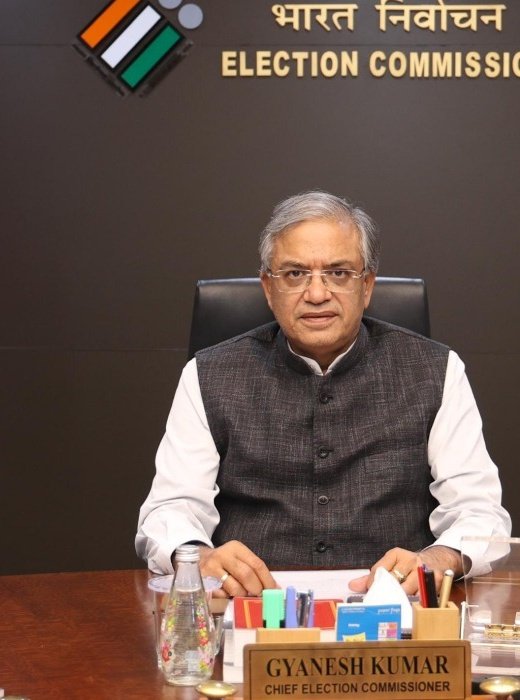
Chief Election Commissioner Gyanesh Kumar. File photo: Election Commission of India.
New Delhi: The Election Commission of India has capped Form 7 applications by an individual elector at 10 during the entire claims-and-objections period and five per month during continuous updating of electoral rolls. The limits apply to both online and offline submissions.
In instructions to the Chief Electoral Officers of all states and Union Territories, the Commission said bulk objections based on unsubstantiated grounds were causing avoidable inconvenience to voters whose inclusion was challenged and increasing the workload of field officials.
What Form 7 covers
Form 7 is used to object to the proposed inclusion of a name or seek deletion of a name from a constituency’s electoral roll. Citing Rule 13(2) of the Registration of Electors Rules, 1960, the ECI said such an application may be made only by someone already enrolled in that constituency. The Electoral Registration Officer (ERO) must examine it under the rules; submitting an objection does not itself remove a voter’s name.
The Commission’s letter, dated October 9 and signed by Under Secretary Sandeep Kumar, draws a distinction between the claims-and-objections period and continuous updating. The first has a total ceiling of 10 applications per individual for the whole period; the second has a ceiling of five applications per individual each month.
Why the Commission prescribed a uniform limit
The ECI said online applications had already been restricted to six at a time, subject to their disposal, but no numerical limit had been defined for physical forms presented in bulk. Decisions had been left to EROs, creating challenges for officials on the ground. The new ceilings are intended to discourage bulk objections by individual electors in either mode.
The letter cites the Manual on Electoral Rolls, 2023, which says bulk claims and objections from an individual, including those sent by post, should not be entertained. It also refers to a requirement for personal cross-verification by the ERO when the same person objects in more than five cases.
Separate provision for recognised parties’ booth agents
For the Special Intensive Revision (SIR), the Commission said it had already allowed Booth Level Agents (BLAs) of recognised political parties to submit applications in bulk. A BLA may submit no more than 50 forms a day to a Booth Level Officer before publication of the draft roll and 10 forms a day thereafter. The letter describes this existing arrangement separately from the new limits for individual electors.
Original signatures, verification and a hearing
The instructions require Form 7 to contain complete details and the objector’s signature at the appropriate place. A signature stamp cannot substitute for an original signature. The ERO must verify the applicant’s genuineness against electoral-roll details. Claims or objections lodged outside the prescribed period, form or manner are to be rejected under Rule 17.
If an objection is not disposed of under Rules 17 or 18, the ERO must first notify the objector, hear that person and record a separate statement for each Form 7. Before passing an order, the officer must give the person whose entry is challenged an opportunity to be heard, following Rules 19 and 20.
Where a complaint is found to be false or fabricated, the ERO is directed to take action against an applicant who knowingly makes a false written statement or declaration under Section 31 of the Representation of the People Act, 1950. Chief Electoral Officers have been asked to circulate the instructions to EROs, assistant EROs and field staff and publicise them.
Electoral-roll dispute in the political spotlight
The directions come amid the opposition’s campaign alleging “vote theft”. INDIA bloc leaders met President Droupadi Murmu over their allegations, while Rahul Gandhi outlined a planned memorandum to the Chief Justice of India. That political dispute provides the wider context; the ECI’s Form 7 instructions address how objections are filed and examined.
About the Author