Bengaluru: The Karnataka final voter list published after the 2026 Special Intensive Revision (SIR) contains 4,55,00,011 electors, including service voters. Belagavi has the largest general electorate among the 34 election districts listed by the Chief Electoral Officer’s office, while Kodagu has the smallest.
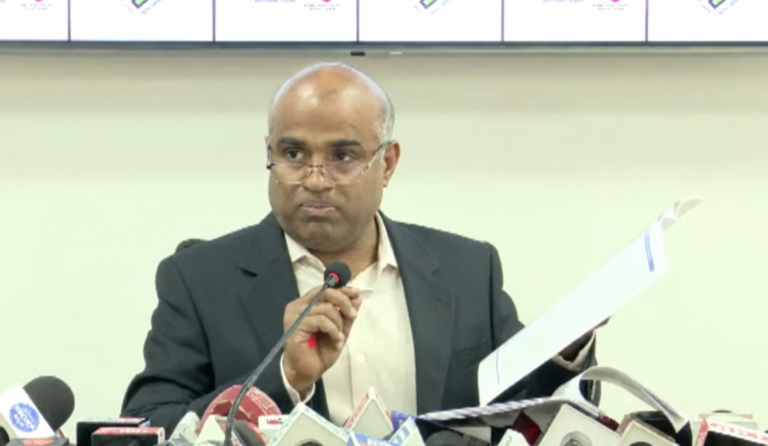
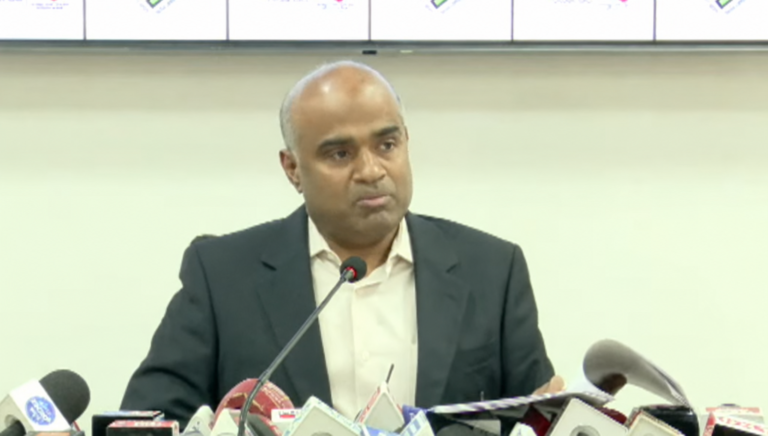
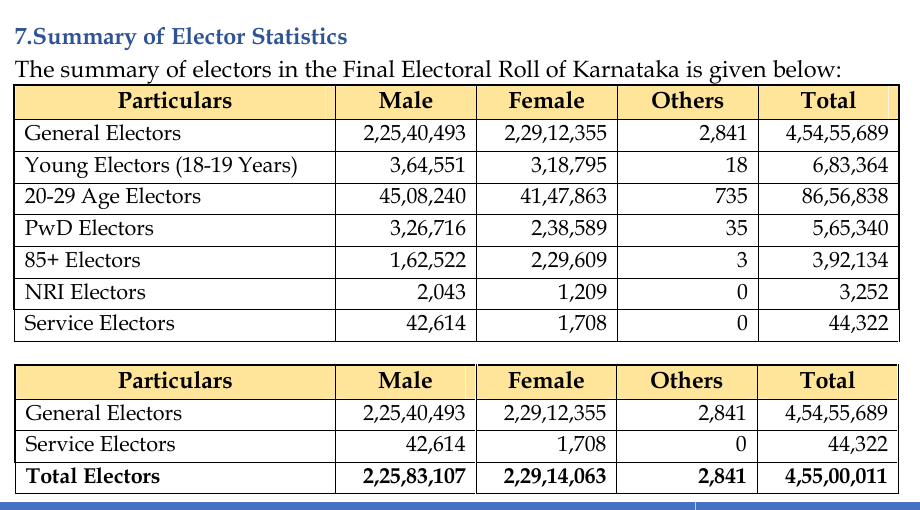
The final list, published on October 27 for all 224 Assembly constituencies, has 4,54,55,689 general electors and 44,322 service electors. Belagavi accounts for 36,35,860 general electors, followed by Bengaluru Urban with 24,01,939. Kodagu is last with 4,11,632, according to the official booklet released for the briefing by Karnataka Chief Electoral Officer V. Anbu Kumar.
Final roll grows from the draft, but remains below the pre-SIR list
The comparison depends on the starting point. The final general electorate is 8,19,714 higher than the August 24 draft, which contained 4,46,35,975 names. Including service electors, the increase from draft to final roll is 8,19,860.
However, the pre-SIR general roll used for enumeration contained 5,54,32,314 electors as on June 16. The final general roll is therefore 99,76,625 lower than that pre-revision base, a difference calculated from the figures in the booklet. This net change across the entire revision is different from the deletions made after the draft was published.
During enumeration, 4,46,35,975 electors, or 80.52%, signed and returned their forms. The remaining 1,07,96,339, or 19.48%, were not included in the draft. The CEO’s office categorised the probable reasons for unreturned forms as permanently shifted (65,45,679), absent (19,00,926), deceased (16,39,864) and duplicate enrolment (7,09,870).
10.08 lakh additions and 1.88 lakh deletions after the draft
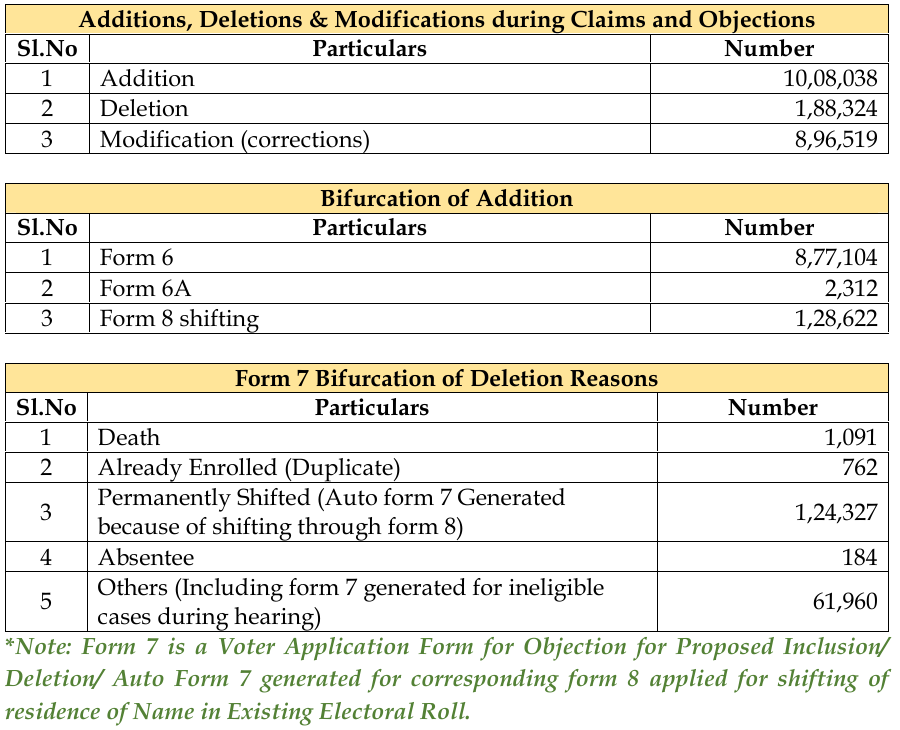
The claims-and-objections stage produced 10,08,038 additions, 1,88,324 deletions and 8,96,519 corrections. Additions included 8,77,104 through Form 6, 2,312 through Form 6A for overseas electors and 1,28,622 through Form 8 residence shifts. All additions should therefore not be read as first-time voter registrations.
Of the 1,88,324 deletions, 1,24,327 were automatic Form 7 entries linked to residence-shifting applications through Form 8. The other categories were death (1,091), duplicate enrolment (762), absentee (184) and “others” (61,960), which includes ineligible cases identified during hearings.
Separately, the hearing report records 43,82,824 notices generated and delivered, the same number of hearings held, and 61,867 electors marked ineligible for the final roll. That hearing figure is a distinct measure; it is not the total number of deletions or the number omitted before the draft.
District ranking: Belagavi first, Kodagu last
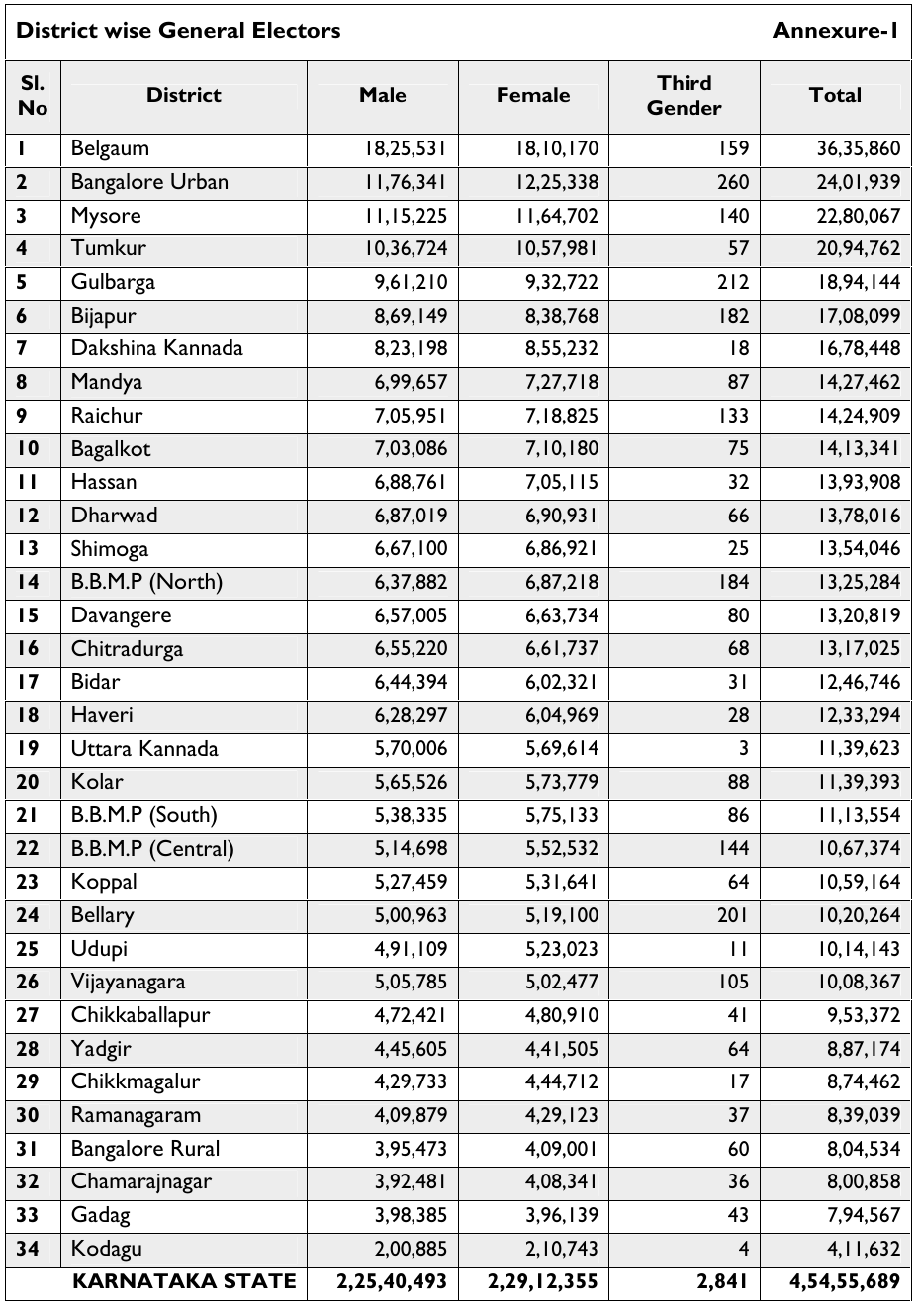
Belagavi’s general electorate is followed by Bengaluru Urban, Mysuru (22,80,067), Tumakuru (20,94,762) and Kalaburagi (18,94,144). At the lower end are Kodagu, Gadag (7,94,567), Chamarajanagar (8,00,858) and Bengaluru Rural (8,04,534).
The table ranks the 34 election districts in Annexure 1 by general-elector count, not turnout, registration performance or the size of the adult population. It excludes service electors.
| Rank | Election district | General electors |
|---|---|---|
| 1 | Belagavi | 36,35,860 |
| 2 | Bengaluru Urban | 24,01,939 |
| 3 | Mysuru | 22,80,067 |
| 4 | Tumakuru | 20,94,762 |
| 5 | Kalaburagi | 18,94,144 |
| 6 | Vijayapura | 17,08,099 |
| 7 | Dakshina Kannada | 16,78,448 |
| 8 | Mandya | 14,27,462 |
| 9 | Raichur | 14,24,909 |
| 10 | Bagalkot | 14,13,341 |
| 11 | Hassan | 13,93,908 |
| 12 | Dharwad | 13,78,016 |
| 13 | Shivamogga | 13,54,046 |
| 14 | BBMP North* | 13,25,284 |
| 15 | Davanagere | 13,20,819 |
| 16 | Chitradurga | 13,17,025 |
| 17 | Bidar | 12,46,746 |
| 18 | Haveri | 12,33,294 |
| 19 | Uttara Kannada | 11,39,623 |
| 20 | Kolar | 11,39,393 |
| 21 | BBMP South* | 11,13,554 |
| 22 | BBMP Central* | 10,67,374 |
| 23 | Koppal | 10,59,164 |
| 24 | Ballari | 10,20,264 |
| 25 | Udupi | 10,14,143 |
| 26 | Vijayanagara | 10,08,367 |
| 27 | Chikkaballapur | 9,53,372 |
| 28 | Yadgir | 8,87,174 |
| 29 | Chikkamagaluru | 8,74,462 |
| 30 | Ramanagara | 8,39,039 |
| 31 | Bengaluru Rural | 8,04,534 |
| 32 | Chamarajanagar | 8,00,858 |
| 33 | Gadag | 7,94,567 |
| 34 | Kodagu | 4,11,632 |
*The official booklet separately lists Bengaluru Urban and the election districts labelled “BBMP North”, “BBMP Central” and “BBMP South”. Those source labels are retained here for matching the data; they should not be read as the current municipal-corporation structure.
Udupi leads elector-to-population ratio
The ranking changes when electorate size is compared with projected total population. Udupi is first at 76.38%, ahead of Dakshina Kannada (71.22%) and Ramanagara (71.20%). The election district labelled BBMP South is last at 45.81%, with BBMP Central at 51.11% and BBMP North at 53.41%. Bengaluru Urban is at 64.78%, against the statewide 66.11%.
This ratio uses projected total population, including people below voting age. It is not voter turnout or a measure showing what proportion of eligible adults are registered.
Women outnumber men; 6.83 lakh electors aged 18–19
Among general electors, the final roll records 2,29,12,355 women, 2,25,40,493 men and 2,841 third-gender electors. Women outnumber men by 3,71,862. The 18–19 age group has 6,83,364 electors, compared with 3,70,341 in the draft; Belagavi leads this age group with 42,743, while Kodagu has the fewest at 5,529.
The roll also identifies 5,65,340 persons with disabilities, 3,92,134 electors aged 85 or above and 3,252 overseas electors. These are categories within the electorate, not separate numbers to add to the general-elector total. Belagavi leads both the PwD and 85-plus counts, with 52,196 and 34,476 respectively.
Karnataka now has 60,923 polling stations, up by 1,873 from the 59,050 recorded before SIR. Belagavi has the most polling stations (4,644), while Kodagu has the fewest (567). The total comprises 21,862 urban and 39,061 rural polling stations.
How to check your name and seek a correction
The CEO’s office has asked electors to check their names with their Electoral Registration Officer, Assistant Electoral Registration Officer or Booth Level Officer. The final roll can also be downloaded through the Election Commission’s Karnataka electoral-roll portal.
The office says roll updating continues through the year. Eligible applicants can use Form 6 for enrolment, Form 6A for overseas registration and Form 8 for corrections or shifting residence, through ECINET, the voters’ portal or election officials.
According to the booklet, a person aggrieved by an ERO’s decision can appeal to the District Magistrate under Section 24(a) of the Representation of the People Act, 1950, and, if still dissatisfied, to the CEO under Section 24(b), within the prescribed time limits.
About the Author