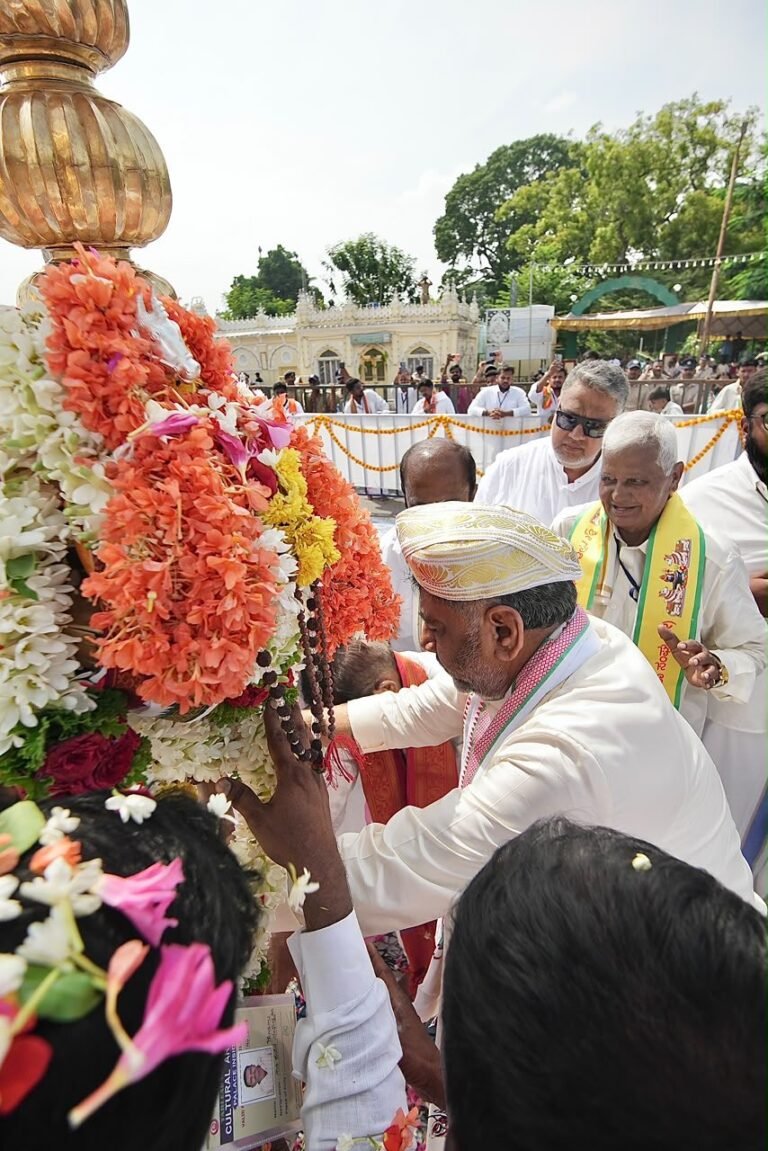
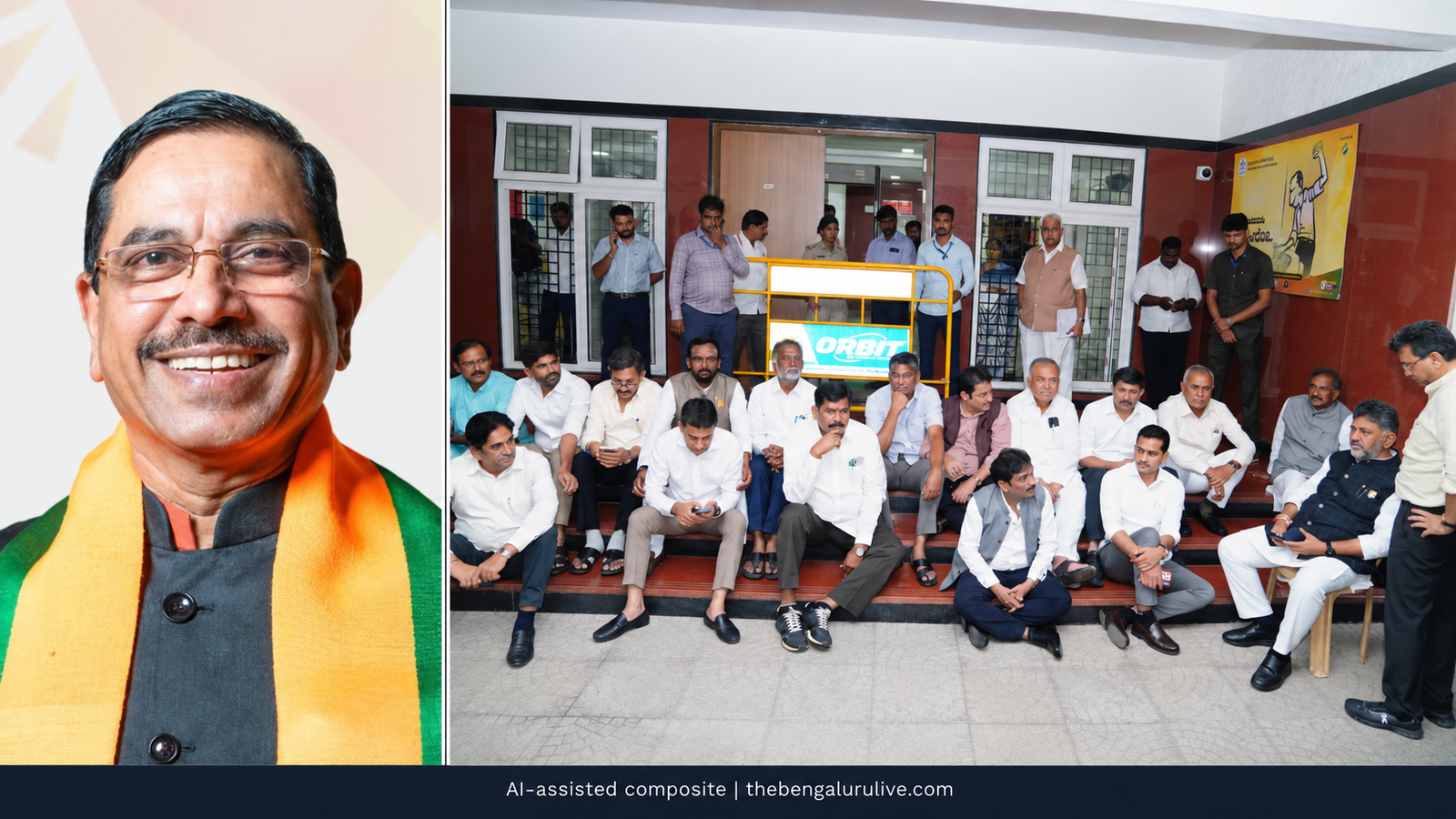
Pralhad Joshi (left) and D.K. Shivakumar’s CEO-office dharna. Sources: Joshi’s X profile and supplied protest photograph. AI-assisted composite, thebengalurulive.com.
Bengaluru: Union Minister Pralhad Joshi has questioned why police had not registered an FIR over Chief Minister D.K. Shivakumar’s dharna at Karnataka’s Chief Electoral Officer’s office, arguing that the authorities act against other protesters who demonstrate outside Freedom Park.
Joshi’s response brings the location of the protest and alleged unequal enforcement into the dispute over Form 7 applications and voter-list deletions. His contention that the dharna violated the law is an allegation in his statement, not a police or court finding cited in it.
He also accused Shivakumar of neglecting drought, farmers’ distress and basic public needs while postponing a Cabinet meeting to take part in the protest. Shivakumar had said protecting eligible voters’ rights took priority over the other matters scheduled for the Cabinet.
Joshi questions police response to the dharna
In his Kannada statement, Joshi maintained that protests in Bengaluru were permitted only at Freedom Park. He asked why police, who he said immediately act when others stage demonstrations elsewhere, had not filed a case against those participating in the CEO-office protest.
The statement does not identify a police order governing this particular event or say that a complaint from Joshi had been registered. His question concerns the action he believes police should take; it does not establish the legal status of the demonstration.
Drought and farmers’ needs should come first, he says
Joshi described the protest as regrettable and condemnable, saying the Chief Minister should focus on drought conditions, farmers’ difficulties and pressing public problems.
He alleged that the dharna was intended to appease the Gandhi leadership and protect voters whose eligibility he questioned. He characterised the agitation as an attempt to create an imaginary threat and mislead the public. These were Joshi’s political accusations; his post did not provide voter-level evidence for the eligibility claim.
He further argued that election officials, booth-level agents and booth-level officers understood the electoral process, Special Intensive Revision, Form 7 and electoral-roll revision, and that the Election Commission continuously monitored the exercise.
Shivakumar’s case: investigate alleged bulk deletion attempts
Shivakumar staged the dharna with Cabinet colleagues and legislators after seeking a criminal case and investigation into an alleged attempt to remove eligible voters through Form 7 applications. He said the government had cooperated with election authorities and was committed to protecting every eligible voter’s franchise.
His written representation asks investigators to examine bulk applications, the source of pre-printed names and EPIC numbers, and possible political coordination. The allegations of voter-list manipulation remain claims requiring investigation; the reported application counts are not verified totals of names actually deleted.
Read our report on Shivakumar’s dharna at the CEO’s office and the detailed account of his Form 7 memorandum and voter-data questions.
Related: Kumaraswamy alleges Shivakumar’s SIR protest aims to divert attention from the NICE row.
Latest development: Karnataka CEO directs inquiry before action against applicants submitting knowingly false voter forms; read the full letter.
About the Author