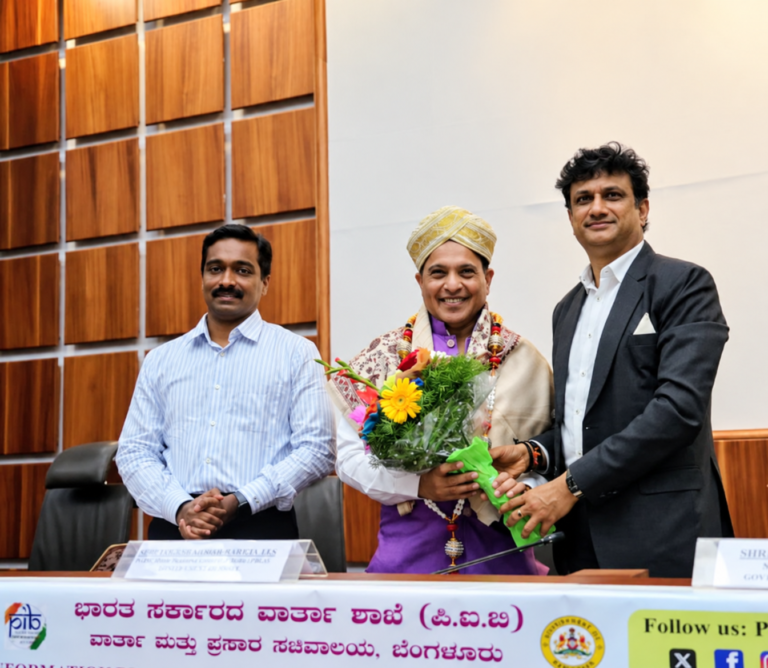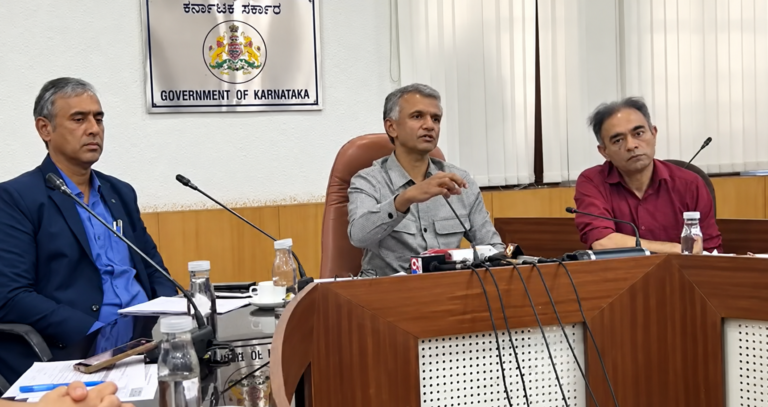
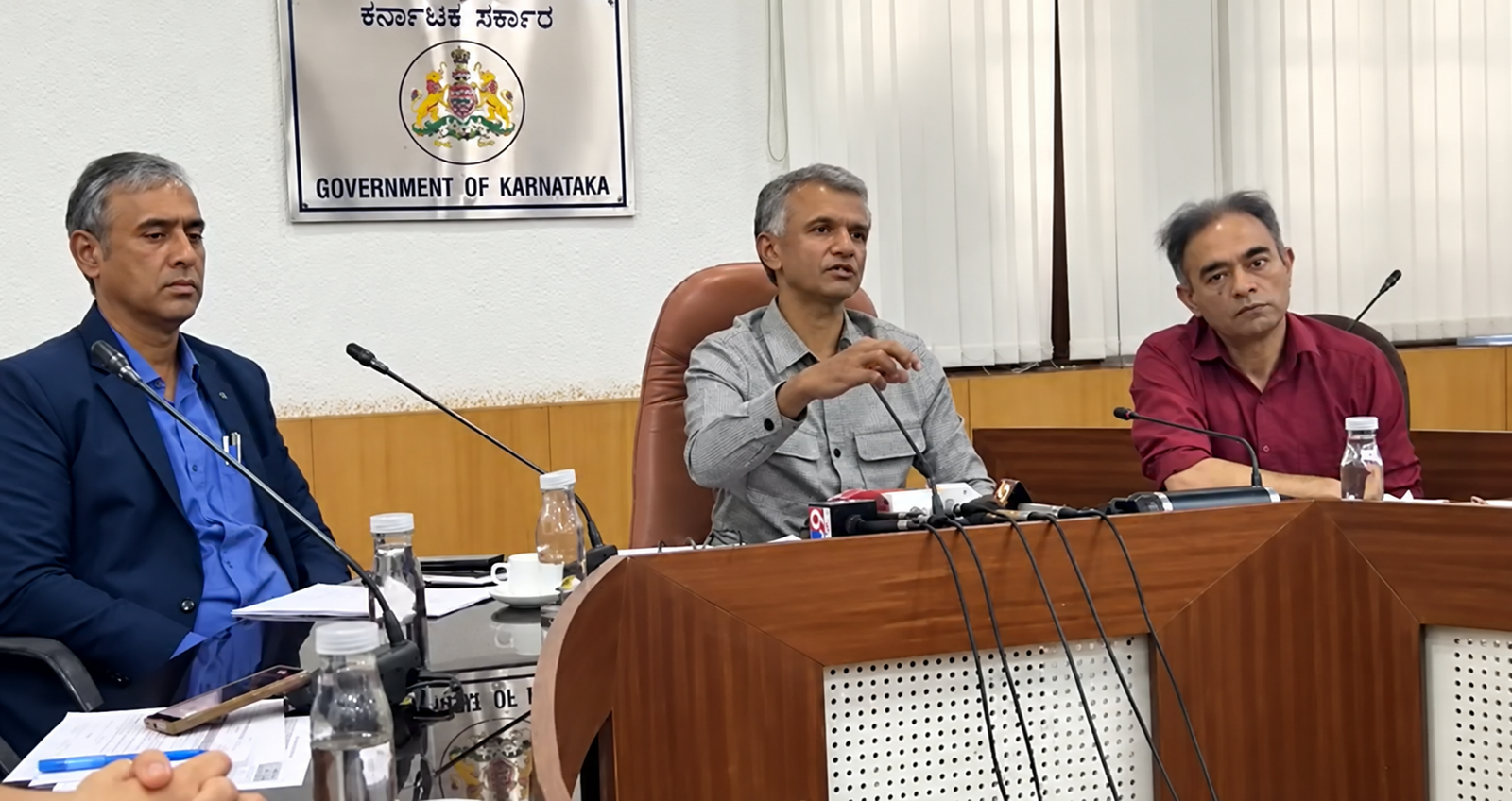
Image: Krishna Byre Gowda/Facebook. From left: M. Maheswar Rao, Krishna Byre Gowda and Munish Moudgil.
Bengaluru: Greater Bengaluru Development Minister Krishna Byre Gowda on Friday announced a major relaxation for small joint property owners in the Greater Bengaluru Authority area, allowing properties of up to half an acre to be bifurcated without going through the regular Town Planning layout-approval route and without surrendering the internal access road to the GBA.
Explaining the changes, Byre Gowda said complaints had been continuously received for nearly one to one-and-a-half years from people unable to bifurcate jointly owned properties. Chief Minister D.K. Shivakumar had directed officials to find a legal solution, following which the Chief Commissioner, Special Commissioner and senior Revenue Department officials held several rounds of discussions over the past three to four months.
According to the minister, property bifurcation had effectively remained stalled since 2021 amid uncertainty over whether such cases should be dealt with by the then BBMP or the BDA. The government has now introduced a system intended to resolve that impasse for smaller family-owned and jointly held properties.
For properties measuring up to half an acre, joint owners will not have to obtain a regular layout approval from the Town Planning wing. If two, three or more joint owners want to divide the property, they can declare which portion belongs to whom, specify the respective areas and mark the access road required for any rear plots. The relevant details, including road length and width, can be uploaded online for approval.
Byre Gowda said the simplified mechanism is meant for small landowners rather than large developers and is intended to reduce the burden on families holding limited extents of land within the GBA limits.
A significant relaxation concerns internal access roads.
Where a jointly owned property of up to half an acre is divided into multiple plots and one or more rear plots require access, the owners must provide an internal road. However, they will no longer be required to relinquish ownership of that road to the GBA.
The road must continue to remain available as access to the subdivided plots, but ownership can remain with the joint property owners. If the owners later decide to merge the subdivided plots back into a single property, the land set aside for the internal road can also become part of the merged property again, the minister explained.
Byre Gowda stressed that the internal road is being insisted upon only to ensure access to plots created at the rear of the original property. It is not intended to become a public road or provide access to unrelated neighbouring properties.
He said the government had addressed objections from landowners who questioned why land retained within a family property should have to be surrendered to the civic authority merely because an internal access road was created.
Under the new relaxation, ownership remains with the property owners, subject to the condition that the access road must continue to be maintained as a road as long as the subdivided plots exist separately.
The minister also outlined a separate relaxation for properties measuring more than half an acre but up to one acre.
Such properties will still have to go through the Town Planning layout-approval process. Under the existing framework, 15% of land in a layout has to be reserved for public or civic use. Byre Gowda said small landowners had represented that surrendering such a large portion of a one-acre property placed a heavy burden on them.
For these properties, the government is now providing an alternative: owners may either surrender the prescribed 15% land for public use or pay an amount equivalent to the Guidance Value of that portion and retain the land themselves.
Byre Gowda said the long-standing 15% requirement itself was not introduced by the present government, but the Guidance Value payment option was being provided as a relief to smaller landowners who did not want to give up the land.
He estimated that 15% of one acre would amount to roughly 6,000 square feet, and said some long-time landholding families around Bengaluru had argued that surrendering such an extent would leave them with considerably less usable property.
Properties above one acre will not receive these relaxations and will have to follow the regular Town Planning and layout-development requirements, including the applicable public-use and road provisions, the minister said.
Byre Gowda said the government’s intention was to provide relief particularly to small landholding families in Bengaluru rather than large developers or major landowners.
He said the changes were aimed at ensuring that smaller property owners are not disproportionately burdened while still maintaining access and planning requirements for newly created plots.
The minister said the latest measure resolves a bifurcation issue that had remained unresolved since 2021 and added that the government was examining other Khata-related problems one by one following directions from Chief Minister D.K. Shivakumar.
Responding to questions on apartment properties, Byre Gowda clarified that the plot-bifurcation relaxation is a separate issue and should not be confused with apartment Khata regularisation.
He said apartments with violations have a different process for moving from B-Khata to A-Khata, subject to the applicable norms, permissible relaxations and fees. Where a building contains multiple apartment owners, all owners would need to apply together and comply with the prescribed norms rather than only some units seeking conversion independently.
The minister said the government had already introduced certain relaxations concerning setback and building-height norms within the applicable regularisation framework, but stressed that apartment regularisation and land bifurcation are separate processes.
About the Author