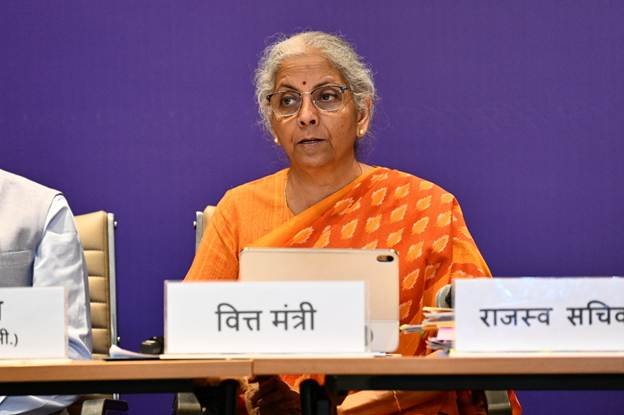
Union Finance Minister Nirmala Sitharaman at the 57th GST Council meeting. Credit: PIB.
NEW DELHI: Businesses could face fewer criminal proceedings under GST after the GST Council recommended withdrawing arrest powers and raising the monetary threshold for prosecution from ₹1 crore to ₹5 crore at its 57th meeting.
The Council, chaired by Union Finance Minister Nirmala Sitharaman, also recommended cutting the maximum general penalty from ₹25,000 to ₹10,000, widening access to input tax credit and speeding up refunds, according to the Finance Ministry’s release.
Arrest powers and penalties
The proposed withdrawal of arrest powers would require omission of Section 69 of the Central Goods and Services Tax Act. The Council also recommended narrowing certain prosecution provisions and rationalising punishments, while retaining action against fraud and evasion.
For tax demand proceedings, it recommended a minimum ₹10,000 threshold for show-cause notices and a reduced 5% penalty in specified non-fraud cases where tax and interest are paid within the prescribed period.
Faster refunds and wider tax credit
The proposed refund reforms include automatic sanction of excess electronic cash-ledger balances and risk-based provisional sanction of 90% of eligible zero-rated and inverted-duty refund claims. The acknowledgement or deficiency-memo period would be reduced from 15 to 10 days.
The Council recommended broader input tax credit eligibility, including removal of specified restrictions involving outdoor catering, health and life insurance, telecom towers, pipelines and certain free samples or expired goods. It also proposed refunds of accumulated credit involving input services and capital goods, subject to the dates and conditions set out in the release.
Registration and movement of goods
Small e-commerce sellers would be able to obtain simplified registration in states where they have no physical presence, subject to conditions. The Council gave in-principle approval to an optional Annual Return Quarterly Payment scheme for eligible businesses with turnover up to ₹5 crore that supply only to unregistered consumers.
For movement of goods, the Council recommended intelligence-based interception with authorisation by an officer of at least Joint Commissioner rank. It proposed restricting interception in transit states, while retaining checks where required documentation is absent.
Changes to return reconciliation and correction mechanisms were recommended from the April 2027 return period, with a time-bound public consultation on the proposed mechanism.
Kumaraswamy welcomes business certainty
Union Minister H.D. Kumaraswamy welcomed the recommendations, saying they would provide greater certainty for businesses and taxpayers while intelligence-based enforcement would continue to address deliberate evasion.
The recommendations will take effect through the relevant law amendments, circulars and notifications; the Council’s announcement itself does not change the law.
Read the Finance Ministry’s full release · Kumaraswamy’s X post
About the Author