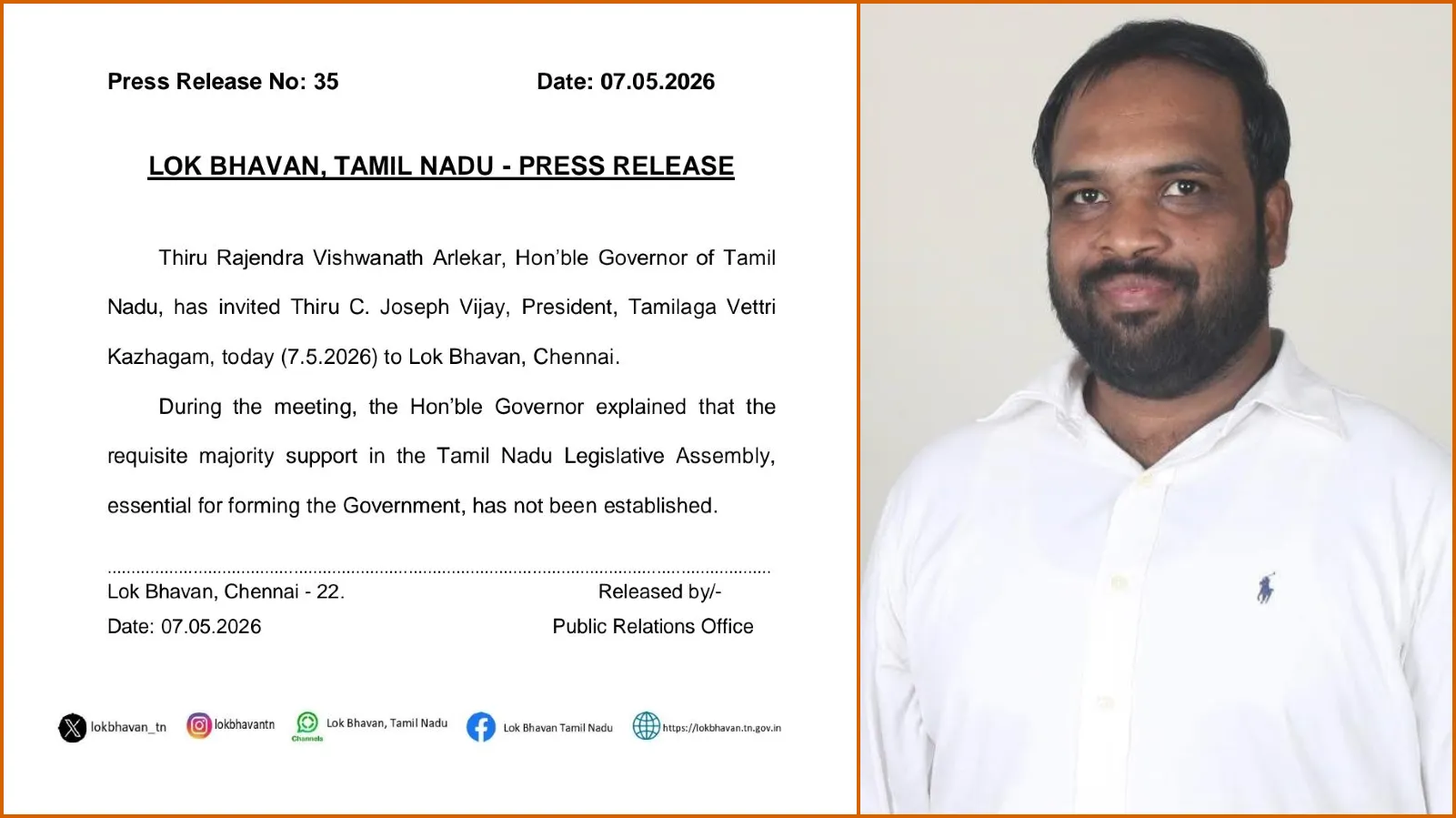
Congress Leader Questions Tamil Nadu Governor’s Decision, Draws Parallel With Karnataka’s 2018 Political Crisis
Chennai/Bengaluru: A fresh political debate has erupted over the role of Governors in government formation after Indian Youth Congress leader Abhishek Raghupathy questioned Tamil Nadu Governor Rajendra Vishwanath Arlekar’s reported decision to reject actor-politician Vijay’s claim to form the government despite his party emerging as the single largest formation.
Drawing comparisons with Karnataka’s controversial 2018 political episode, Raghupathy alleged inconsistency in constitutional standards followed by Governors in different states.
In a strongly worded statement, the Congress leader recalled how BJP leader B.S. Yediyurappa was sworn in as Karnataka Chief Minister in 2018 by then Governor Vajubhai Vala, despite the BJP falling short of the majority mark with 104 MLAs against the required 113 seats.
At the time, the Congress and JD(S), which had staked claim with a post-poll alliance majority, had challenged the Governor’s decision before the Supreme Court.
Raghupathy alleged that Yediyurappa was initially granted 15 days to prove majority on the floor of the House, which had triggered allegations of possible horse-trading before the Supreme Court intervened and ordered an immediate floor test.
Yediyurappa eventually resigned before the trust vote after failing to secure the required numbers.
Referring to the present Tamil Nadu situation, Raghupathy argued that constitutional principles and Supreme Court rulings clearly establish that majority must be tested on the floor of the Assembly and not decided inside Raj Bhavan.
“The Governor needs to be reminded that majority is proved in the House and not before him. There are Supreme Court rulings to this effect. The single largest party should be invited to prove its strength on the Assembly floor,” he stated.
The remarks have added to the growing political debate over the discretionary powers exercised by Governors in inviting parties to form governments in hung Assembly situations.
The controversy also revives larger questions regarding constitutional morality, gubernatorial neutrality and judicial precedents governing floor tests in Indian legislatures.
About the Author