Siddaramaiah says he will write to government to name Hoovina Hadagali engineering college after M.P. Prakash
Vijayanagara, July 11: Former Chief Minister Siddaramaiah on Friday said he would write to the government seeking that the government engineering college in Hoovina Hadagali be named after late leader M.P. Prakash.
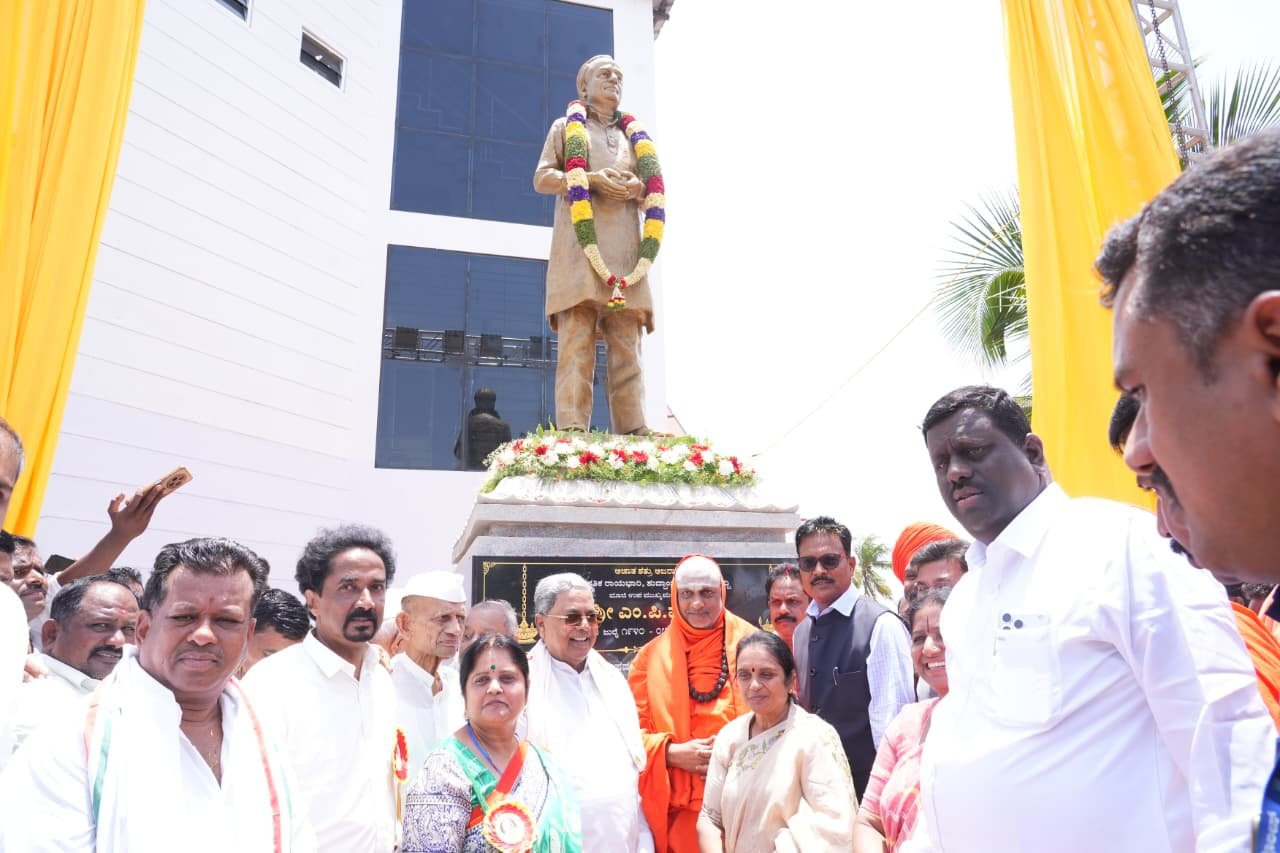
Speaking at a programme organised on the occasion of M.P. Prakash’s 86th birth anniversary, Siddaramaiah said Uma Prakash had invited him to unveil the statue of M.P. Prakash, and described it as his good fortune to get the opportunity to unveil the statue of such a senior politician. He said he had unveiled the statue with great happiness and respect.
Siddaramaiah said July 11 also marked the 86th birth anniversary of M.P. Prakash and that 15 years had passed since his death. He said Karnataka had lost not only an honest, value-based and people-oriented leader, but also a rare politician who was decent, principled and “ajaatashatru”.
Remembering his long political association with M.P. Prakash, Siddaramaiah said Prakash was six to seven years older than him and remained committed to ideology and public service throughout his political life. He said both of them belonged to the same political generation.
Recalling the early years, Siddaramaiah said M.P. Prakash had contested as a Janata Party candidate in 1978 and was elected as an MLA. At that time, Siddaramaiah said, he too was in the Janata Party but could not contest because he did not get a ticket. He said M.P. Prakash later faced defeat in an election, but won again in the 1983 Assembly polls. Siddaramaiah said he too was elected to the Assembly as an Independent candidate and got the opportunity to serve alongside M.P. Prakash in the legislature.
He said M.P. Prakash had been in the Socialist Party before joining the Janata Party, and that when Siddaramaiah himself was in the Socialist Party, Prakash was already known as a highly active leader. He said Prof. Nanjundaswamy had made him a member of the Socialist Party, and that M.P. Prakash was then recognised as one of its prominent leaders.
Describing M.P. Prakash as an intelligent politician with vast knowledge, Siddaramaiah said leaders with such scholarly depth and interest in reading were rare in politics. He said Prakash used every spare moment to read books, which helped him acquire deep knowledge across subjects and develop an ideological and scientific outlook.
Siddaramaiah said that whenever he faced any problem while serving as a minister, M.P. Prakash was the first person he would meet, and that discussions with him would lead to suitable solutions. He said he had visited Hoovina Hadagali many times with M.P. Prakash and had eaten several times at his home. He said Prakash was not just a friend, but also a close political colleague and guide.
He said that whenever they met, they would discuss contemporary political developments, what should happen in society, and how government programmes should be designed. Siddaramaiah said it would not be an exaggeration to call M.P. Prakash his guide.
Siddaramaiah said M.P. Prakash had a secular personality and never engaged in caste-based politics. He said that if Prakash had used caste for political gain, he might have risen to even higher office in the present political environment. He also said Prakash stayed away from the tendency to use swamijis for political benefit.
Referring to the period when former Prime Minister H.D. Deve Gowda was Chief Minister, Siddaramaiah said he had served as Finance Minister while M.P. Prakash was Kannada and Culture Minister. He said Prakash’s view that Leelavathi should succeed him as Kannada and Culture Minister remained fresh in his memory. Siddaramaiah said a politician as principled and honest as M.P. Prakash would have found it very difficult to survive in today’s political system because he never compromised on integrity.
He said that although both of them had entered politics in the same period, he did not consider himself to be as scholarly or intelligent a politician as M.P. Prakash. Siddaramaiah added that in J.H. Patel’s government, he had got the opportunity to serve as Deputy Chief Minister before M.P. Prakash. He said M.P. Prakash had unwavering faith in the principle of social justice and had never compromised on his beliefs at any stage of his political life.
Siddaramaiah also recalled visiting M.P. Prakash at his home after he was diagnosed with cancer. He said Prakash had never taken to habits such as smoking or drinking, and that it had caused him great surprise and pain that he was afflicted with cancer. He said that about 15 days before Prakash’s death, he had sat with him at Janardhan Hotel and eaten dosa, and that he found it hard to believe the news when he later learnt of his death.
Recalling political developments in 2004, Siddaramaiah said all of them were then in the Janata Dal (Secular), with Deve Gowda, Ibrahim, M.P. Prakash, Scindia and himself among the party’s key leaders. He said that when discussions took place on who should be chosen as Chief Minister during the formation of the cabinet, M.P. Prakash had proposed Siddaramaiah’s name and said he should become Chief Minister. Siddaramaiah said Prakash never projected himself for the top post. He added that after the JD(S)-Congress coalition government was formed, Dharam Singh became Chief Minister, while Siddaramaiah served as Deputy Chief Minister and M.P. Prakash served as a minister.
Siddaramaiah said that when he was building the AHINDA organisation, he had invited M.P. Prakash to join him, but Prakash had clearly said he would continue in the political party. He said one of Prakash’s special qualities was his command over subjects to the extent that he could answer questions related to any department in the Cabinet or the Assembly. Siddaramaiah said Prakash was one of those rare politicians who paid attention to the functioning of every department.
He also recalled that when M.P. Prakash was suffering from cancer, some people had criticised him. Siddaramaiah referred to remarks he attributed to Janardhan Reddy at the time, saying it had caused pain that such comments were made about an honest politician like M.P. Prakash. He expressed the view that a statesman and people-oriented leader like Prakash should have become Chief Minister of Karnataka at least once.
Siddaramaiah said he too would write to the government seeking that the government engineering college in Hoovina Hadagali be named after M.P. Prakash so that his name would remain permanently. He also recalled that when he was organising the Mysuru Dasara festival, it was M.P. Prakash who suggested that the Hampi Utsav should also be started, secured funding from him for it, and successfully organised the first edition of the festival.
He said he firmly believed that M.P. Prakash would remain alive forever in public memory through his ideals, service and personality.
About the Author