
Karnataka Launches ₹28.52 Crore Cloud Seeding Programme From Bengaluru HAL Airport Amid Rainfall Deficit, Drought Concerns
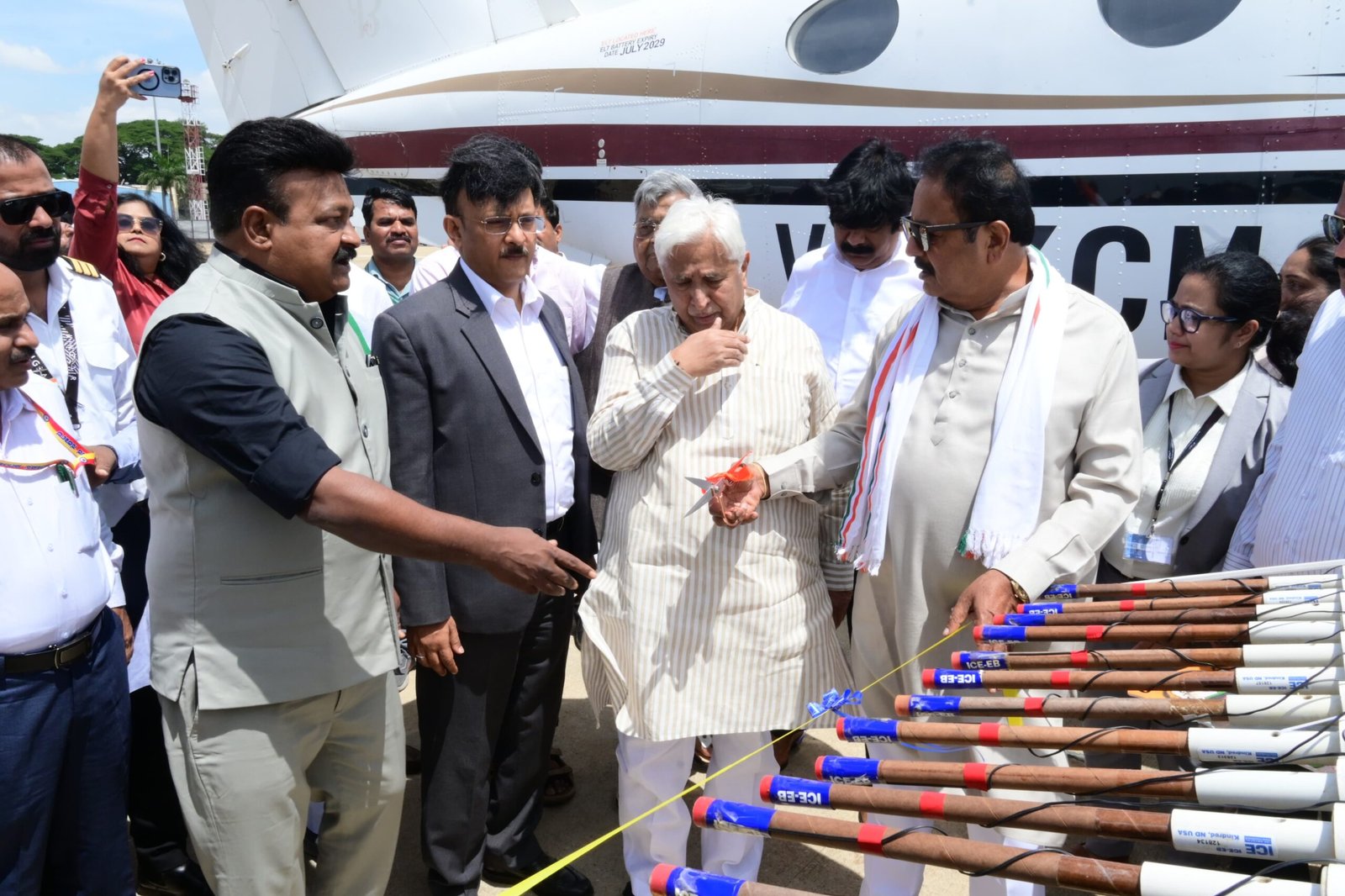
Bengaluru, September 4: Water Resources Minister N. Cheluvarayaswamy launched the Karnataka government’s cloud seeding programme from HAL Airport in Bengaluru, as the state seeks to address rainfall deficit and the possibility of drought and improve water availability for drinking and agriculture.
The minister flagged off a specially equipped light aircraft for cloud seeding by displaying the national and Karnataka flags and expressed hope that the programme would succeed in reducing water scarcity in the state.
Speaking on the occasion, Cheluvarayaswamy said rainfall in Karnataka has been low this year and warned that the state could face severe drought in the coming days, though the exact extent could not yet be assessed.
He said the monsoon season would end by the close of the month and cautioned that if sufficient drinking-water storage was not built up by then, the state could face severe scarcity until the end of next June.
The minister said the government had therefore decided to undertake cloud seeding to address water shortages and in the interest of farmers. He said an earlier cloud-seeding operation had achieved about 35% success.
Cheluvarayaswamy said the government’s priority was the welfare of people and that it was not concerned about the financial burden if the programme could benefit the state.
The programme has received administrative approval at an estimated cost of ₹28.52 crore, excluding GST.
It is being jointly implemented by Karnataka Neeravari Nigam Limited (KNNL) under the Water Resources Department and the Karnataka State Natural Disaster Monitoring Centre (KSNDMC) under the Revenue Department.
The cloud-seeding work has been awarded to M/s Kyathi Climate Modification Consultants LLP after granting exemption from the Karnataka Transparency in Public Procurements (KTPP) Act, according to the information provided.
The government has constituted two separate committees to oversee the programme and ensure that the cloud-seeding operation is carried out scientifically and effectively.
A Monitoring Committee headed by the Additional Chief Secretary and Development Commissioner will undertake overall supervision and review of the programme.
An eight-member Technical Advisory and Evaluation Committee headed by the KSNDMC Director will provide technical guidance. The committee will update information on cloud-seeding operations and their impact every two hours.
Cloud seeding is a scientific process intended to stimulate precipitation by dispersing substances into suitable clouds to encourage the moisture within them to develop into precipitation.
The material used depends on the nature of the clouds, including whether they are warm or cold. The programme information identifies silver iodide, potassium iodide, dry ice or solid carbon dioxide, and sodium chloride among the materials used in cloud-seeding operations.
Silver iodide is described as a commonly used substance that helps droplets in clouds come together and form ice crystals. Sodium chloride, or common salt, is used in warm clouds to attract water droplets and help them develop into larger raindrops.
Under the operational process, the technical team will continuously monitor atmospheric conditions, including heat, wind speed and cloud density, using the meteorological department’s Doppler radar.
Clouds identified as having the potential to produce rain but not precipitating will be targeted. The information provided identifies cumulonimbus clouds for such operations.
Once suitable clouds are identified, specially equipped aircraft fitted with weather radar and flares will fly into or below the clouds and disperse the seeding material by burning it through flares.
The chemical particles are intended to attract small water droplets inside the clouds, increasing their weight and helping them fall as precipitation. According to the programme information, there is a possibility of rainfall within about 30 minutes to one hour after the process.
The government has not pre-designated specific districts for the operation. Instead, the location of each cloud-seeding sortie will be determined on the basis of continuous technical reports and prevailing weather conditions.
Aircraft will be sent to areas facing rainfall deficit, catchment areas of major reservoirs and districts experiencing agricultural distress whenever suitable clouds are detected. Weather data updated every two hours will be used to decide where the operation should be carried out.
Chief Minister’s Political Secretary G.C. Chandrashekhar, former minister H.K. Patil, MLA Konareddy, Additional Chief Secretary Gaurav Gupta and others were present at the launch.
About the Author