
Karnataka Forest Department Issues New Trekking SOP With Entry Caps, Trained Guides and GPS Safety Monitoring
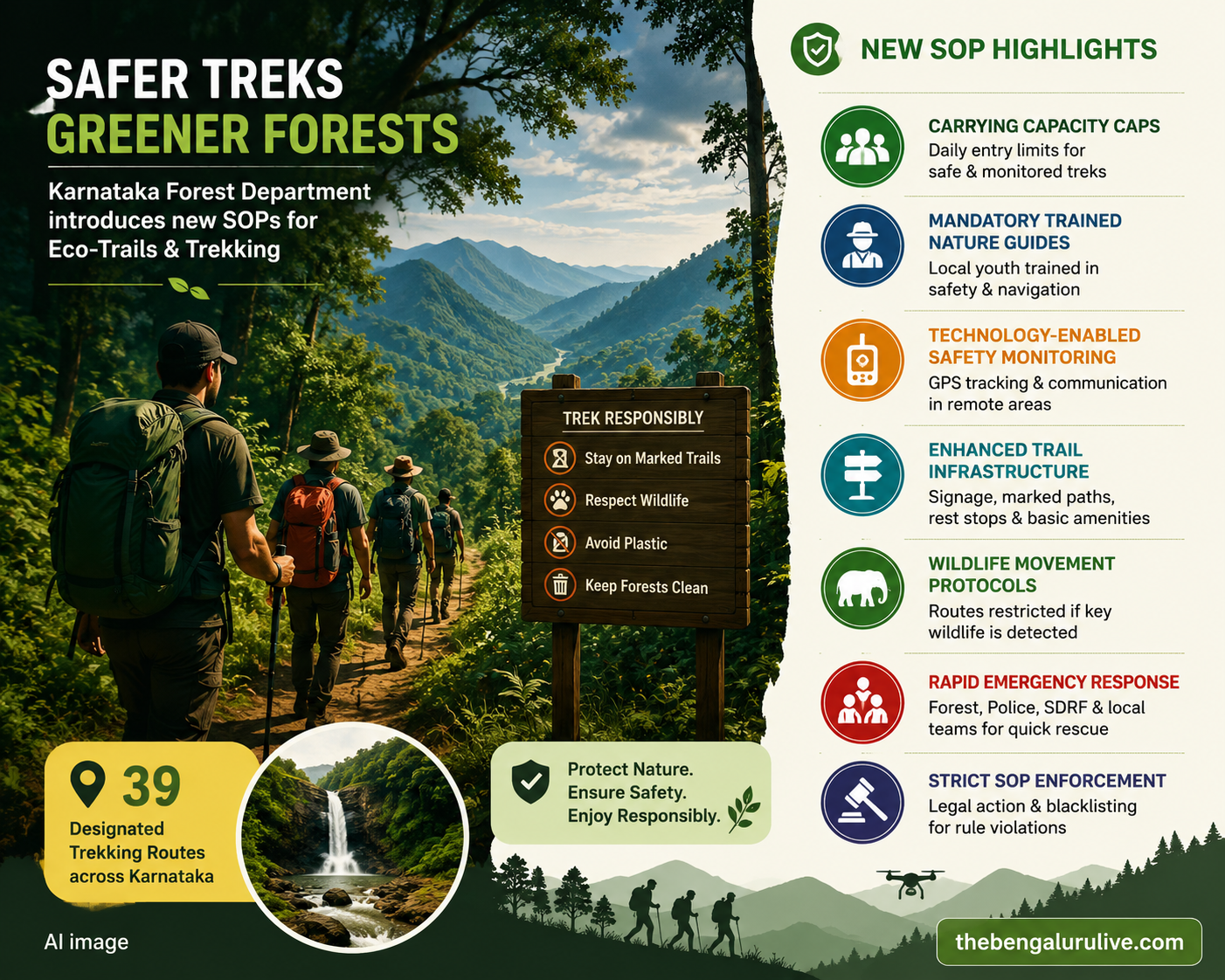
Bengaluru, August 30: The Karnataka Forest Department has introduced a comprehensive Standard Operating Procedure (SOP) to regulate eco-trail and trekking activities across forest divisions in the State, with measures including daily entry limits, mandatory trained nature guides, GPS-enabled safety monitoring and temporary trail closures during wildlife movement.
Karnataka’s Western Ghats and forest regions have nearly 39 designated trekking routes. The department said incidents reported in 2026, including a fatal leopard attack in Male Mahadeshwara Hills, a rescue operation for a missing trekker at Tadiandamol in Kodagu and a critical incident at Bandaje Waterfalls in Chikkamagaluru, had highlighted the risks associated with deep-forest navigation, extreme weather, limited cellular connectivity and wildlife movement.
Under the new SOP, trekking routes will undergo route-wise assessments before they are reopened to the public. The department will impose daily carrying-capacity limits on designated trails to prevent overcrowding and enable forest personnel to continuously monitor trekking groups.
The framework makes trained nature guides mandatory for trekking groups. Local youth trained in biodiversity, navigation, headcount management and emergency response will be engaged to accompany trekkers.
GPS-enabled communication and tracking tools will also be deployed to reduce the risk of trekkers becoming untraceable in remote forest areas with limited connectivity.
The SOP provides for improved trail infrastructure, including clear directional signage, marked paths and rest stops. Basic facilities such as drinking water and toilets are to be provided at base camps.
Routes may be temporarily suspended or restricted when the movement of wildlife, including tigers, leopards, elephants or bears, is detected in trekking areas.
For emergencies, the framework provides for coordinated search and rescue operations involving Forest Department personnel, Police, State Disaster Response Force units and local communities, along with the use of drone monitoring.
The SOP also provides for legal action and official blacklisting of trekkers or guides who violate entry conditions or stray from designated trekking paths.
The Forest Department said trails passing through sensitive natural habitats could not be treated like ordinary tourist roads and that public access would therefore be restored in phases based on the field readiness of individual routes.
Selected routes in the Kudremukh Wildlife Division have recently been reopened as part of this phased approach, according to the department.
The department said the combination of carrying-capacity regulation, trained personnel and real-time monitoring tools was intended to provide a safer and more sustainable trekking experience while protecting human life and conserving wildlife habitats.
About the Author