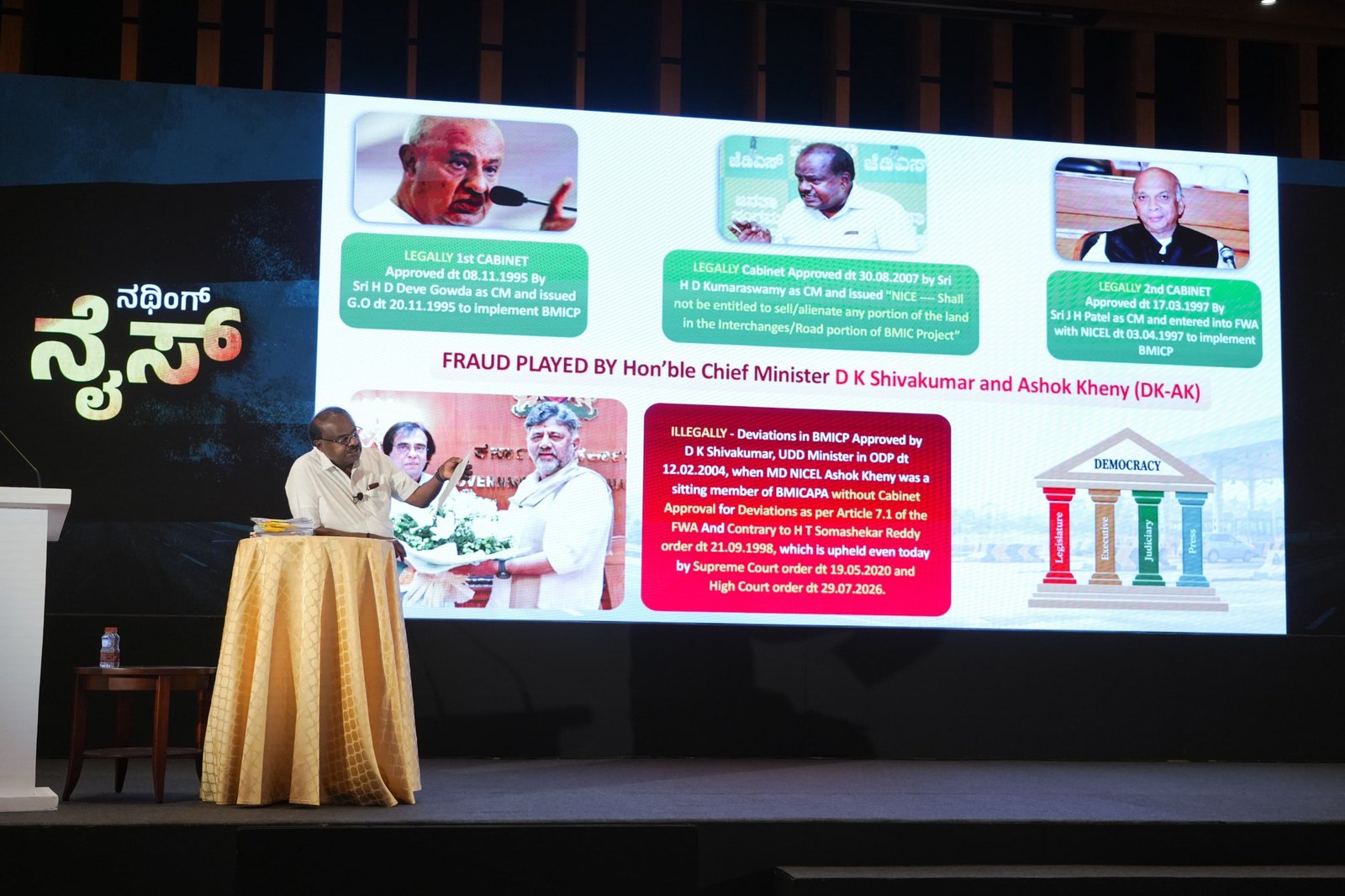
H D Kumaraswamy presents his allegations concerning the BMIC/NICE project. Photograph supplied.
Bengaluru: Union Minister H D Kumaraswamy has questioned changes to the land allocation and planning framework of the Bengaluru–Mysuru Infrastructure Corridor (BMIC), alleging that decisions taken after the project’s inception benefited private interests and demanding an explanation from Karnataka Chief Minister D K Shivakumar.
At a Bengaluru press conference on September 29, Kumaraswamy traced agreements and planning decisions from 1995 onwards, accused Shivakumar and NICE promoter Ashok Kheny of facilitating deviations, and called for an inquiry. He also questioned land transactions involving Shivakumar’s family and challenged the Chief Minister to an open debate.
Shivakumar, responding separately in New Delhi, rejected the allegations, said his assets had been acquired lawfully and declared to the authorities, and challenged Kumaraswamy to debate inside the Assembly. Read Shivakumar’s detailed response on his ₹1,400-crore assets and the NICE controversy.
1995 MoU and the original project framework
Kumaraswamy sought to rebut the argument that former Prime Minister H D Deve Gowda alone was responsible for the project’s subsequent course. He said the first memorandum of understanding, signed on February 20, 1995 during Deve Gowda’s tenure as Chief Minister, involved a consortium comprising VHB, the Kalyani Group and SA Engineering and Construction, rather than NICE.
“The question is not who signed the first MoU. The question is how the project was subsequently changed and who authorised those changes,” he said. Decisions taken a decade later could not automatically be attributed to the government that signed the original MoU, he argued.
According to Kumaraswamy, the Framework Agreement signed in 1997 envisaged 20,193 acres, comprising private land to be acquired and government land. While seven townships were initially proposed, the Cabinet approved five. The private consortium was to invest in the project and recover its expenditure through its components, including toll collections.
Cabinet approval and the 2002–04 planning decisions
He said NICE entered the arrangement after the original consortium and foreign participants moved out, and referred to an agreement involving the Karnataka Industrial Areas Development Board (KIADB) in 1998. Citing a 1999 communication, he argued that changes to a Cabinet-approved Framework Agreement required fresh Cabinet approval.
Kumaraswamy focused on 2002–04, when Shivakumar was Urban Development Minister and, according to his account, chairman of the Bangalore–Mysore Infrastructure Corridor Planning Authority (BMICPA). He alleged that an Outline Development Plan (ODP) prepared during that period departed substantially from the original agreement.
He alleged that the ODP dated February 12, 2004 changed the alignment, township locations, peripheral and link roads, interchanges and the treatment of land around lakes. Referring to Shivakumar and Kheny, he described “DK” as the “tailor” and “AK” as the “assistant tailor” behind the alleged alterations.
Road acreage figures and the separate 2,747-acre claim
Kumaraswamy said the overall project area continued to be shown as 20,193 acres, but alleged that land was redistributed between the toll road and individual townships. He cited an increase in the road component from 6,999 acres under the original framework to 9,468.86 acres in the revised plan, with township allocations raised in some places and reduced in others.
He separately alleged that an additional 2,747 acres had been brought into the arrangement and asked who had authorised it. The two road-area figures quoted above differ by 2,469.86 acres; the supplied account does not explain how that difference relates to the separate 2,747-acre claim. The figures therefore cannot be treated as a single reconciled calculation.
Questioning whether the revisions had gone before the Cabinet, Kumaraswamy alleged that the changed alignment could affect around 10 to 12 lakes, as well as temples, cremation grounds and other public-use areas.
2007 land cap and allegations over the tripartite agreement
Kumaraswamy said his own Cabinet in 2007 had restricted the project to the land required under the original Framework Agreement. He maintained that NICE was not to receive more than 20,193 acres and that land was to be provided in the proportions laid down in the relevant court proceedings.
He also said his government’s decision prevented NICE from selling or alienating land forming part of road and interchange components. His position, he said, was to follow the original framework without granting additional land.
In contrast, he alleged that a 2002 tripartite agreement involving NICE, the National Highways Authority of India and the Karnataka government introduced provisions concerning sale or alienation of project land. Describing that agreement as a “deliberate fraud”, he accused Shivakumar and Kheny of structuring it to enable private financial gains. These are Kumaraswamy’s allegations, not findings established by this report.
Questions over family purchases and B K Kaval land
Kumaraswamy alleged that parcels notified for KIADB acquisition in 2004 were subsequently purchased in the names of Shivakumar’s brother D K Suresh and other family members, including his mother Gowramma. He claimed that around 10 acres involved was government land at the time and questioned how the transactions could have occurred.
Responding to Shivakumar’s accusation of blackmail, Kumaraswamy used the term himself in a taunt, saying he was raising the issue to “protect” Shivakumar’s mother and brother. Shivakumar has said he will not be intimidated or blackmailed over his assets.
The Union Minister also raised questions about the ownership and names appearing in land records at B K Kaval. He alleged that a wider property exceeding 300 acres included gomala, or grazing land, that records had been created or altered, and that some conversions had been secured through intimidation. He called for a drone survey to establish the extent and nature of the properties.
Siddaganga Mutt and the 1,040-unit allegation
Kumaraswamy alleged that land associated with Siddaganga Mutt had also been affected. He said an application concerning land had been made by Suresh while a response came from Shivakumar, which he characterised as misuse of official position.
He further referred to an application concerning 1,040 units and alleged that a joint venture resulted in a share of the units going to Suresh. Citing prevailing property values, he put the amount involved at around ₹2,000 crore and questioned whether the land was genuinely required for BMIC. The valuation and the alleged beneficiary arrangement were claims made at the press conference.
Inquiry demand and recording attributed to Kheny
Kumaraswamy said he was putting documents before the public and invoked court proceedings to demand an inquiry. He described the alleged wrongdoing as bigger than the 2G and coal controversies; that comparison was his political assessment, rather than a judicial conclusion reported here.
The supplied account also said he released a recording attributed to Kheny. Kumaraswamy alleged that remarks in it linked the burden of Karnataka’s guarantee schemes to the possibility of the government parting with assets such as Vidhana Soudha or Vikas Soudha. He questioned whether Kheny believed he enjoyed political protection. The recording’s contents and authenticity have not been independently verified for this report.
Mysuru extension, farmers and the demand to resign
Questioning plans to continue the NICE project towards Mysuru, Kumaraswamy asked why an expansion was needed when a national highway between Bengaluru and Mysuru was already operational. He alleged that the purpose was to obtain more land.
He said affected farmers should be treated as rightful landowners and adequately compensated in any settlement. He also warned of a substantial financial burden on the state, referring to the project and the government’s guarantee commitments, and demanded that Shivakumar resign if he could not correct the alleged deviations.
Calling the documents presented on Tuesday only the first part of his campaign, Kumaraswamy said he would release further material on land records, the Framework Agreement, ODP and tripartite agreement. He said he was ready for a public discussion.
Shivakumar says assets are lawful and disclosed
In his response, Shivakumar said assets valued at ₹1,400 crore at current prices had been acquired within the law. He defended his and his family’s right to conduct business and buy property, said the relevant declarations had been made, and dismissed Kumaraswamy’s allegations as politically motivated.
Shivakumar also challenged his critic to a discussion inside the legislature rather than on the steps of Vidhana Soudha. Read the full response, including his remarks on asset appreciation, disclosures and the debate challenge.
This report sets out the claims in the supplied press-conference account and Shivakumar’s response. The underlying agreements, land records and court orders cited in the allegations have not been independently examined for this report.
Related: Kumaraswamy alleges Shivakumar’s SIR protest aims to divert attention from the NICE row.
Latest development: Karnataka CEO directs inquiry before action against applicants submitting knowingly false voter forms; read the full letter.
About the Author