NIPDA Seeks Ethanol-Petrol SOP, Says Failed Fuel Test Alone Does Not Establish Dealer Fault
Bengaluru: A failed fuel sample should trigger an investigation into the cause rather than automatically establish a petroleum dealer’s responsibility, the Namma IndianOil Petroleum Dealers Association (NIPDA), Greater Bengaluru, has said. The association has sought a common industry protocol for ethanol-blended petrol, including financial protection where investigations establish that dealers were not at fault.
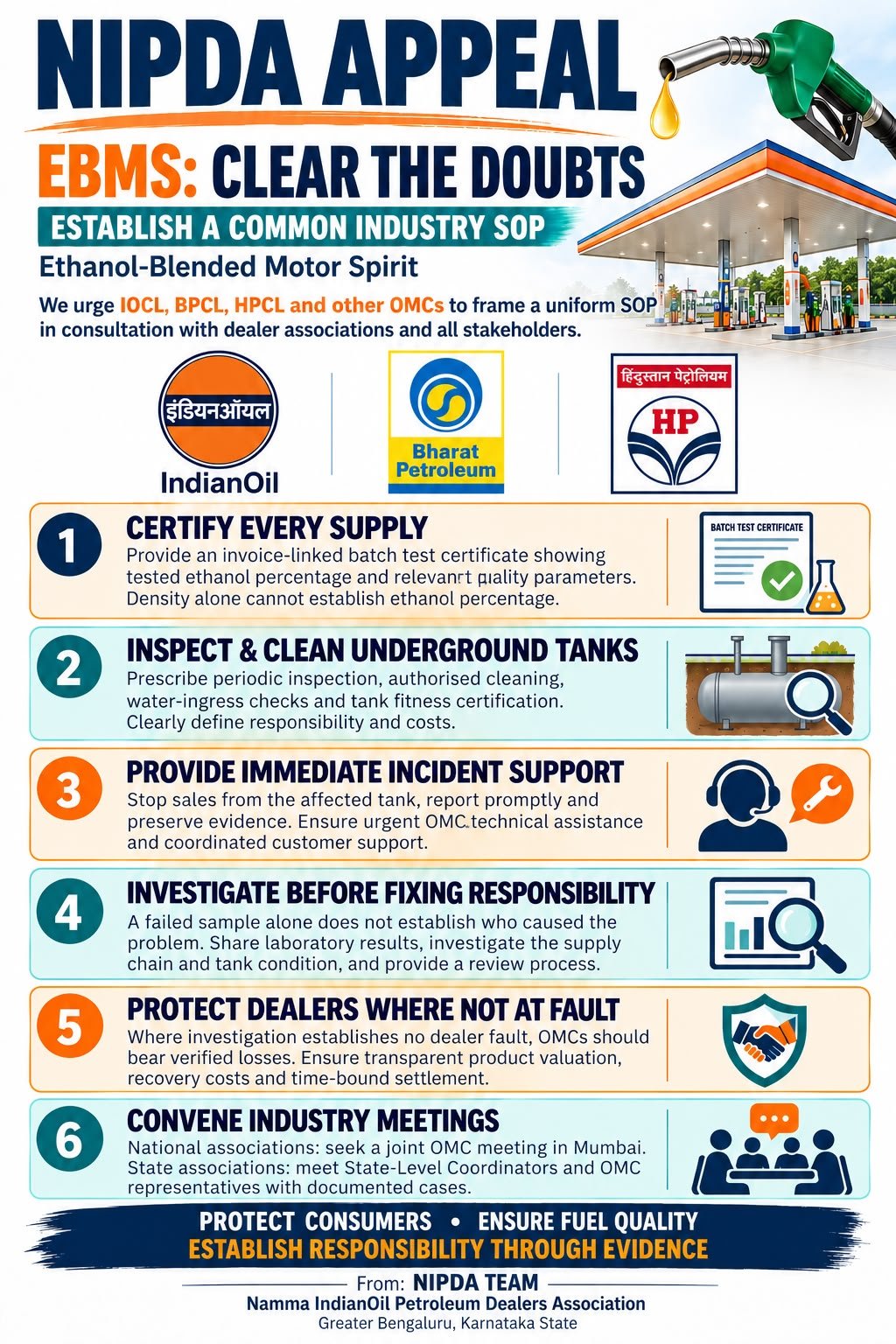
In an appeal to the petroleum dealer community, NIPDA has urged IOCL, BPCL, HPCL and other oil marketing companies (OMCs) to develop a clear, uniform Standard Operating Procedure (SOP) in consultation with dealer associations and other stakeholders.
The appeal identifies unanswered questions concerning Ethanol-Blended Motor Spirit (EBMS), particularly quality verification, underground storage, phase separation and financial liability when an incident occurs.
NIPDA’s proposed framework covers six areas: quality certification for each delivery, periodic tank inspection and cleaning, immediate incident assistance, investigation of failed samples, product recovery and financial protection, and national and state-level consultations.
Batch Test Certificate Sought for Every Delivery
NIPDA has called for every EBMS delivery to be accompanied by a traceable batch test certificate linked to the delivery invoice.
The certificate should state the tested ethanol percentage and relevant quality parameters, giving dealers a documented basis for checking the fuel supplied to their outlets.
The association said routine density checks alone cannot establish the exact ethanol percentage. It has therefore asked OMCs to provide approved verification methods, suitable equipment and practical training, with a clear distinction between field screening and laboratory certification.
Tank Cleaning Responsibilities and Costs Must Be Clear
The appeal also seeks a documented schedule for inspecting and cleaning underground storage tanks.
NIPDA said tanks may accumulate sludge, sediment and corrosion products over time. It wants the inspection process to include checks for water ingress, tank integrity and compatibility with the ethanol blend being supplied.
The proposed SOP should specify who arranges the inspection and cleaning, who pays for it and how the tank’s fitness is certified. Cleaning should be undertaken only by authorised and qualified agencies, the association said.
NIPDA has also called for technical investigation whenever fuel shows cloudiness, a milky appearance or separated layers.
A dealer cannot independently certify whether such a condition has been caused by water contamination, the condition of the tank, the quality of the supplied product or another factor, the appeal said.
Immediate Technical Support During Fuel Incidents
The association said suspected phase separation can result in customer complaints, allegations of vehicle damage, disruption of sales and serious tension at an outlet.
It wants the SOP to provide for an immediate halt in sales from the affected tank, prompt reporting, urgent attendance by an OMC technical team, preservation of evidence and coordinated customer support.
Where public safety is threatened, emergency assistance should be sought immediately, NIPDA said.
The association has also sought a designated OMC contact for dealers to help manage incidents and arrange an objective assessment of vehicle-related claims.
Failed Sample Must Lead to Investigation of the Cause
A central demand in the appeal is that sampling and testing under the applicable Marketing Discipline Guidelines should be accompanied by a transparent investigation into how a quality problem arose.
“A failed sample establishes a quality concern; by itself, it does not establish who caused it,” NIPDA said.
The association wants investigators to examine dispatch records, available retained samples, the product’s transport history, checks conducted when it was received, tank-maintenance records and possible water ingress.
Dealers should receive copies of sampling records, laboratory results and findings explaining the conclusions reached. They should also have access to a defined review or retesting process, according to the appeal.
OMCs Should Bear Verified Losses Where Dealers Are Not at Fault
NIPDA has sought clear procedures for cases in which affected fuel must be removed from an outlet and taken to an OMC-designated facility.
The process should document the quantity removed, its valuation, transport costs, recovery deductions and the settlement timeline, the association said.
Its compensation demand is tied to the findings of an investigation. Where the incident is established to have occurred without dealer fault, the OMC should bear the verified losses, NIPDA said.
The losses it wants covered include affected stock, necessary product removal, tank restoration and substantiated customer claims attributable to the incident.
Dealers should not be compelled to accept unexplained deductions or shoulder the entire financial burden before responsibility has been established, the association argued. It has also called for a time-bound interim relief mechanism.
Joint Industry Meeting in Mumbai Sought
To take the proposals forward, NIPDA has appealed to national dealer associations to seek a joint industry meeting in Mumbai with OMC leadership and technical teams.
State associations should hold corresponding discussions with their respective State-Level Coordinators and OMC representatives, bringing documented cases for examination, it said.
The final SOP should be developed with dealer participation and clearly define preventive measures, emergency response, testing, responsibility, compensation and dispute resolution.
NIPDA said the objective was to protect consumers, ensure traceable fuel quality, establish responsibility through evidence and protect dealers from losses where they were not at fault.
About the Author