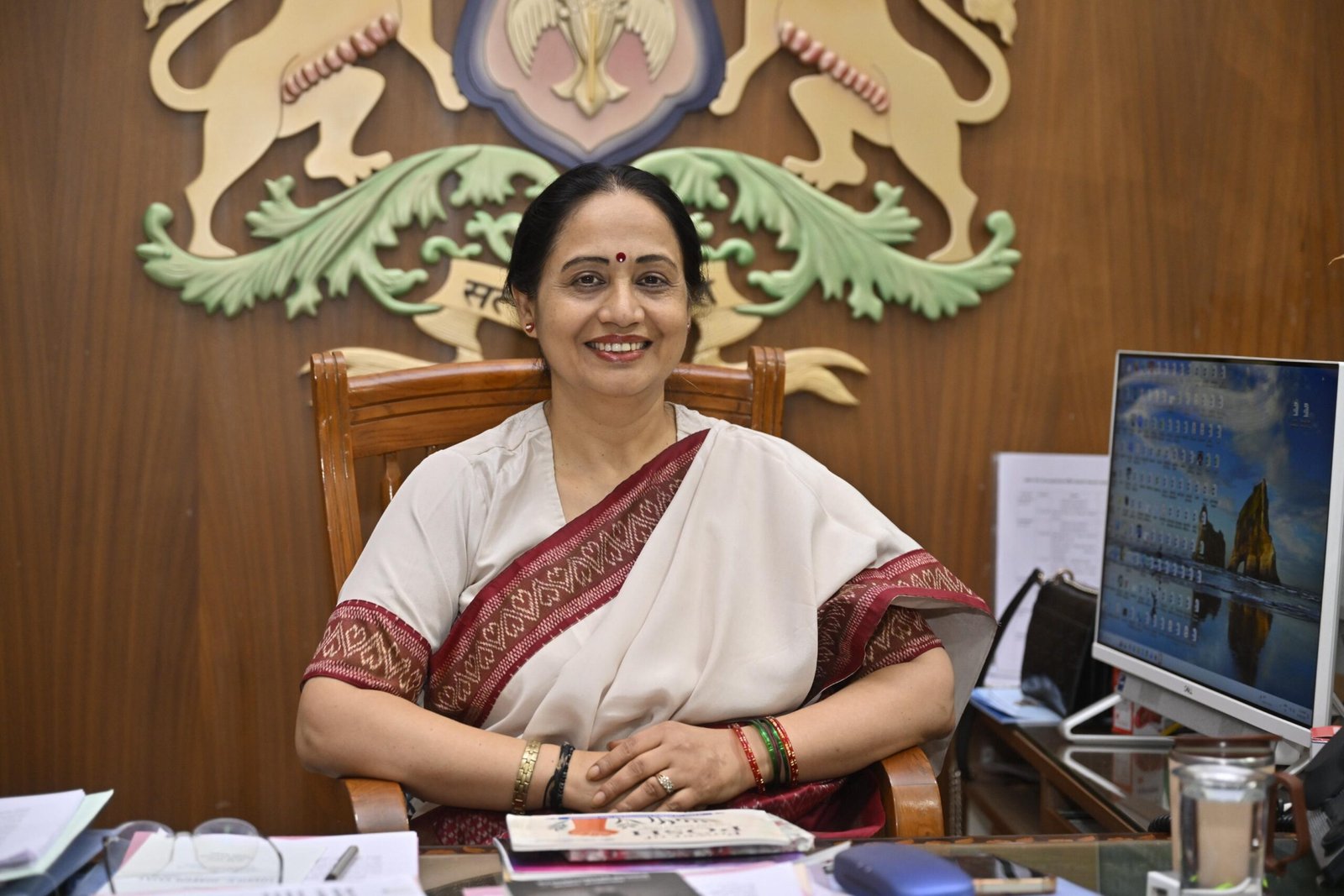
Karnataka Chief Secretary Shalini Rajneesh
Bengaluru: The Karnataka government will launch its Prajaseva Abhiyana from Kudligi hobli in Vijayanagara district on September 5, introducing an integrated system to receive public grievances, provide services at meeting venues and ensure time-bound review of unresolved applications at taluk, subdivision and district levels.
The initiative, under the newly created Prajaseva Department, is intended to take the administrative system closer to citizens and reduce the need for people to repeatedly visit government offices over grievances or access to schemes and services.
Under the programme, Prajaseva Abhiyana meetings will be held across the State on Saturdays, alternating between taluk and hobli levels. Meetings on the first and third Saturdays of every month will be held at taluk headquarters under the chairmanship of the district in-charge minister. On the second and fourth Saturdays, meetings will be organised at the taluk or hobli level under the chairmanship of the local MLA.
The government has prepared an integrated calendar of events with the objective of covering all taluks and hoblis within three to four months.
When a taluk-level meeting chaired by the district in-charge minister is held in a constituency, a separate hobli-level meeting chaired by the MLA will not be conducted in the same constituency on that day. The MLA concerned will instead participate in the minister’s meeting.
District-level officials will attend meetings chaired by district in-charge ministers along with the relevant taluk officials, while taluk-level officials will participate in meetings chaired by MLAs in constituencies falling within their taluks. Former members of zilla panchayats, taluk panchayats, gram panchayats and urban local bodies, along with local leaders, will also be invited.
The public will be informed about each meeting at least 15 days in advance through door-to-door distribution of pamphlets. These will contain a pre-printed application form and a checklist of documents required. An artificial intelligence-based call centre will also make outbound calls to residents of the relevant taluk or hobli, informing them about the date, time and venue of the meeting and the elected representative chairing it.
Citizens will be able to submit applications and grievances in advance at Grama One centres. Grama One counters equipped with computers or laptops, printers and internet connectivity will also be established at Prajaseva Abhiyana venues to enable online submission of applications and grievances.
On the day of each meeting, grievances will be handled through two separate queues. One will be for new grievances being registered for the first time. The second will deal with grievances that remain unresolved or have been resolved unsatisfactorily despite being registered through Sakala or the integrated grievance redressal software.
Grievances that have received no response or have not been satisfactorily resolved even after 21 days will be considered in the second queue. Citizens using this facility will have to provide their Sakala, CSC or IPGRS number. If time is limited, priority will be given to such complainants for direct interaction with the elected representative chairing the meeting.
Eligible beneficiaries of government schemes may be issued sanction letters at the venue itself. In cases where grievances have already been resolved, appropriate approval or confirmation documents relating to the resolution can also be handed over at the meeting.
A real-time status tracking facility will allow citizens to monitor the progress of their applications and grievances.
Departmental stalls will be established at meeting venues to explain eligibility conditions for government schemes and the procedures for applying. Displays of good practices will also be organised, while drinking water and basic medical facilities will be provided to participants.
After every meeting, details of the proceedings will be recorded on the portal. Key points, photographs, videos and beneficiary feedback will be uploaded on the IPGRS portal and shared on social media under #prajasevaabhiyana.
The government has also developed the Integrated Public Grievance Redressal System under the Prajaseva Department as a multi-channel, data-driven and paperless platform for grievances relating to services and schemes of different departments. Citizens can register grievances through helpline 1902, the IPGRS portal or the Janaspandana mobile application. The system also uses artificial intelligence technology as part of a three-tier grievance redressal mechanism.
Applications and grievances received at Prajaseva Abhiyana meetings will be reviewed every Wednesday through a three-stage mechanism.
At the taluk level, reviews will be held from 9 am to 11 am. Tahsildars and taluk panchayat executive officers will review the status of applications and grievances with their officials using the software systems. Matters that cannot be resolved at their level will be forwarded to the subdivision officer through e-Office.
Subdivision-level reviews will take place from 11 am to 1 pm. Assistant commissioners will consolidate and examine information received from taluks and forward matters that cannot be resolved at their level to the deputy commissioner.
District-level reviews will be conducted from 3 pm to 5 pm, with deputy commissioners consolidating and examining information received from subdivisions. Deputy commissioners may require district-level officials to attend in person, while subdivision and taluk officials may be allowed to participate through video or audio conference.
At every stage, citizens dissatisfied with the resolution of their grievance will be allowed to appear personally before the officer concerned and present their case.
The new mechanism is intended to strengthen the existing weekly review system at the deputy commissioner level without conflicting with it. To facilitate the Saturday public meetings and Wednesday review mechanism, other meetings at State, district and taluk levels have been prohibited on Saturdays and Wednesdays.
Applications and grievances not disposed of within the prescribed period will be automatically escalated to the head of the department concerned, enabling higher-level intervention on pending cases.
A government secretary has been appointed as district in-charge secretary for each district. These secretaries will visit their assigned districts on the first and third Fridays of every month to oversee preparations for meetings chaired by district in-charge ministers on Saturdays.
They will also coordinate with secretaries of other departments on matters that remain unresolved at the district level and forward grievances through e-Office. A separate portal has been established for district in-charge secretaries, and the Chief Secretary will review it at the monthly meeting of all secretaries.
Progress in disposing of pending applications and grievances in the districts will also be reviewed at meetings chaired by the Chief Minister. District in-charge ministers will participate in these meetings to discuss pending issues by district, hobli, taluk and department and review whether changes to policies or schemes are required.
Chief Secretary Dr Shalini Rajneesh said the Prajaseva Abhiyana, being implemented under the Chief Minister’s leadership and directions, is intended to decentralise the administrative machinery closer to citizens, directly hear grievances, speed up disposal of applications, provide services at meeting venues, continuously review unresolved cases and strengthen accountability and transparent reporting.
She said the initiative would also provide citizens an opportunity to learn about government schemes and submit suggestions to the government, while functioning as a continuing platform for public participation.
About the Author