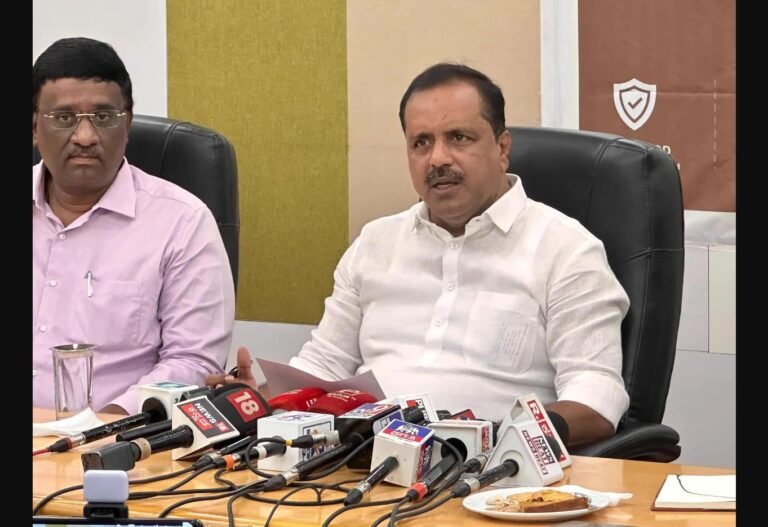
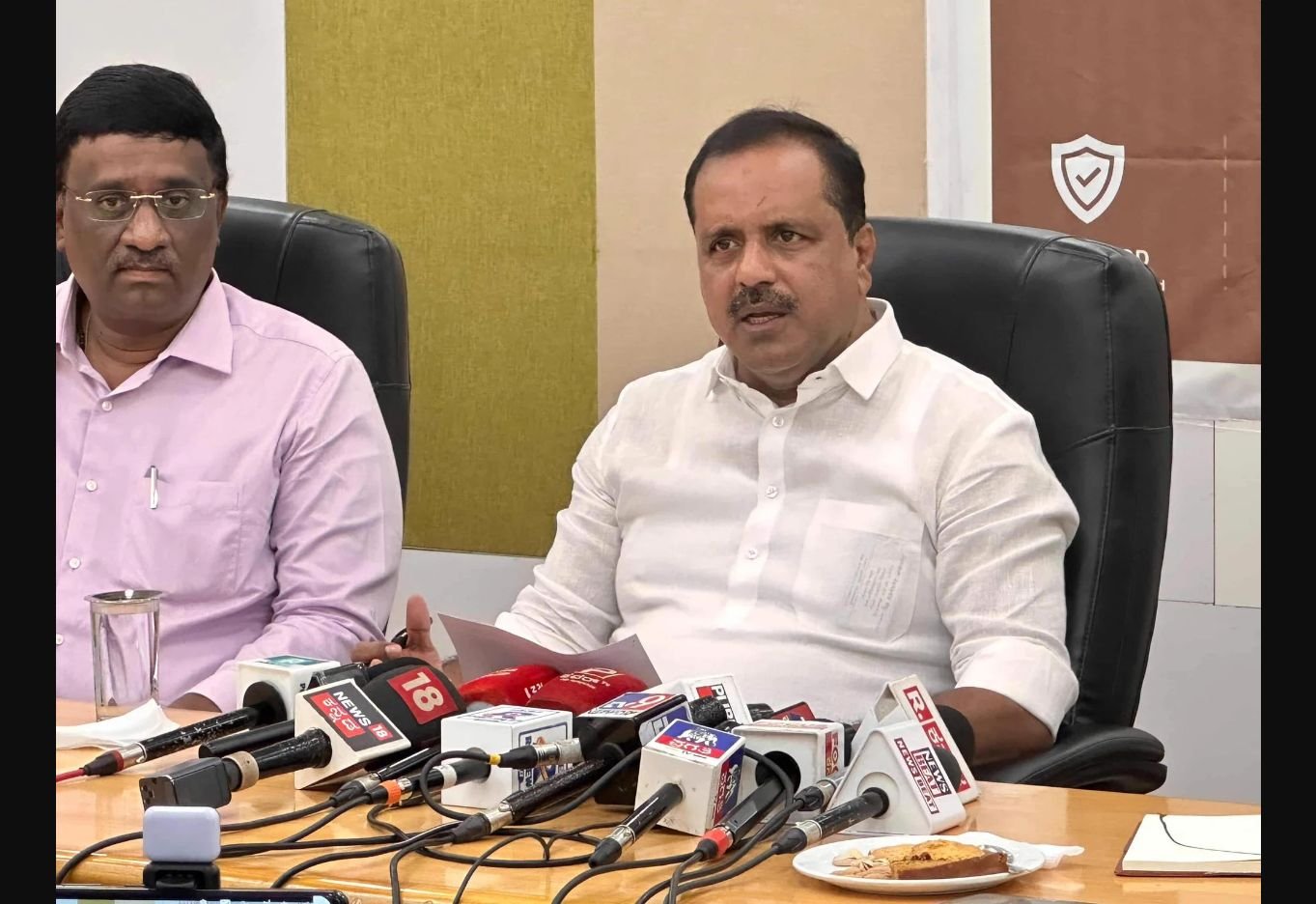
U.T. Khader at a media briefing in a photograph shared with his drug-pricing statement. Photo: @utkhader/X.
Bengaluru: Karnataka has asked the Centre to make hospitals disclose the institutional landing cost of medicines alongside their maximum retail price on patient bills, after inspections found some MRPs exceeding procurement costs by more than 52 times, U.T. Khader said.
A comparison shared by Khader lists Gufipol (Criticare) at a landing cost of ₹86 against an MRP of ₹4,528—a ratio of about 52.6 times. The proposed disclosure would put the amount paid to acquire an item and its printed maximum price on the same bill, making the gap visible to patients.
Khader said he had written to the Union Health Minister seeking urgent intervention. He described the findings as part of Karnataka’s examination of institutional procurement costs, MRPs and patient billing practices, aimed at improving transparency and protecting patients from unjustified financial burdens.
253 drugs flagged; verification covers more products
According to Khader, inspections by the Food Safety Department identified 253 drugs with extreme pricing anomalies. Further verification covered more than 768 medical consumables and 189 high-cost drugs, he said.
These figures describe the categories cited in his statement; they should not be added together as a single count of distinct products. Khader said the findings would be brought to the Central government’s attention for appropriate action.
From medicines to IV sets: the gaps in the shared table
The comparison also lists Guficycline-50 injection at ₹160 against an MRP of ₹7,110, and Terlitis at ₹118 against ₹4,416. For consumables, an adult nebuliser mask is shown at ₹44.50 against ₹950, while an IV set is listed at ₹14.75 against ₹295.
The following figures are reproduced from the table shared by Khader. They compare institutional landing cost with MRP, not an independently verified amount charged to a particular patient.
| Drug or consumable | Landing cost (₹) | MRP (₹) | MRP / landing cost (times) |
|---|---|---|---|
| Gufipol (Criticare) | 86 | 4,528 | 52.6 |
| Guficycline-50 injection (GUFI) | 160 | 7,110 | 44.4 |
| Terlitis (AEQU) | 118 | 4,416 | 37.4 |
| Taxocare 120 mg (Intas) | 1,000 | 21,617 | 21.6 |
| Canmab 440 mg | 6,600 | 57,457 | 8.7 |
| Bevatas 400 mg injection | 5,850 | 62,690 | 10.7 |
| Cytax 100 mg (cancer drug) | 342 | 3,836 | 11.2 |
| Adult Nebuliser Mask | 44.50 | 950 | 21.3 |
| IV Set | 14.75 | 295 | 20 |
| Polysafety PRO IV Cannula | 33.21 | 548 | 16.5 |
The ratios in the source table are rounded. The comparison does not by itself establish a hospital’s net profit or whether a particular patient was billed at the full MRP.
What Karnataka wants the Centre to change
Alongside mandatory disclosure of landing cost and MRP on patient bills, Karnataka has sought wider coverage of medicines under price controls and regulation and rationalisation of trade margins on essential high-value medicines and medical consumables, Khader said.
The requests include amending or supplementing the Drugs (Prices Control) Order, 2013, wherever necessary, and expanding the National List of Essential Medicines. These are proposals for Central action, rather than newly announced price limits.
Khader also called for an inter-ministerial expert group and a comprehensive national data study. Another request is to treat “back end considerations” as part of acquisition cost; the post does not spell out a calculation method for that category.
A stronger audit, monitoring and enforcement mechanism forms the final part of the proposed response. Khader said Karnataka would continue pursuing fair pricing and greater accountability in the healthcare system.
Disclosure sought, not a new patient-billing rule
The immediate development is the state’s request for Central intervention following the inspection findings. The post does not specify an implementation date for mandatory cost disclosure, announce an approved trade-margin ceiling or identify individual hospitals against which action has been taken.
About the Author