
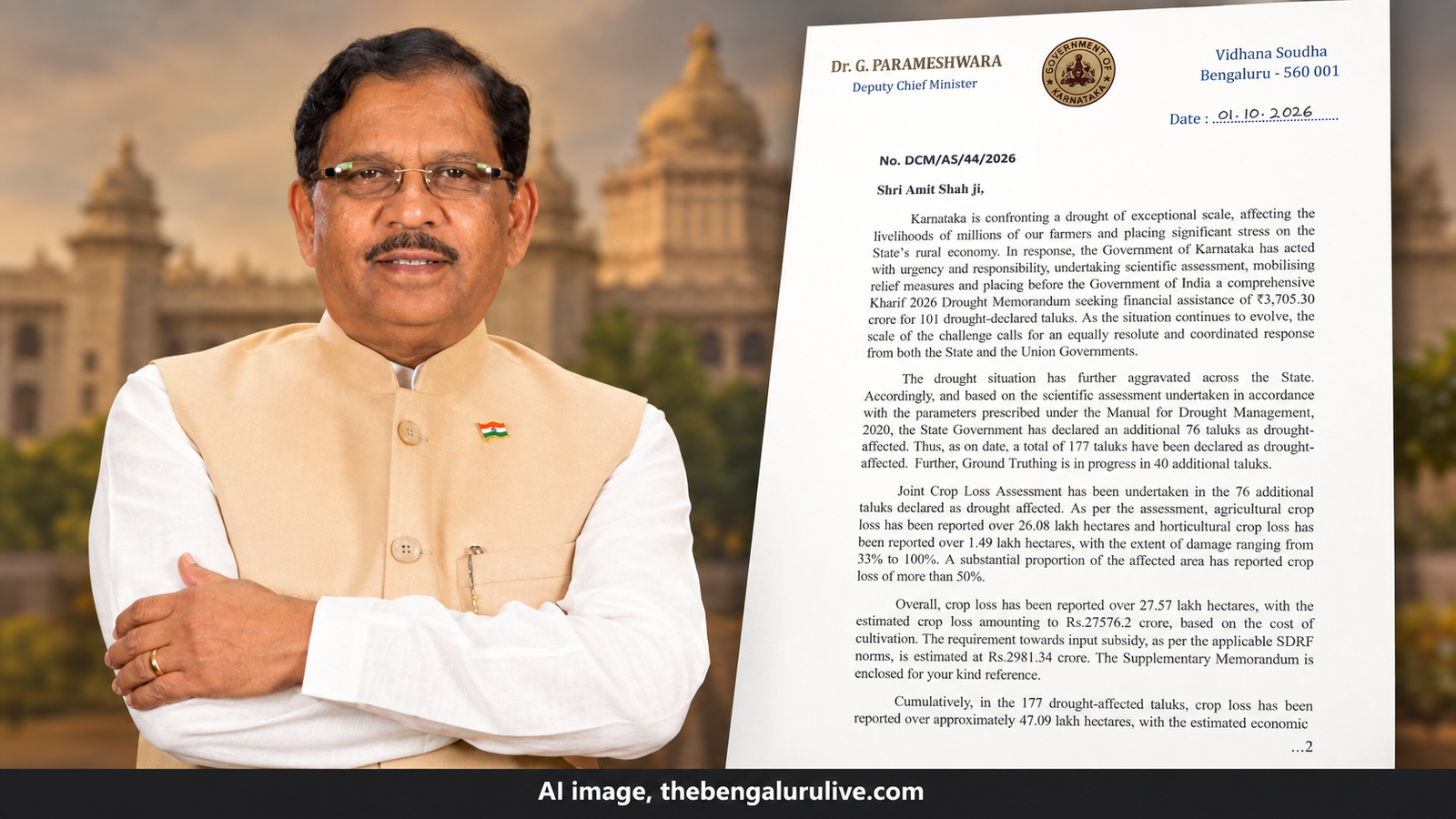
G. Parameshwara and his drought-relief letter to Amit Shah, shown in an editorial composite. AI image, thebengalurulive.com
Bengaluru: Karnataka has pressed the Centre to raise drought-relief norms, arguing that existing input subsidies cover only a fraction of farmers’ losses, as the state’s estimated crop damage across 177 drought-hit taluks reaches ₹46,324.5 crore.
Deputy Chief Minister G. Parameshwara has written separately to Union Home Minister Amit Shah and Union Agriculture Minister Shivraj Singh Chouhan, seeking revised assistance norms, a faster Central assessment and timely release of support. The two letters, dated October 1, put the cost-of-cultivation burden at the centre of Karnataka’s appeal.
In the accompanying statement, Parameshwara said Karnataka had sought ₹7,142.64 crore under National Disaster Response Fund norms for two phases of drought declaration. That request includes ₹4,998.6 crore for input subsidy and ₹2,144.04 crore for measures such as fodder and drinking water; it is a relief demand, not an announcement of funds sanctioned.
Why Karnataka wants the subsidy formula revised
The letter to Shah says existing input-subsidy norms are substantially inadequate against prevailing agricultural input costs and cover only a fraction of the losses suffered by farmers. Parameshwara has sought a substantial upward revision so assistance better reflects cultivation costs and the economic impact of crop damage.
He linked the request to the commencement of the 16th Finance Commission cycle and said Karnataka had already submitted detailed comments and justification to the Union Home Ministry on revising State Disaster Response Fund and National Disaster Response Fund assistance norms.
177 taluks declared drought-hit; 40 more under assessment
The first Kharif 2026 drought memorandum sought ₹3,705.30 crore for 101 taluks. A further 76 taluks were declared drought-affected after scientific assessment, taking the declared total to 177, according to the letters.
Ground verification is underway in another 40 taluks. The letter to Chouhan says the number of drought-declared taluks could eventually exceed 220 by the end of the southwest monsoon season. This remains a projection under continuing assessment, rather than the current declared tally.
The letters say a comprehensive assessment of remaining taluks will be undertaken at the end of the month as part of the continuing drought-assessment process.
Second-phase losses span 27.57 lakh hectares
A joint assessment in the additional 76 taluks recorded damage to 26.08 lakh hectares of agricultural crops and 1.49 lakh hectares of horticultural crops. Damage ranges from 33% to 100%, with a substantial proportion of affected land recording losses above 50%.
For these 76 taluks, the combined affected area is 27.57 lakh hectares and the estimated loss is ₹27,576.2 crore, calculated on the cost of cultivation. The corresponding input-subsidy requirement under existing SDRF norms is put at ₹2,981.34 crore.
Tur, maize and cotton among the major affected crops
The Agriculture Minister’s letter gives a crop-wise picture not detailed in the accompanying post. Major affected agricultural crops include red gram or tur across 6.49 lakh hectares, maize across 5.31 lakh hectares, cotton across 4.13 lakh hectares, sugarcane across 2.8 lakh hectares, soyabean across 1.90 lakh hectares and green gram across 1.81 lakh hectares.
Among horticultural crops, the letter identifies onion losses across 0.54 lakh hectares, arecanut across 0.33 lakh hectares and red chilli across 0.17 lakh hectares. These are the major crops listed, rather than a complete breakdown of all affected acreage.
Cumulative damage could rise further
Across all 177 declared taluks, the letters record damage over approximately 47.09 lakh hectares, with estimated economic losses of ₹46,324.5 crore based on cultivation costs. The Agriculture Minister’s letter projects that the affected area during Kharif 2026 may exceed 55 lakh hectares as assessment continues.
Parameshwara has asked Chouhan to expedite the drought-assessment process to enable timely consideration and release of assistance. He has called for close coordination between the state and Union governments to deliver adequate support to affected farmers.
About the Author