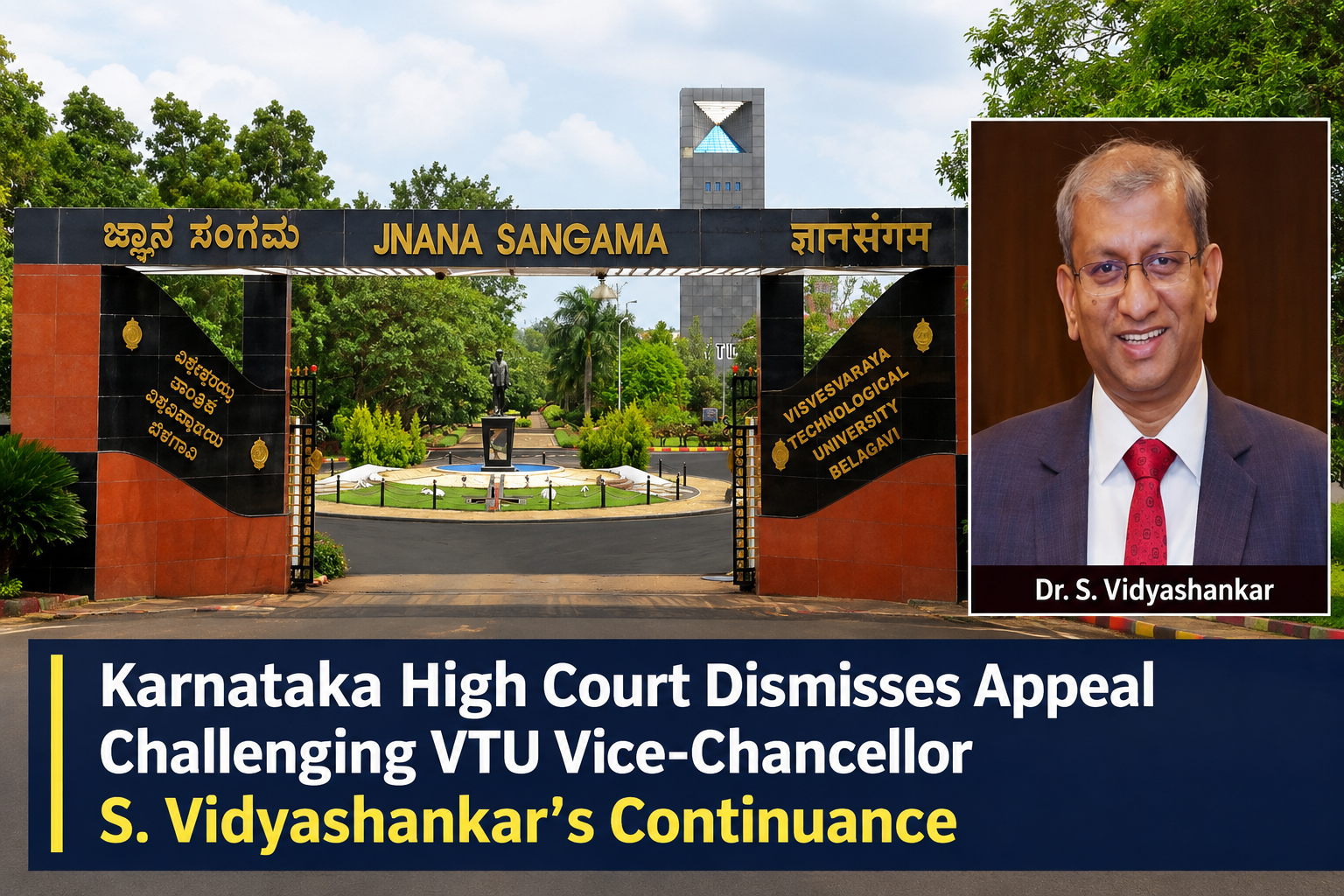
Karnataka High Court Dismisses Yogesh B’s Appeal Challenging VTU Vice-Chancellor S Vidyashankar’s Continuance
Bengaluru, September 10: The Karnataka High Court has dismissed a writ appeal filed by Yogesh B challenging an order arising from his attempt to question the appointment and continuance of Dr S Vidyashankar as Vice-Chancellor of Visvesvaraya Technological University (VTU), holding that no case had been made out for issuance of a writ of quo warranto.
A Division Bench comprising Justice D K Singh and Justice H. Shanthi Bhushan dismissed Writ Appeal No. 10 of 2026. The appeal challenged a November 27, 2025 order of a Single Judge dismissing W.P. No. 16651/2025 as infructuous.
The original writ petition, filed by Yogesh B and Venugopal K.A., had principally sought a writ of quo warranto questioning Vidyashankar’s continuance as VTU Vice-Chancellor. They challenged his appointment pursuant to a September 29, 2022 notification, alleging violations of the UGC Regulations, 2018 and Section 13 of the VTU Act, 1994.
The petitioners had raised objections concerning the constitution of the Search-cum-Selection Committee, including the alleged absence of a nominee of the UGC Chairman, and had also questioned Vidyashankar’s academic credentials and antecedents.
During the pendency of the petition, the Chancellor issued a notification dated September 3, 2025 extending Vidyashankar’s term as Vice-Chancellor for another term of similar period with effect from September 30, 2025.
The Single Judge subsequently dismissed the petition as infructuous, holding that the petitioners had not amended their writ petition to challenge the subsequent notification, while granting them liberty to challenge the later order if they wished.
Yogesh challenged that decision before the Division Bench, arguing, among other things, that a subsequent extension could not render the quo warranto proceedings infructuous and that the alleged illegality in the original appointment remained open to judicial scrutiny.
The Division Bench, however, declined to interfere with the Single Judge’s order and took note of earlier litigation concerning Vidyashankar’s appointment.
The court recorded that W.P. Nos. 21681/2022 and 23349/2022 had earlier challenged the same appointment and were dismissed by a Division Bench on November 7, 2023. The matter subsequently reached the Supreme Court in SLP No. 5941/2024.
Referring to the Supreme Court’s April 9, 2024 order, the High Court noted that the apex court had specifically recorded that it found no merit in the challenge to the Vice-Chancellor’s appointment and declined to interfere with the Division Bench’s view. The High Court said the liberty granted by the Supreme Court was confined to approaching the High Court regarding adverse observations made against the petitioner in that earlier proceeding and did not permit reopening the Vice-Chancellor’s appointment through successive proceedings.
The Division Bench also expressed concern over repeated litigation concerning substantially the same subject matter. It observed that the constitutional court’s extraordinary jurisdiction could not be used as a continuing platform for pursuing private disputes or making successive attempts to unsettle an appointment.
Explaining the limits of quo warranto jurisdiction, the Bench said the court’s inquiry concerns whether an incumbent is legally entitled to occupy a public office and whether the appointment violates statutory provisions. It said such proceedings are not intended for a comparative assessment of eligible candidates or for deciding whether another candidate would have been a better choice.
The court held that Yogesh had not demonstrated that Vidyashankar suffered from any statutory disqualification rendering him ineligible to hold the office of Vice-Chancellor. It also found no material establishing that the appointment had been made by an authority lacking jurisdiction or in patent violation of a mandatory statutory requirement.
The Bench said the grievances essentially concerned the constitution and functioning of the selection process and the assessment of Vidyashankar’s credentials and suitability. In the absence of a clear statutory prohibition or illegality affecting his authority to hold office, these could not form the basis for issuing a writ of quo warranto.
The court concluded that no perversity, jurisdictional error or infirmity in the Single Judge’s order warranted interference and dismissed the writ appeal. I.A. Nos. 1/2026, 2/2026 and 4/2026 were consequently disposed of.
About the Author