From Modi’s 2014 ‘Pradhan Sewak’ to DK Shivakumar’s ‘Praja Sevaka’: Karnataka CM Says ‘Don’t Call Me Ruler’
Vijayanagara/Bengaluru, September 5: Twelve years after Narendra Modi used his first Independence Day address as Prime Minister to tell the country that he stood before the people not as the “Pradhan Mantri” but as the “Pradhan Sewak”, Karnataka Chief Minister D.K. Shivakumar has struck a similar public-service note, saying he would rather be called a “Praja Sevaka”, or servant of the people, than the “ruler of the state”.
Launching the new Prajaseva Department campaign at Kudligi in Vijayanagara district on Saturday, Shivakumar said the era of rulers had ended with the advent of democracy and that he would be happiest if people called him a Praja Sevaka instead of referring to him as the ruler of Karnataka.
The formulation echoes a phrase used by Modi from the Red Fort on August 15, 2014, during his first Independence Day address after becoming Prime Minister. Modi had said he was present before the people not as the Prime Minister but as the “Pradhan Sewak”, or first servant, and that he had come with a government not as a ruler but as a servant.
Shivakumar, while setting out the philosophy behind Karnataka’s Prajaseva initiative, said he believed that service to the people was service to God.
Also Read: ‘How Can You Call Yourself Praja Sevaka?’: Vijayendra Targets DK Shivakumar Over BPL Cards, Vacancies, North Karnataka Visit
He said Karnataka’s voters had given the government an opportunity to pursue a new path by electing 136 legislators and argued that the time when citizens had to repeatedly visit government offices and officials for their work should end. The administration itself should reach people’s doorsteps, he said.
Shivakumar said governance could not be conducted by remaining distant from people in the Vidhana Soudha, Deputy Commissioner’s offices or taluk offices. Since every citizen could not directly meet ministers, legislators or officials, the Prajaseva Department would focus on hearing grievances and providing solutions at the local level.
He said the initiative should not remain merely another government department but develop into a people-oriented system capable of bringing positive changes to citizens’ lives.
Under the campaign, officials are expected to go directly to people instead of requiring citizens to search for legislators, ministers or taluk-level officers. Shivakumar appealed for public cooperation with the slogan that the government had come to people’s doorsteps.
He said the Prajaseva system would be implemented across all 224 Assembly constituencies without distinction on the basis of politics, religion or caste. The Cabinet has decided that elected representatives and officials should work among the people on the first and third Saturdays of every month, he said.
Ministers will lead the programme at taluk and hobli levels, while legislators will lead it at the panchayat level. If legislators are not present, officials themselves should visit panchayat centres, conduct small meetings, receive public grievances and work towards resolving them, he directed.
Shivakumar said the success of the programme should not be measured merely by acknowledging applications. It would succeed only when applicants received appropriate solutions and people had smiles on their faces, he said.
He said officials would visit local areas twice a month to hear public grievances. Applications relating to pensions, land disputes, government benefits, khata changes, guarantee schemes, houses and sites would be examined and addressed.
The government would also provide free legal assistance to poor and marginalised people who have to pursue disputes at the level of tahsildars, Assistant Commissioners or Deputy Commissioners, he said. If an application was rejected, the reason should be clearly explained, and the government would stand with applicants until their cases reached a conclusion, Shivakumar said.
He said the government wanted every section of society to receive equal dignity in accordance with B.R. Ambedkar’s thinking. Referring to the five guarantee schemes, Shivakumar said the government had implemented them despite criticism from opposition parties and expressed confidence that the Prajaseva initiative would become a model for the country.
The Chief Minister also proposed a new form of recognition for teachers. Marking Teachers’ Day, he said soldiers, workers, farmers and teachers all make important contributions to national development and suggested that “Tr” for Teacher be placed before teachers’ names as a mark of respect.
Shivakumar said Karnataka had more than 4.5 lakh teachers and that a mother who gives birth and a teacher who provides education were both like gods. He said the Cabinet would discuss the proposal to use a title identifying teachers before their names, similar to the recognition associated with professions such as doctors and engineers.
On education and employment, Shivakumar said the government was planning measures to support poor students studying in government and rural schools. He referred to 15% rural reservation and an additional proposed 7.5% internal reservation in government jobs for those who studied in government schools.
He also spoke about property documentation under what he described as the government’s sixth guarantee, “Bhoomi Guarantee”. He said 25,276 people in the taluk had already been given title deeds and officials had been instructed to measure properties and deliver e-khata documents carrying owners’ photographs directly to their homes.
Shivakumar said the government had decided to provide legal assistance, including free government lawyers, to help poor and powerless people.
He also said “Bharat Jodo Yuvaka Sangha” units were being started in villages to identify cultural, sporting and leadership talent and strengthen democratic values. Guarantee-scheme committees would be constituted in every panchayat to work towards ensuring benefits for eligible people, he said.
On drought, Shivakumar said a decision on declaring additional drought-affected taluks would be taken within the framework of the Union government’s guidelines and rules. A second-phase report on drought conditions was expected, while surveys were under way in more than 50 additional taluks, he said.
He said rainfall over a 21-day period and other prescribed parameters would be examined and that all taluks facing scarcity and meeting the criteria would be declared drought-affected by the end of the month.
Shivakumar also referred to his visit to the site in Kudligi where Mahatma Gandhi’s ashes are kept and said he had paid respects there. He recalled visiting Basavanna’s Aikya Sthala the previous day and inspecting drought-affected areas.
Responding to criticism over his helicopter visits, Shivakumar said he was not concerned by such criticism and argued that criticism would fade while work done by the government would remain. Taking the administration closer to people was the government’s fundamental objective, he said.
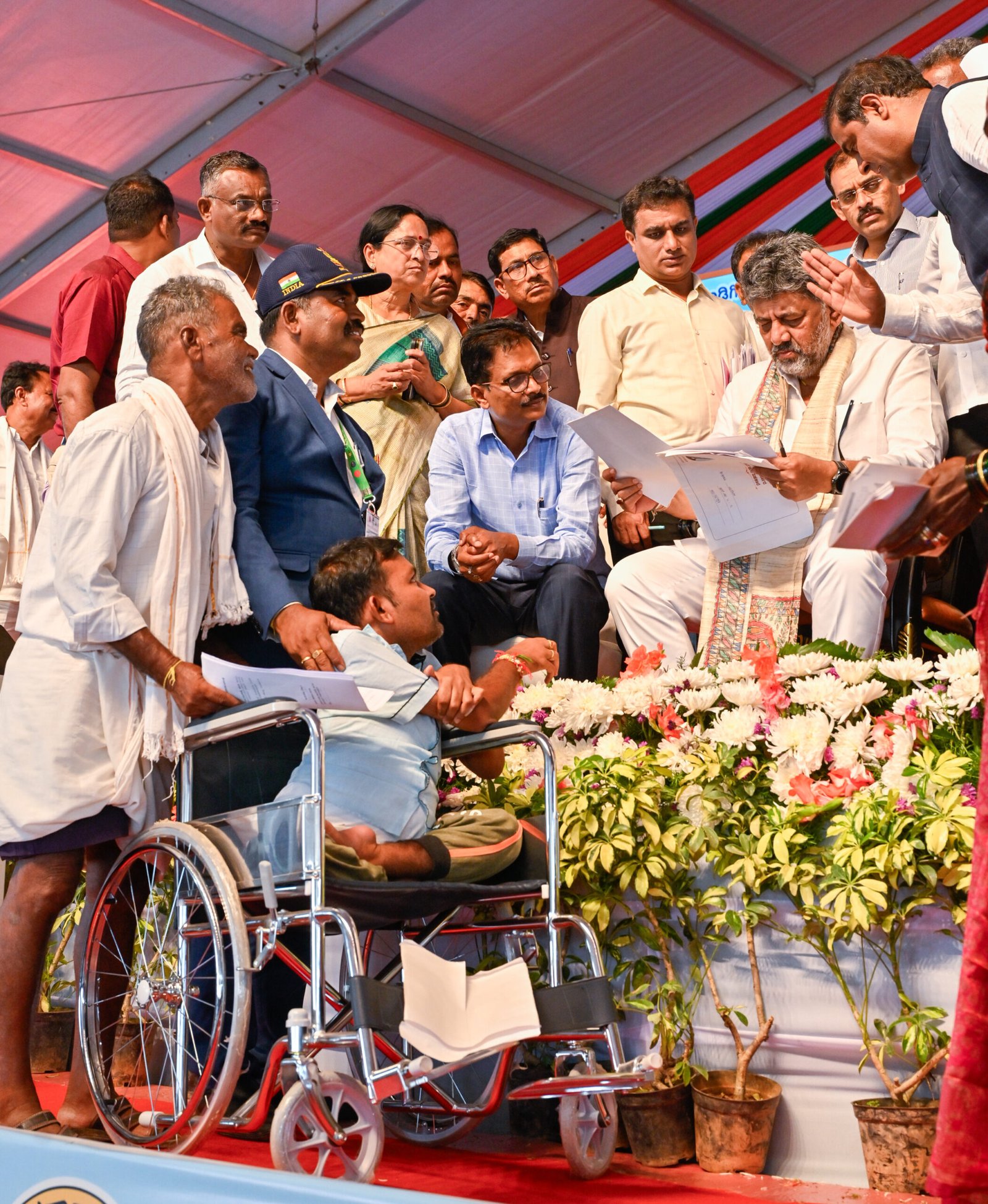
After the programme, Shivakumar interacted online with ministers leading Prajaseva campaigns in different districts and obtained information about their programmes. He also spoke to members of the public who had come to submit grievances.
Cheques were distributed to beneficiaries selected under various schemes and vehicles were handed over to persons with disabilities at the conclusion of the programme.
Deputy Speaker Mankalu Vaidya, Minister K.S. Basavantappa, State Guarantee Schemes Implementation Authority Vice-Chairman P.T. Parameshwar Naik, Ballari MP E. Tukaram, Davanagere MP Dr Prabha Mallikarjun, legislators H.R. Gaviyappa, K. Nemiraj Naik, L. Krishnanaik, M.P. Latha Mallikarjun and Y.M. Satish, Chief Secretary Dr Shalini Rajneesh, Additional Chief Secretary Gaurav Gupta, senior officials and others attended the programme.
About the Author