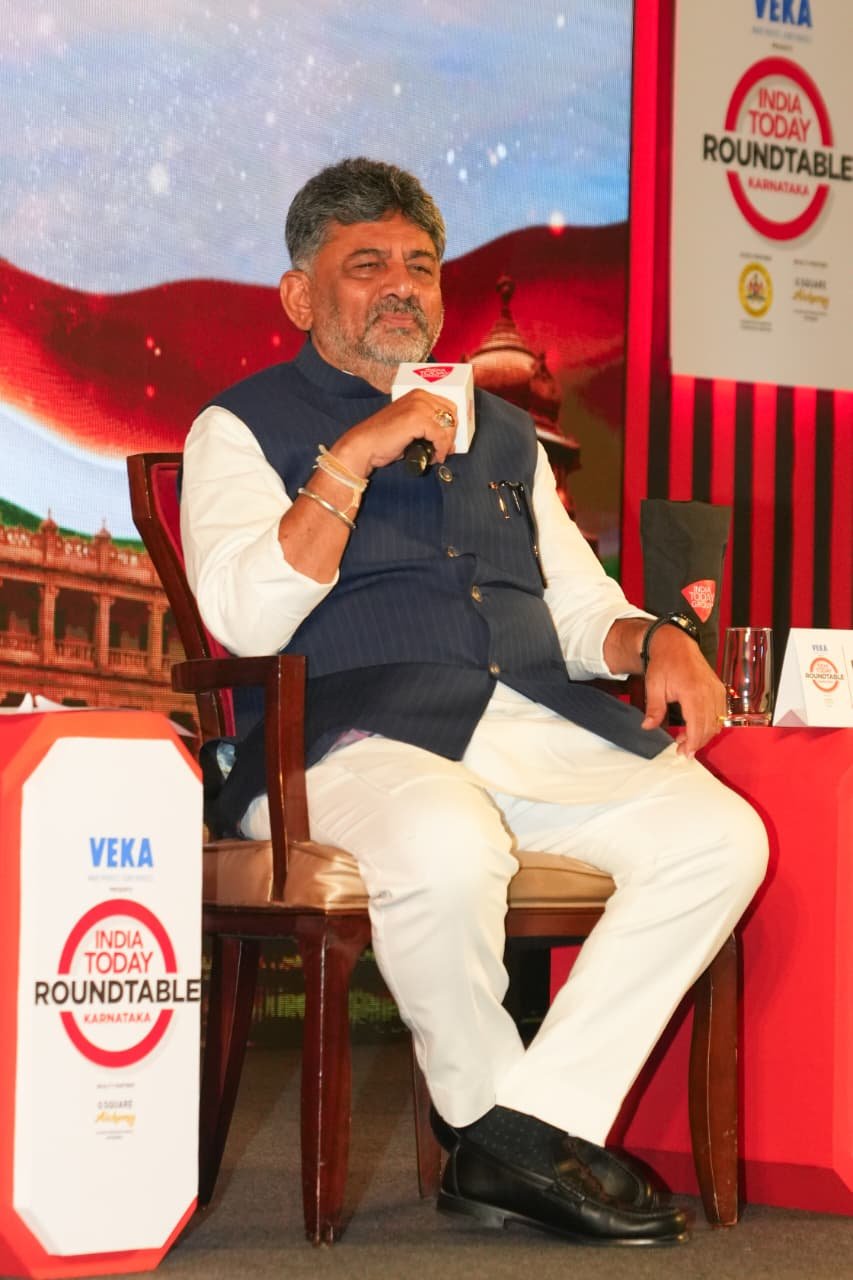
Woman to Join Karnataka Cabinet Within Days; D.K. Shivakumar Rejects Congress Factionalism, Flags Delimitation and Centre’s ‘Bias’
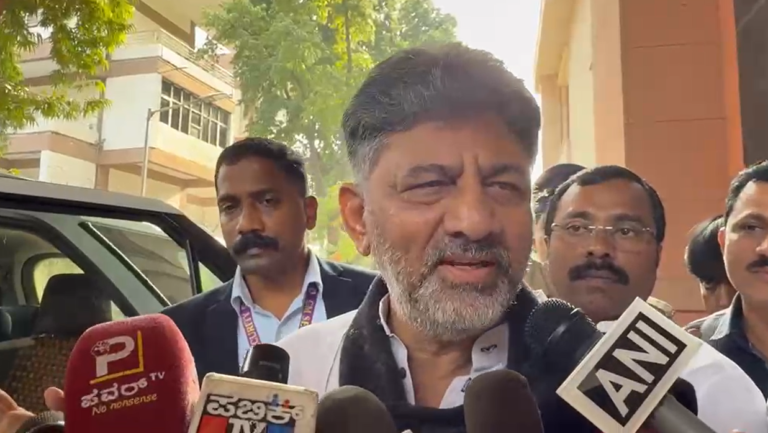
Bengaluru: Karnataka Chief Minister D.K. Shivakumar has said a woman will be inducted into the state Cabinet within the next two or three days, while rejecting reports of discontent and factionalism within the Congress.
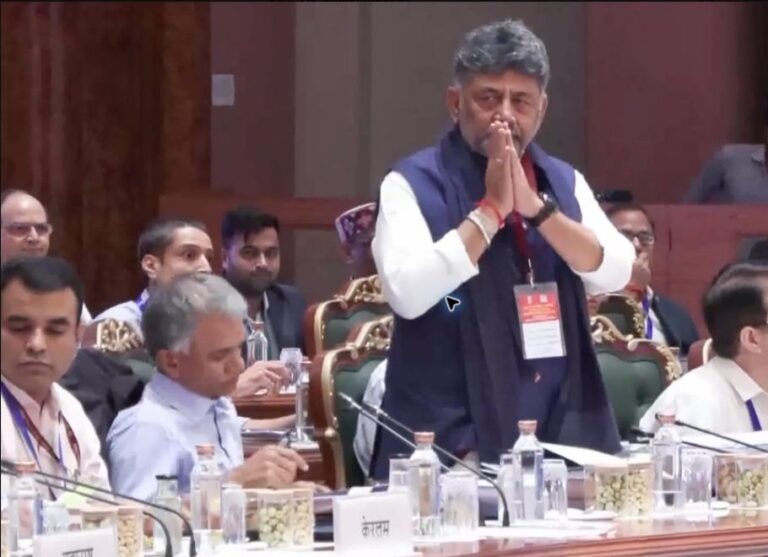
Speaking at the India Today Round Table Karnataka programme, Shivakumar addressed questions concerning governance, Cabinet representation, constituency delimitation, Bengaluru’s infrastructure, irrigation projects, the Valmiki Corporation case, youth mobilisation and the Congress’s electoral plans.
“I am now a person in a hurry. The people of the state and party workers across the country have immense expectations from me. They believe I will provide good governance,” Shivakumar said.
He maintained that India’s progress was possible through Karnataka and said he wanted to use the time available to deliver effective governance, strengthen the Congress organisation and make Karnataka a model for other states.
Addressing reports of dissatisfaction among legislators, Shivakumar said the Congress did not face such a problem.
He said all Congress MLAs and MLCs were capable of becoming ministers or heading state-owned boards and corporations, but it was impossible to accommodate everyone in the Cabinet.
The Congress high command would consult the state leadership before taking the final decision on ministerial appointments, he said.
Shivakumar cited earlier governments to argue that senior leaders had also remained outside the Cabinet at different stages of their careers.
He said Mallikarjun Kharge, Dharam Singh and S. Bangarappa were not ministers during the Veerendra Patil government. Senior leaders were also excluded from the Cabinet during S.M. Krishna’s tenure, he added.
Shivakumar said he and G. Parameshwara were denied ministerial positions during the Dharam Singh government. He added that he was initially denied an opportunity during Siddaramaiah’s earlier tenure.
“Today, I am the Chief Minister and Parameshwara is the Deputy Chief Minister. In politics, one has to accept and absorb everything. There is nothing wrong in having aspirations, but one must understand the party’s situation,” he said.
On representation for women, Shivakumar said providing Cabinet positions to women was part of the Congress government’s commitment and ideology.
“A woman minister will be given a place in the Cabinet within the next two or three days,” he said.
Rejecting suggestions of rival factions in the Congress, Shivakumar said the party itself constituted a single group.
“Neither Siddaramaiah nor I have any faction. We are united,” he said.
Shivakumar recalled telling the Assembly that his strength, including Siddaramaiah, stood at 138 legislators.
“Factionalism may exist in the BJP, but it does not operate in the Congress. We work as soldiers of the party,” he said.
Explaining his meetings with former chief ministers after assuming office, Shivakumar said he might have risen through the Congress but was the Chief Minister of the entire state.
He said a person occupying the Chief Minister’s position was constitutionally bound to take every section of society along and could not discriminate on political grounds.
Shivakumar alleged that government benefits in Assam were restricted to BJP workers but said Karnataka’s programmes were extended to people from every section.
“One should not dispense injustice while sitting on the seat of justice. In administration, we must treat everyone equally,” he said.
The Chief Minister accused the Union government of discriminating against southern states, including Karnataka, in the allocation of resources and political representation.
He said Karnataka contributed substantially to the country’s gross domestic product and tax revenues but was not receiving treatment proportionate to its contribution.
Shivakumar said southern states had implemented the Union government’s population-control policies, but population was now being considered while determining constituency delimitation and the distribution of grants.
“This is an injustice to us. We will not accept the Union government’s decision on delimitation,” he said.
He demanded that the existing number of constituencies be retained while implementing women’s reservation.
Increasing the number of constituencies on the basis of population would weaken southern India’s voice, he said, adding that the chief ministers of Tamil Nadu, Telangana and Kerala had also raised similar concerns.
“We must protect the voice of southern India,” Shivakumar said.
Turning to Bengaluru’s infrastructure, the Chief Minister said potholes were not unique to the city and existed in other metropolitan areas as well.
He said the government was pursuing white-topping as a long-term solution and claimed that 60 per cent of the identified roads had been white-topped.
Bengaluru had approximately 1.35 crore vehicles and a population of about 1.40 crore, he said, arguing that the city’s existing roads were unable to handle the present traffic load.
Shivakumar said Bengaluru’s economic growth also supported the development of rural Karnataka and that the government was prioritising both the capital and the state’s rural regions.
To address traffic congestion, the government was proceeding with a 47-km tunnel-road project and 115 km of elevated corridors, he said.
Shivakumar claimed the tender process had been completed and said similar projects were being implemented in BJP-ruled states, even as a BJP parliamentarian opposed the Bengaluru proposals.
Responding to questions concerning the use of park land, Shivakumar alleged that parks had been allotted to organisations and party workers for activities during the BJP government’s tenure.
He said the present government proposed to use only five per cent of open areas for public purposes and had not transferred them to private entities.
A Bill had been introduced to prevent illegal encroachments, he said.
Shivakumar announced that the government proposed to develop five arboretums modelled on Lalbagh during his tenure and had initiated discussions with the Forest Department.
“I will return before you after implementing this project within the next 18 months,” he said.
On the Mekedatu balancing-reservoir project, Shivakumar said 95 per cent of the water stored under the proposed scheme would eventually flow to Tamil Nadu.
Only drinking water would be supplied to Bengaluru, and no water would be used for irrigation, he said.
Shivakumar maintained that Tamil Nadu would benefit more from the project and claimed the court had held that Karnataka did not require anyone’s permission to implement a project within its territory.
He reiterated that Karnataka was committed to releasing Tamil Nadu’s allocated share of 177 tmc ft of Cauvery water.
On the Tungabhadra issue, Shivakumar said the chief ministers of three states had reached a consensus under the leadership of Union Jal Shakti Minister C.R. Patil.
“Not every problem can be resolved in court. Solutions can be found if we sit together and hold discussions. That is our priority,” he said.
Shivakumar also accused the Union government of failing to release the ₹5,400 crore announced for the Upper Bhadra Project.
He said the Prime Minister and Union Finance Minister had announced the allocation four years earlier, following which the Basavaraj Bommai government incorporated it into the state Budget.
“Not a single paisa has been released so far. This is how the BJP-led Union government is discriminating against the Congress government in Karnataka,” he alleged.
People should not be treated unfairly merely because they did not vote for the BJP, Shivakumar said.
Defending the reinduction of B. Nagendra into the Cabinet, the Chief Minister asked whether Union ministers and ministers in BJP-ruled states did not face criminal cases.
He said Nagendra had remained outside the Cabinet for the past two years and claimed that an internal departmental inquiry had found no involvement on his part in the Valmiki Corporation case.
Shivakumar alleged that the Central Bureau of Investigation and Enforcement Directorate intervened before a closure report could be filed.
He further claimed that neither agency had recovered any money from Nagendra’s residence and that 95 per cent of the money allegedly diverted in the case had been recovered.
These claims were made by the Chief Minister and were not independently verified.
“Nagendra is a disciplined soldier of the party and follows the party’s directions,” Shivakumar said.
Speaking about Generation Z, the Chief Minister described young people as the country’s voice and said progress would be impossible without providing them opportunities.
He said the government must not only create employment but also encourage young people to become employment generators.
Under the Bharat Jodo Yuva Sangha initiative, the Congress proposed to establish 10,000 youth associations across Karnataka, he said.
The initiative would seek to promote social harmony, keep young people away from drugs and other addictions and involve them in constructive activities.
Shivakumar said the objective was to nurture young leaders not only in politics but across different fields.
Responding to allegations of religious appeasement, the Chief Minister asked whether the Karnataka government should shut down its Minority Welfare Department and whether the Union government would do the same.
He said protecting minorities, who comprised an estimated 18 to 20 per cent of the country’s population, was the government’s duty.
“They are also Indians. We respect every community,” he said.
On the Vande Mataram issue, Shivakumar said the government would remain committed to the Congress’s ideology and decisions and would follow the party’s position in the coming days.
Addressing the Special Intensive Revision of electoral rolls, he said protecting the voting rights of every eligible voter was the government’s responsibility.
The state was issuing residence-verification documents and caste certificates to help protect eligible citizens’ voting rights, he said.
Shivakumar expressed confidence that the Congress would return to power in Karnataka in 2028 with more Assembly seats than it currently held.
He also predicted that the party would win more than 20 Lok Sabha constituencies in Karnataka in the 2029 general election and said Rahul Gandhi would become the Prime Minister.
Discussing the recent Legislative Council election, Shivakumar said he did not aspire to become Amit Shah and described himself as a Congress worker who would perform whatever responsibility the party assigned to him.
He denied engineering any split in the BJP–JD(S) alliance.
Shivakumar claimed that several BJP legislators believed the Congress government represented Karnataka’s future and that 12 opposition MLAs had consequently cast “conscience votes” in favour of the Congress.
He said the opposition parties had conducted an inquiry into the cross-voting and asked what had happened to its report.
Referring to Union Minister H.D. Kumaraswamy, Shivakumar claimed the JD(S) leader had subsequently said that he knew of the likely defeat before the election and had fielded a candidate to understand what was in the legislators’ minds.
Asked whether similar political surprises could occur again, Shivakumar said: “More surprises and changes will definitely take place in the coming days.”
No immediate response from the BJP, JD(S) or the Union government to the Chief Minister’s allegations was available.
About the Author