
What happens in an autopsy? A forensics expert explains
Sydney: Sometimes it’s unclear how or why a person died. A detailed examination of the body after death, known as an autopsy or postmortem, can help find answers.
Despite what you may have seen on TV crime shows, most autopsies are minimally invasive; body often stays intact throughout a mostly observational procedure.
Sometimes, though, a more extended investigation is needed.
Through each step of the autopsy process, the dignity and respect of the deceased is prioritised by all involved.
Not every death will result in an autopsy
If someone dies from natural causes, there is no evidence of suspicious circumstances or there is a recent medical history, the death is certified by a doctor. The person is then taken into the care of a funeral service.
But when questions about the death remain, specialist doctors, technicians and support staff might investigate further. Sometimes this involves an autopsy.
Non-coronial and coronial autopsies
Depending on the circumstances of death, there are two types of autopsies in Australia: non-coronial and coronial.
A non-coronial autopsy is done when the cause of death is known but more information is needed. For example, the family may wish to know:
the extent of a known medical condition that led to the death
how effective any treatments leading up to the time of death were, or
if there’s evidence of a potential undiagnosed medical condition that may have contributed to the death.
Non-coronial autopsies are done in a hospital mortuary or a forensic pathology facility by an anatomical pathologist or forensic pathologist. An anatomical pathologist is a specialist in the detection and diagnosis of disease in organs and tissues (mainly in the living). A forensic pathologist takes part in medico-legal investigations and examines the body and its organs to look for disease or injury that may have caused death.
A coronial autopsy happens when death is unexpected, violent, unnatural or the result of an accident.
Deaths like these are classified as “reportable” deaths; by law they must be reported to the coroner, who is a magistrate of the court with legal training.
These reports (typically prepared by the police), as well as the legislation relevant to the state, assist the coroner to decide whether or not to order an autopsy.
This order can be a minimally invasive external examination, an internal examination of a single body cavity or an invasive multiple cavity autopsy.
Coronial autopsies are done in a forensic pathology facility by a forensic pathologist.
The first steps
Someone who has died under “reportable” circumstances will be admitted to the forensic facility. The person’s identity will be established, where possible.
If the coroner orders an autopsy, the body first undergoes a CT scan, which may be enough for the forensic pathologist to determine cause of death without further investigation.
If not, the body will then be laid carefully on an examination table where any clothing and personal belongings are removed.
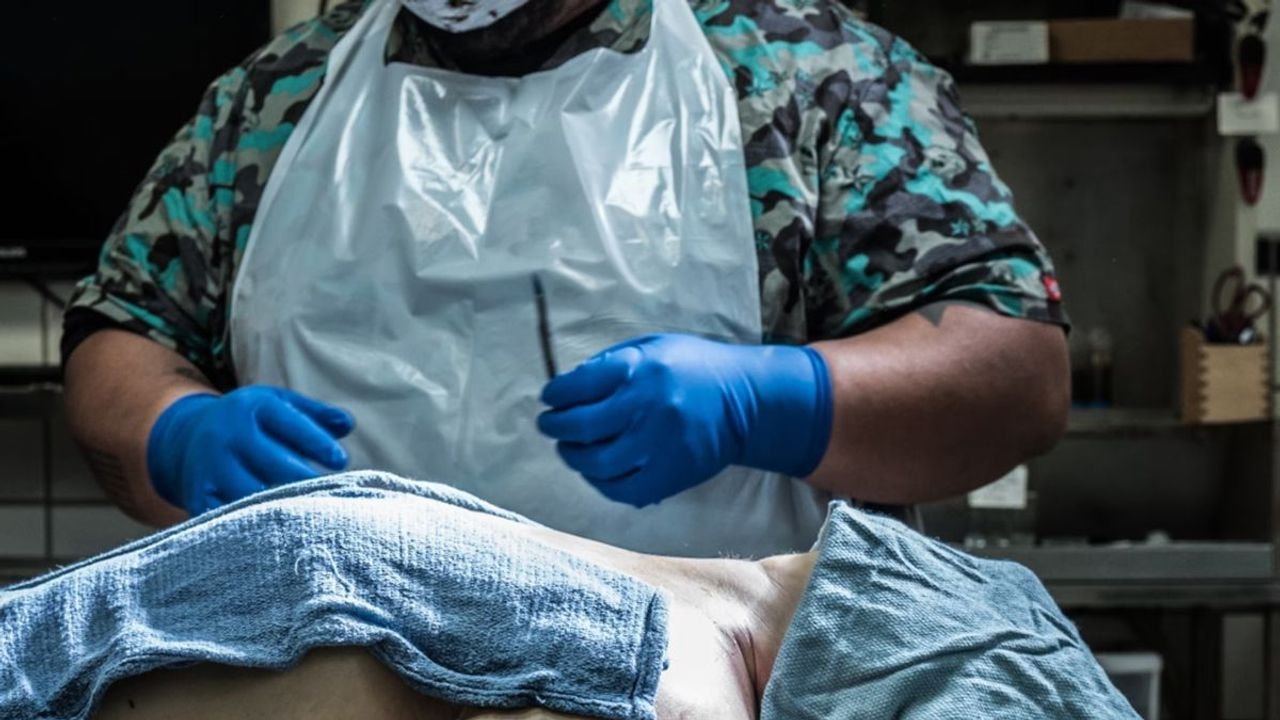
The pathologist will then do an external examination, searching the body surface and recording any visible signs of cause of death or identifying marks. These might include tattoos or scars that can establish or confirm the identity of the deceased.
Photographs of the body can be taken, and body fluids such as urine, blood and vitreous fluid from the eyes are sampled and tested for drugs, poisons or other substances.
In many cases, the cause of death can be determined from the external examination alone and no further examination is necessary.
Other times, more invasive methods are needed.
Organ removal
Evisceration is the important process of removing organs for the pathologist to examine in detail to help determine cause of death.
The most common evisceration technique used in Australia is known as the Letulle method (sometimes called the en masse method), where organs are removed in a single large block that starts at the tongue and throat and extends to the rectum.
The first step of this process involves using a scalpel to make a large incision in the skin known commonly as the y-incision.
This incision extends from behind each ear, or at times, the collar bones, to the mid line of the chest (just above the sternum).
The incision will be extended through the centre of the chest towards the abdomen, stopping at the front of the pelvic bone.
Skin, fat and muscle layers are pulled back to expose the neck structures, abdominal organs and the rib cage. The rib cage will then be cut on each side using shears to allow the front of the chest plate to be removed, revealing the heart and lungs.
After an inspection of the positioning of the organs in the chest and abdomen, the bowel can be removed.
Connections between organs and the body wall are separated and the organ block is then lifted from the body.
Once out, the pathologist can do a detailed examination, weighing each organ individually. They will then dissect it to determine if there are any visible signs of disease or trauma that could have contributed to the cause of death.
Tissue samples will be taken from each organ for histology (studying it under a microscope) to look for evidence of a cause of death.
The brain
A coroner may also request an examination of the brain. This involves an incision across the scalp within the hairline where possible, so the skin can be peeled back to expose the skull.
The top of the skull will be removed using an oscillating saw to access the brain, which will then be removed (after separating it from the brainstem).
The pathologist will look for signs of blood clots, trauma or disease. In some cases, the coroner may make an order to keep the brain for a longer period of time for a more detailed and thorough examination.
After the autopsy is over, the organs are returned to the abdominal cavity and all incisions are stitched closed.
The body can then be released to the family and funeral arrangements made. An interim report on the cause of death is prepared for the coroner and made available to the family.
This will be updated with a final determination on the cause of death after test results come back. Sometimes the cause of death will be listed as “unascertained”, meaning the cause of death could not be determined. (The Conversation)
About the Author