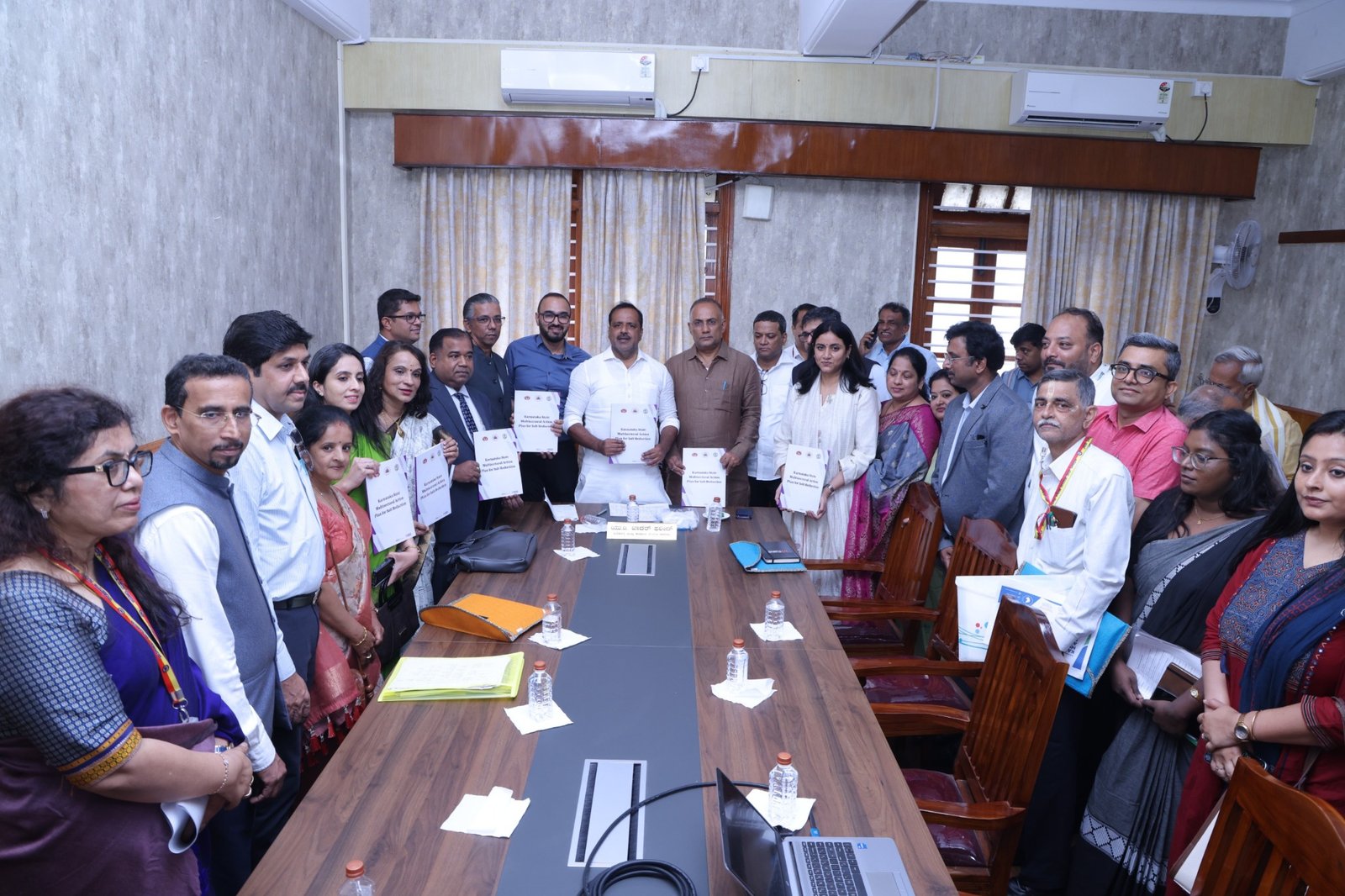
The launch of Karnataka’s salt reduction action plan at Vidhana Soudha. Photo supplied with the press release.
Bengaluru: Karnataka has launched a multisectoral action plan aimed at contributing to a 30% reduction in population salt intake by 2030, with measures covering household cooking, food eaten outside the home and processed or packaged products.
Health and Family Welfare Minister U T Khader released the Karnataka State Multisectoral Action Plan for Salt Reduction and Promotion of Healthy Dietary Habits at a Technical Advisory Group (TAG) meeting at Vidhana Soudha on Tuesday. Former minister Dinesh Gundu Rao and Rajya Sabha MP Mansoor Ali Khan joined the launch, according to a statement on the meeting.
Khader called for a State Steering Committee involving multiple departments to coordinate sustained action on healthier diets and prevention of non-communicable diseases (NCDs).
Three settings, from home kitchens to packaged food
The plan prioritises reducing salt added during cooking and at the table, encouraging healthier food choices, lowering salt in processed and packaged foods, and strengthening dietary counselling through the health system.
The document proposes phased, expert-guided exploration of potassium-enriched low-sodium salt substitutes, subject to safety and feasibility. It also calls for awareness of contraindications for people with advanced chronic kidney disease and other high-risk conditions.
Implementation is intended to build on existing programmes, including salt-reduction measures under PM POSHAN, dietary counselling through Gruha Arogya, and dietary risk-factor counselling under NP-NCD.
The statement said Karnataka’s existing measures concerning foods high in fat, sugar and salt (HFSS) provide a foundation for strengthening healthier food environments. It did not announce a new mandatory salt limit for food products.
Why salt reduction is a public-health priority
The Karnataka action plan cites estimates of average salt intake in India at 8–11 grams a day and notes the WHO recommendation of less than 5 grams a day. It identifies excess sodium intake as a contributor to raised blood pressure and cardiovascular disease. Read the Karnataka State Multisectoral Action Plan for Salt Reduction (PDF), supplied by the Health and Family Welfare Department.
The plan’s 30% figure is a reduction target for population intake by 2030, while the WHO recommendation is a daily intake benchmark for adults. The launch marks the start of coordinated implementation, rather than an announcement that the reduction has already been achieved.
Technical group to guide coordinated action
The TAG is chaired by Dr Bhagavan B C, Vice-Chancellor of Rajiv Gandhi University of Health Sciences (RGUHS). It includes representatives and experts from the Health and Family Welfare Department, Sri Jayadeva Institute of Cardiovascular Sciences and Research, NIMHANS, academic and nutrition institutions, and public-health organisations.
Dr Jnanesh Kamath, Joint Director, Health and Family Welfare, presented the plan’s priorities, objectives and proposed cross-sector actions. Dr Dinesha B contributed to the technical discussion on dietary risks and NCD prevention.
Other participants included Dr Raghunandan, DD-NCD; Dr Amrut Kadam of RGUHS; Dr U S Vishal Rao; Resolve to Save Lives representatives Dr Syed Imran Farooq and Dr Manika Sharma; and Vision for Social Development director Amit Karnik.
The action plan was developed through collaboration among government departments, academic institutions, public-health experts, development partners and civil-society organisations, with technical support from Resolve to Save Lives and Vision for Social Development.
Government plan details school-meal training and departmental roles
The action plan says around 1.08 lakh PM POSHAN cook-cum-helpers have been trained in salt-reduction practices, benefiting nearly 47 lakh students. It also records training of about 100 Anganwadi functionaries as master trainers and around 70 master trainers under the NCD Division.
Its implementation framework assigns the Health and Family Welfare Department responsibility for coordination, workforce training and monitoring salt intake and blood-pressure trends. It proposes nutrition standards for public food settings and work with food businesses on healthier products, alongside household awareness and dietary counselling.
The state strategy encourages voluntary salt reduction by local food manufacturers. The document outlines a programme of coordinated and phased action; these proposals should be distinguished from a newly notified mandatory limit.
About the Author