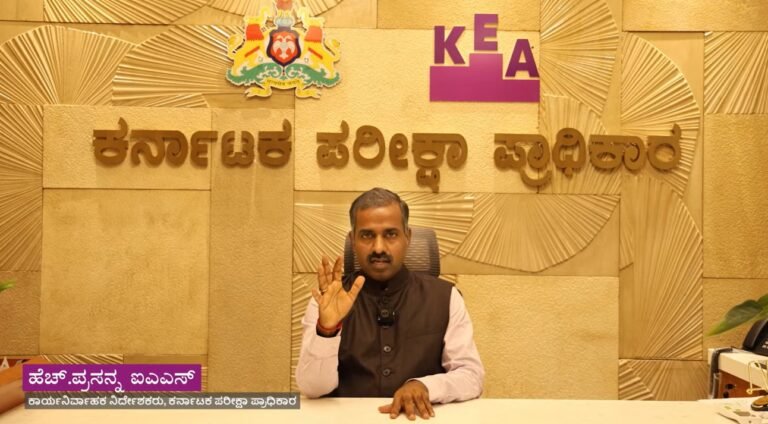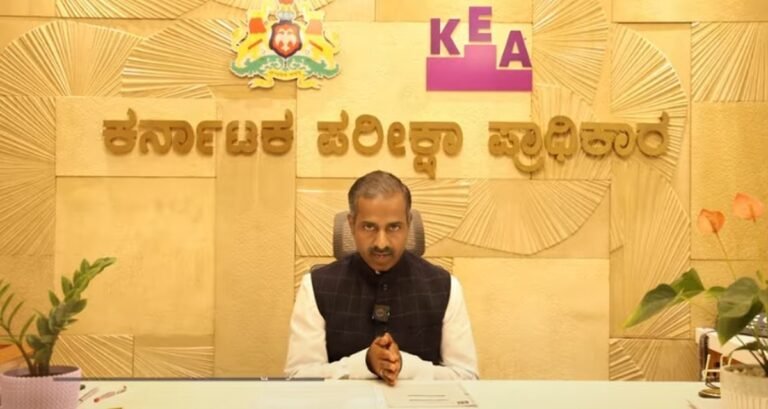
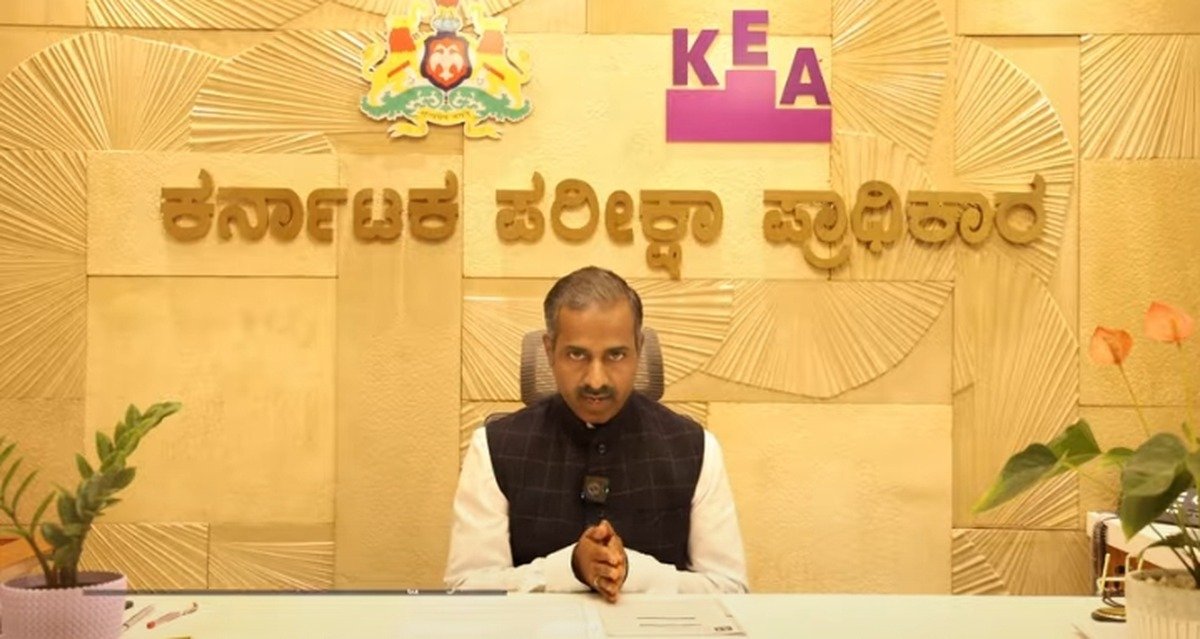
KEA Executive Director H Prasanna in his video message to invigilators and candidates. Screengrab: KEA video
Bengaluru: Invigilators should stay silent and avoid walking about once an examination begins, and candidates should not stay quiet when someone tries to disrupt the hall, Karnataka Examinations Authority (KEA) Executive Director H Prasanna said in a video message, as he explained a new exam-day schedule and OMR sealing procedure that the authority has issued to invigilators in writing.
Prasanna said invigilators and candidates had given many suggestions by email and on the KEA YouTube channel, and that some were being implemented in stages. A key concern, he said, was that candidates must get the full two hours for the paper without disturbance.
Candidates are asked to reach the centre two hours before the exam for facial recognition verification and frisking at the gate. Taking a 10.30 am exam as the example, the first bell rings at 10 am, 30 minutes before the start, and candidates then go to their rooms. Each room holds 24 candidates and both invigilators must already be present at the first bell. They frisk candidates again, check the hall ticket and Aadhaar or another ID, seat them and hand out the OMR sheets straight away, which candidates fill in by about 10.10 am.
The second bell rings at 10.10 am, 20 minutes before the start. The custodian or the staff member designated by the principal then brings the question paper bundles to the room, where they are opened and distributed in the zigzag manner prescribed. Each of the two invigilators takes 12 candidates’ signatures on the nominal roll, which should take no more than about 10 minutes. The third bell marks the start of the exam, and both tasks must be over before it rings. For an afternoon exam the same process begins at 2.30 pm for a 3 pm start.
After the third bell, Prasanna said, invigilators should move about silently and not talk to each other, because front-row candidates are disturbed when nominal rolls are carried around mid-exam. Observers, custodians and the centre chief who walk in should also not talk in the classroom. “Every question and every minute is important for our students,” he said, urging invigilators to stay alert for the first 30 minutes and then keep to a “vow of silence” for the two hours.
The seventh bell marks the end of two hours. Candidates then get five minutes to mark the fifth bubble for questions they have not answered, so that no negative marks are awarded, and the eighth and final bell follows. Prasanna said leaving the fifth circle blank leads to a mark deduction and asked invigilators to follow the authority’s rules on this.
Earlier, the replica copy was sealed in the classroom while used OMR sheets from all rooms were opened, counted and packed together in the principal’s room, which raised doubts among candidates, Prasanna said. From now on, two tamper-evident covers will be given for each room, one for the replica copy and one for the used OMR sheets of the candidates present, both sealed in the classroom in front of candidates. They will not be reopened in the principal’s room and will be sent in a larger sealed cover. The used OMR sheets will be opened and scanned at the district scanning centre in the presence of the Deputy Commissioner before results are put on the website, he said. Candidates should not doubt the packing, which sometimes has seven, 10 or even 12 layers, he added.
Prasanna cited a recent incident at a centre in a district he did not name, where one candidate raised a ruckus over a minor scratch on the outer tamper-evident layer of the question paper packing, though three more layers were intact. According to him, distribution was delayed by 25 to 30 minutes and other candidates stayed silent. The Deputy Commissioner gave no extra time because the lapse was not the administration’s, he said, adding that the authority has sought reports, has received CCTV footage from the district administration and is considering a permanent ban on those involved.
Prasanna asked honest candidates not to be “silent spectators” and to stand with invigilators and the exam centre staff when someone tries to spoil an exam. He urged candidates who feel there is a lapse to raise it through the proper forums and not to confront invigilators in the classroom, or post doubts on social media as facts. He said the authority’s newly framed rules have been published, and that candidates who do not intend to write the exam should not come to the centre.
Also read:
- KEA Ready for Residential School Teacher, Warder Exams From November 27 to 30; Candidates to Be Verified by QR Code
- KEA Orders VAO Exam Probe; Says Identity and OMR Checks Were in Order
About the Author