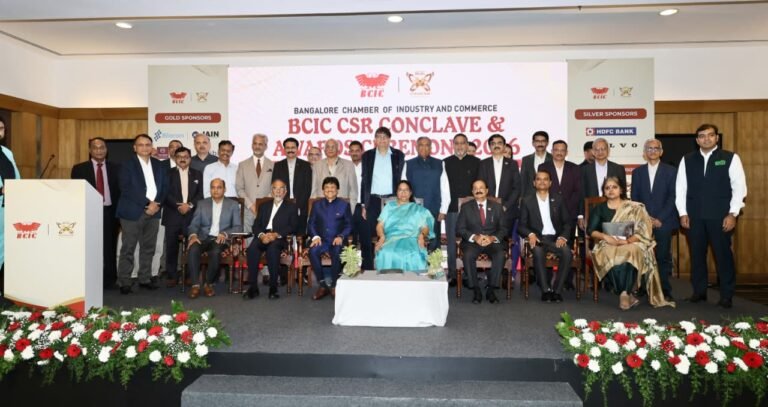
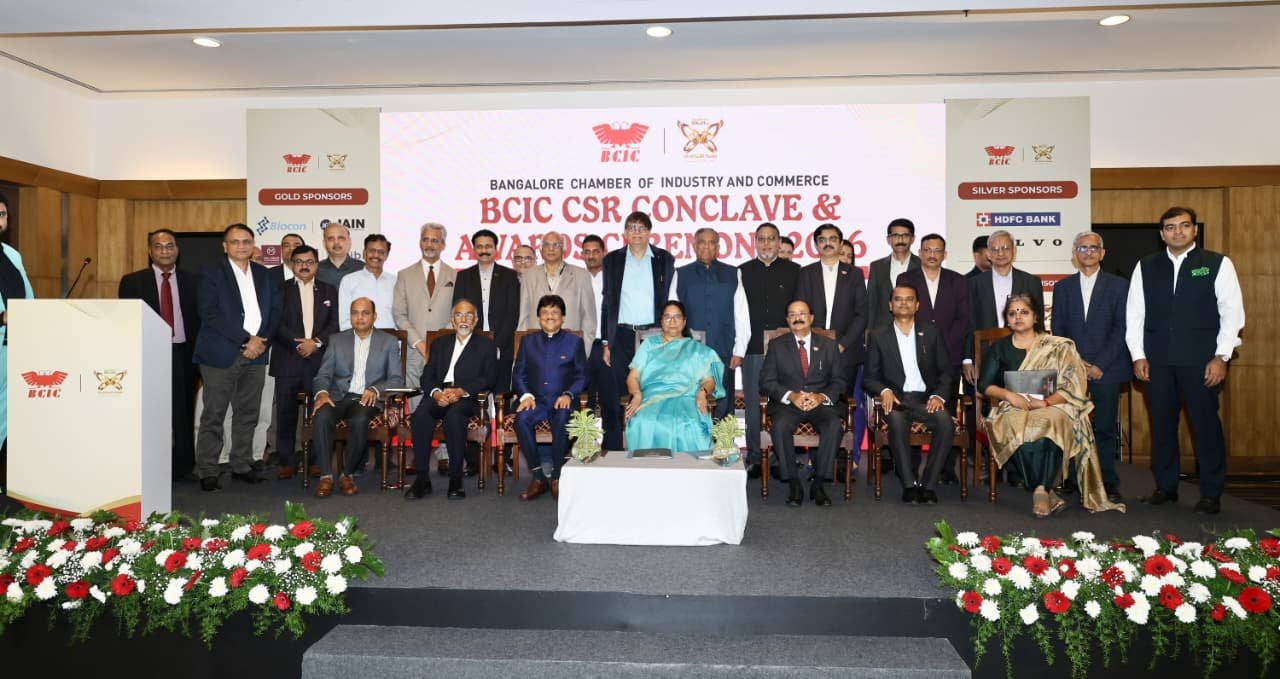
Participants at the BCIC CSR Conclave and Awards Ceremony 2026 in Bengaluru. Photo: Supplied
Bengaluru: Governor Dr Sudha Yadav said corporate social responsibility (CSR) should be an investment in the future of society and in building a developed India, and not only a legal obligation, according to a press release dated November 27.
She was speaking at the golden jubilee of the Bangalore Chamber of Industry and Commerce (BCIC) and the BCIC CSR Conclave and Awards 2026 in Bengaluru. Every industry should have the spirit of returning to society the wealth it has received from it, she said.
Citing the Sanskrit saying “Paropakaraya satam vibhutayah”, the Governor said the idea that the wealth of good people should be used for society’s welfare has been part of the tradition for centuries, from Kautilya’s Arthashastra to the Vedic principles of dana and dharma. In Karnataka, ancient merchant guilds contributed to temples, stepwells, lakes and educational institutions, and Basavanna’s 12th-century principles of kayaka and dasoha are apt models for CSR today, she said, adding that Mahatma Gandhi’s trusteeship theory holds the same idea.
Government efforts alone cannot realise “Sabka Saath, Sabka Vikas”, and the active partnership of society and the corporate sector is needed, she said. Quoting J.R.D. Tata, she said the basic spirit of CSR should be to return to society many times what is taken from it.
India has taken important steps in CSR, but challenges remain, including uneven distribution of funds, limited participation by small and medium industries, and a lack of proper assessment of the long-term impact of projects, the Governor said. She called on industry bodies and industrial associations to work together to address them.
Sharing her experience, she said industries are doing good work under CSR in women’s empowerment, women’s health, education, school development and tree planting. But starting projects is not enough, she said; maintaining them until the expected results are achieved matters more. Many saplings planted do not survive for lack of upkeep, and in Karnataka, where summer temperatures can rise to 40 to 48 degrees Celsius, planting must be followed by continuous care, she said.
Merely releasing funds or spending money cannot bring social change, she said. Projects need continuous monitoring and evaluation from the stage they start to their final impact, and only then can CSR funds be put to proper use.
Referring to what she saw in remote rural and tribal areas of Karnataka, the Governor said many areas still need basic facilities and development opportunities, and that the living standards, education and social progress of tribal communities need more attention. Industries and industry bodies should think beyond their own spheres about the state’s backward and remote areas, she said.
Instead of each taking up separate projects, companies could jointly choose a few key areas and carry out integrated development projects there, she suggested. They should identify needs, set development goals, implement projects in stages and keep analysing where a project began, how much progress it has made and how many people have benefited. Only such result-based working can fulfil the real purpose of CSR, she said.
The Governor called on the industry sector to understand its social responsibility and make a meaningful contribution to the dream of a developed India through CSR, saying the responsibility of building a nation with better opportunities, equality and sustainable development for the next generation lies with everyone.
Also read:
About the Author