Karnataka Sets $1 Trillion Economy Target by 2037; DK Shivakumar Unveils Growth, Jobs and Social Development Blueprint
Bengaluru, September 10: Karnataka has set a target of expanding its economy to $1 trillion by 2037, with Chief Minister D.K. Shivakumar unveiling a long-term blueprint that combines industrial investment, employment generation, artificial intelligence, Bengaluru’s development, regional growth, water security and social welfare with goals to reduce malnutrition below 5% and bring child dropouts and poverty down to zero.
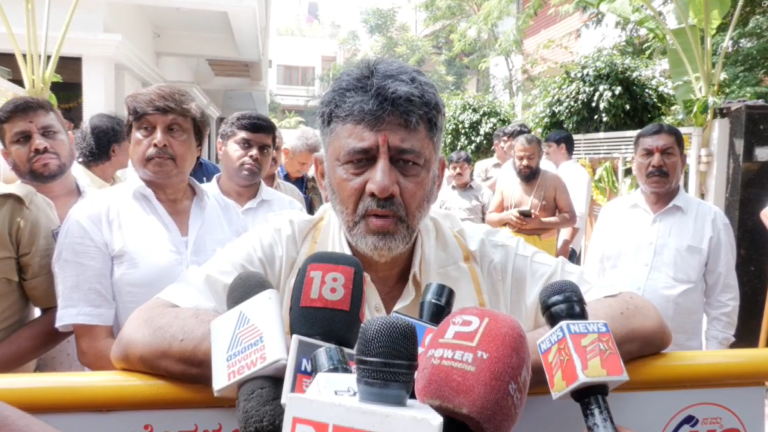
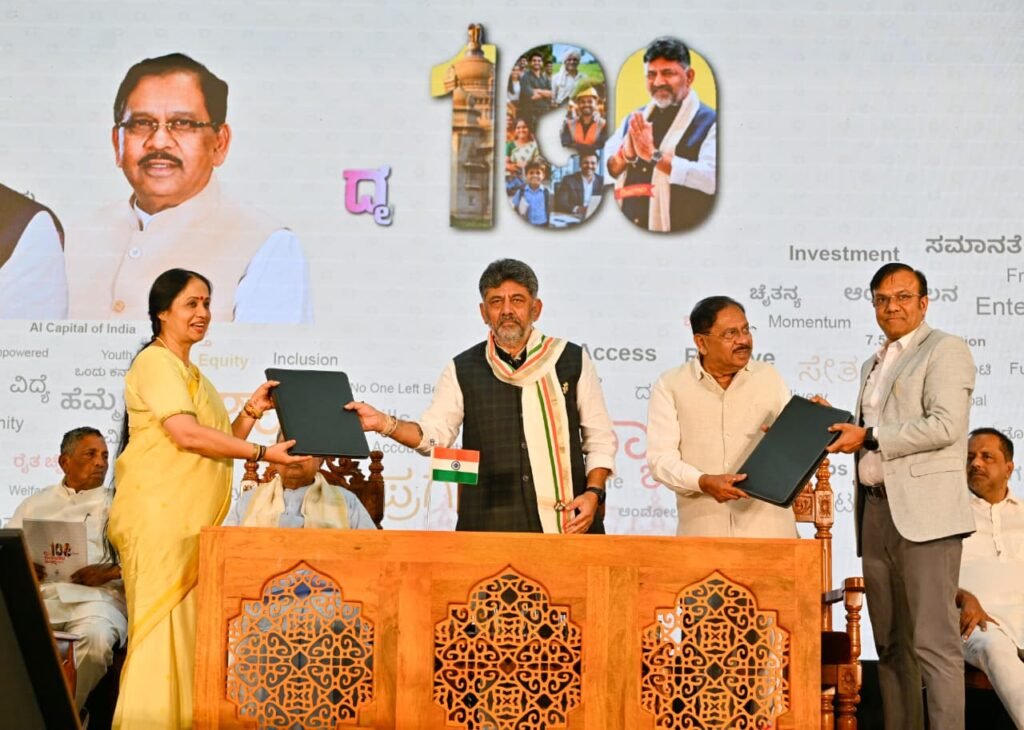
Unveiling the “Strong Karnataka” blueprint at the “Strong Karnataka Sankalpa: Shatakada Patha, Pragathiya Ratha” programme at the Banquet Hall of Vidhana Soudha on Thursday, marking 100 days since he assumed office, Shivakumar said his vision was not merely to make Karnataka the fastest-growing state in the country but to build it as a model for India’s future.
“We have made grand resolves to take Karnataka’s economy to $1 trillion by 2037, to bring malnutrition below 5%, and to bring child dropouts and poverty down to zero,” Shivakumar said. Responding to questions about whether the targets were achievable, he said he would attempt only what he believed could be delivered, pointing to the implementation of the five guarantee schemes after questions had earlier been raised over their feasibility.
The Chief Minister said the new roadmap would give priority to health, education, water security, investment and economic strength, Bengaluru’s development, regional balance, social justice, capital investment and employment.
Shivakumar said the government’s development approach would be based on collective participation and constitutional governance. He said all 224 MLAs, 75 MLCs, 28 Lok Sabha members and 12 Rajya Sabha members should work together for Karnataka’s progress, irrespective of political differences.
Calling the administration a government of the state’s seven crore people, he said Karnataka’s land, the labour of its people and the aspirations of its youth formed the basis of the “Strong Karnataka” resolve.
A major component of the economic strategy is accelerated industrial investment. Shivakumar said investment proposals worth ₹43,214 crore had been approved during his first 100 days in office. The government plans a special accelerator package for investments in backward taluks as part of an effort to spread industrial growth beyond established centres.
Under the Shramika Nivas initiative, permission has been given to use 15-20% of land near industrial areas for housing workers. The government is also planning a textile policy and a jeans park in Ballari and has framed Aerospace and Defence policies, he said.
Shivakumar said a ₹20,000-crore production cluster spread over 4,000 acres had been approved in Doddaballapur. A separate ministry for non-resident Indians would also be created with the objective of attracting overseas investors.
The government’s “Beyond Bengaluru” approach will seek to distribute economic activity outside the capital. Coastal and Malenadu tourism policies are being framed, while five global technology centres are proposed in Kalaburagi, Belagavi, Hubballi-Dharwad, Mangaluru and Mysuru.
Technology and artificial intelligence are another pillar of the plan. Shivakumar said Karnataka had decided to establish what he described as India’s first government-sponsored AI university and introduce AI education for students from Class 6 to prepare the next generation for emerging technologies.
The government is also seeking to expand employment opportunities outside Bengaluru. Under the Udyoga Nidhi scheme, Shivakumar said ₹2,500 per job would be paid to those creating private-sector employment in rural areas outside Bengaluru. Through Yuva Udyoga Setu, the government plans job-exchange centres to match candidates with private-sector vacancies and provide training based on skills required by employers.
Shivakumar also announced a large youth mobilisation programme under Bharat Jodo Yuva Sangha. He said 10,000 associations would be established across Karnataka to encourage rural youth talent, leadership and efforts towards a drug-free state. Each association is proposed to receive an annual grant of ₹10 lakh, with ₹1,000 crore earmarked for the initiative. Offline applications were made available from Thursday, and the government expects at least 25 lakh members to register.
For rural students, Shivakumar said the government would provide an additional 7.5% reservation in higher education for students who studied in government schools, within the existing 15.5% reservation for rural students.
The government also plans to upgrade 1,000 government schools at the panchayat level into Karnataka Public Schools to reduce the need for families to migrate to cities in search of quality education. Shivakumar said the schools would be developed using CSR funds and that 1,000 schools would be built across the state this year with World Bank support. He cited 20 schools built in his district at a cost of ₹12-15 crore each.
Agriculture and drought resilience also form part of the blueprint. Shivakumar said farmers were facing distress because of drought and noted that Karnataka has a large extent of dry land.
Under the Chief Minister’s Negila Yogi scheme, farmers holding less than three acres are to receive subsidised ploughing services at lower rates using available tractors. The Gramanubhava programme has been introduced to expose urban students to village life.
Under the Tegada Siri initiative, teak saplings will be planted along roadsides and farmers entrusted with maintaining them. Once the trees mature and are ready for harvest, Shivakumar said 70% of their value would go to the farmer and 30% to the government.
Housing and land access for disadvantaged families form another part of the plan. Shivakumar said the government had decided to provide free houses and sites to homeless Dalit and tribal families in rural areas and distribute five lakh sites to landless rural families.
Roads, drains and streetlights in Dalit colonies would be upgraded. The government also plans to facilitate self-employment for 50,000 youth from Dalit, tribal, backward class and minority communities within two years and establish entrepreneurship and skill-development training centres for minority youth.
In health, Shivakumar said Tele-ICUs would be established in all taluks. He also referred to the Aarogya Spandana programme and said the government had decided to develop 1,000 burial grounds across Karnataka, drawing on the “Muktivana” model associated with H.K. Patil’s constituency.
The government also plans to take administration closer to citizens through the Praja Seva department. Shivakumar said 30,000 applications had been received at the programme he launched, covering issues such as pensions, podi, khata, sites and other public services.
He directed ministers to conduct the campaign in their districts and said MLAs should go to the panchayat level to address public problems. Where MLAs do not go, officials should reach citizens and respond to their grievances, he said.
Shivakumar described land-related reforms as the government’s “sixth guarantee”. He said 26 lakh property records in Bengaluru were being scanned and digitised, while more than one crore property records across Karnataka were being digitised into podi records.
Water security will remain a priority, he said, adding that the government would take all necessary steps on the Mekedatu project. Referring to the Mahadayi project in North Karnataka, Shivakumar said some hurdles remained and questioned the efforts of Union ministers and MPs to resolve them, adding that the state would continue its fight on the issue.
The Chief Minister also announced an ambition to develop five parks modelled on Lalbagh and said the government was prepared to take up such projects on Forest Department land.
Reviewing his first 100 days, Shivakumar said the government had on its first day approved free bus passes for all students, announced 10,000 Bharat Jodo Yuva Sanghas, provided occupancy certificate exemption for buildings up to 2,400 sq ft, approved CC exemption and extended B-khata to A-khata conversion across Karnataka.
He said the government had also begun the process of filling 72,000 vacant government posts and approved ₹2,000 crore for Bengaluru road development. An Anti-Rowdy Squad was subsequently constituted to act against organised crime, goondagiri and extortion, he added.
On interstate water issues, Shivakumar cited the inauguration of all 33 new gates of the Tungabhadra Dam, where the Chief Ministers of Karnataka, Telangana and Andhra Pradesh came together under the leadership of the Union Jal Shakti Minister. He described the occasion as one of the most satisfying moments of his life.
He also referred to the South Zonal Council meeting at Mahabalipuram, saying Karnataka and other southern states had raised issues including fair tax distribution, water rights and protection of their political influence.
Shivakumar used the 100-day event to review the government’s record over the previous three years. He said ₹1,45,416 crore had been provided through the five guarantee schemes, describing them as a major social-security intervention.
According to the figures presented by the Chief Minister, ₹76,951 crore has been provided to 1.24 crore women under Gruhalakshmi, amounting to ₹66,000 per woman so far, though two months’ instalments remain pending. Under Gruha Jyothi, 1.67 crore households have been covered at an expenditure of ₹30,522 crore.
Under Anna Bhagya, 4.44 crore people receive 10 kg of rice a month and ₹21,054 crore has been spent. Shivakumar said women had undertaken free travel worth ₹821 crore under Shakti, while expenditure on the scheme stood at ₹15,735 crore. Under Yuva Nidhi, ₹1,154 crore had been provided as unemployment allowance to 3.72 lakh youth.
He said the government had directly credited ₹1,41,210 crore to the accounts of 2.70 crore beneficiaries. The SCP/TSP allocation for the current year stood at ₹42,018 crore, while ₹25,652 crore in zero- and low-interest loans had been provided to 28.63 lakh farmers this year.
The state has approved 121 irrigation projects worth ₹17,073 crore, while the annual allocation for the development of Kalyana Karnataka has been increased from ₹3,000 crore to ₹5,000 crore, Shivakumar said.
In healthcare, 88 lakh people had received doorstep health check-ups under Gruha Aarogya, while 21,659 heart attack cases had been detected under Hrudaya Jyothi before a mishap occurred, according to the Chief Minister. Eggs are also being distributed to schoolchildren six days a week to improve nutrition.
Shivakumar said Karnataka had attracted ₹2.53 lakh crore in capital investment over the past three years and stood second in the country in attracting foreign investment. He said more than six lakh jobs were likely to have been created during the period.
The state’s GDP has reached ₹32.81 lakh crore with growth of 8.1%, which Shivakumar said was above the national growth rate. The government’s longer-term ambition is now to build on that economic base and take Karnataka to the $1 trillion mark by 2037.
Shivakumar said the “Strong Karnataka” goal was to build a state that is economically strong, socially empowered, technologically advanced and rooted in values. Describing himself as a public servant, he sought public cooperation for corruption-free administration.
He also said a special session had been called to discuss farmers’ issues and the Kasturirangan report.
About the Author