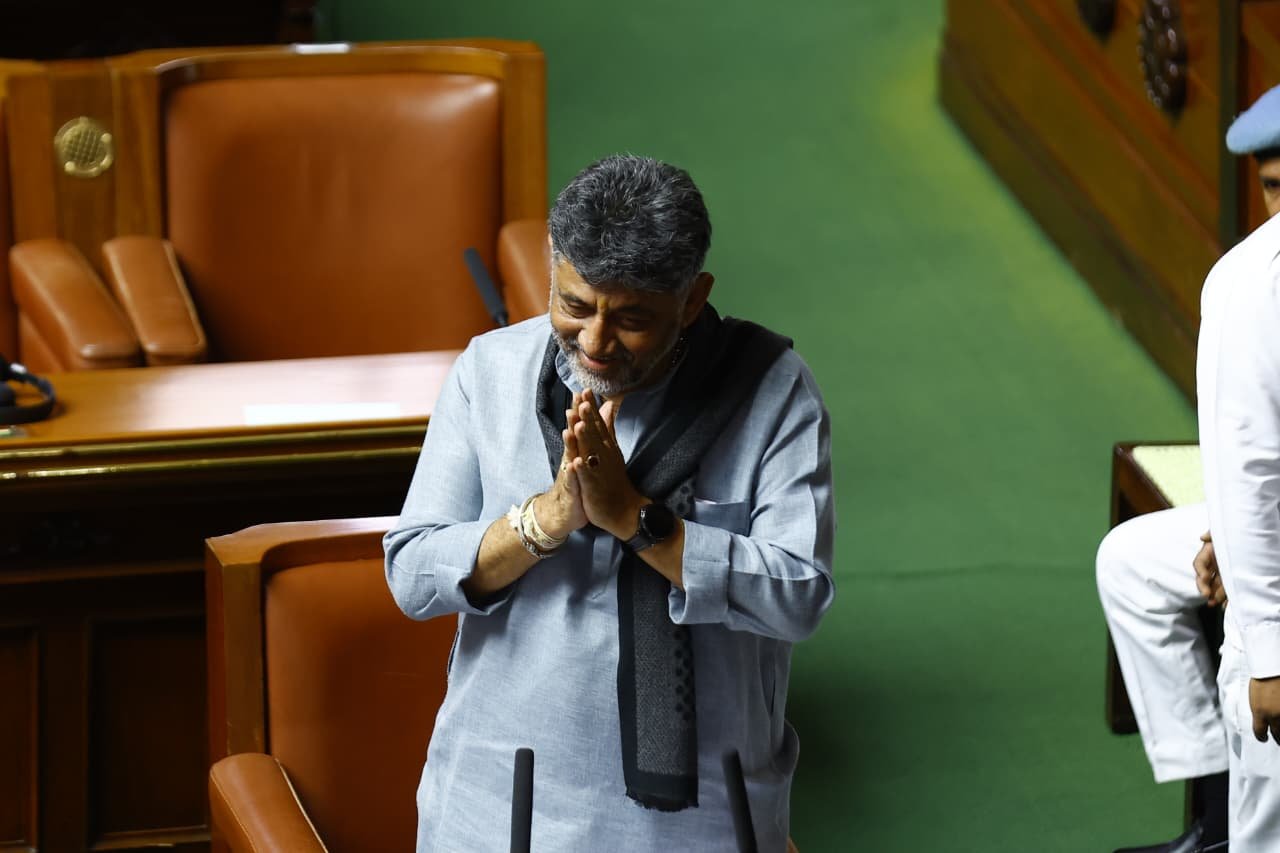
D K Shivakumar in the Legislative Assembly. Photo supplied with the report on the Kasturirangan resolution.
Bengaluru: Both Houses of the Karnataka legislature on Tuesday unanimously adopted a resolution backing a high-level committee headed by a retired judge to examine shortcomings in the Kasturirangan report and recommend changes, along with a request to the Centre for one year to conduct village-wise and survey-number-wise ground surveys.
The resolution also backed an all-party delegation to the Centre. Chief Minister D K Shivakumar presented the proposals while replying to the debate on the draft notification in the Legislative Assembly and Legislative Council, according to a statement issued on the proceedings.
In the Assembly, Leader of the Opposition R Ashoka supported the official resolution presented by Shivakumar after the debate that began on Monday. It was then adopted unanimously by voice vote, according to a further account of the proceedings.
The state will ask the Centre not to finalise the draft notification before detailed discussions and the proposed assessment. The one-year period is a request Karnataka plans to make; the statement does not announce approval of an extension by the Centre.
Ground survey to distinguish forests, farms and settlements
Shivakumar said the proposed committee would include Revenue and Forest Department officials, representatives of farmers, industry and business, forest and environment experts, and specialists from academic institutions. Committees would also be formed at gram panchayat level.
Several members suggested following Kerala’s approach to surveys. Shivakumar said the state would undertake physical measurements at village level, survey number by survey number. Gram panchayat committees including elected representatives would assist the state-level panel.
Its task would be to recommend a scientific separation of ecologically sensitive areas, forests, agricultural and horticultural land, and inhabited areas through physical surveys. Village-level mapping would identify houses, schools, plantations, drinking-water infrastructure and electricity poles.
The resolution seeks to limit ESA inclusion to notified and other forest areas, excluding agricultural land, horticultural and plantation areas, settlements and spaces used for public activities. It also calls for guidelines on alternative livelihoods and financial assistance for farmers and workers affected by ESA designation. These are demands the state will put to the Centre.
The Chief Minister said Karnataka could not accept the seventh draft notification in its present form. According to the figures he cited, the July 27, 2026 draft identifies 20,668 sq km across 1,449 villages in 10 Karnataka districts.
He criticised the satellite-based assessment as unscientific, arguing that forests and agricultural or plantation areas can appear similarly green in satellite images. Declaring an entire village ecologically sensitive because one-fifth of it is forest was not a scientific approach, he said.
Shivakumar said residents were concerned about possible difficulties involving housing, inheritance, farming, roads, schools, hospitals and water pipelines. These were concerns raised in his remarks, rather than a finding that every such activity is prohibited under the draft.
All-party delegation to take state position to Centre
The Chief Minister said there was agreement on taking an all-party delegation to meet the Prime Minister and Union ministers. He called on Karnataka MPs across parties to jointly present the state’s position and said a date for the delegation would be fixed soon.
He said representations from farmers had been received and the views of 30 legislators brought together during the special session. The government’s position was that the Western Ghats’ environment, biodiversity, rivers and wildlife must be protected while safeguarding the livelihoods of farmers and local families.
Existing rights and pending cases to be examined
Shivakumar said the government did not favour displacing or harassing farmers, plantation growers, tribal communities and families who had lived in these areas for generations. He said already granted land should not be included and evictions should not take place without rehabilitation proposals.
Before action against residents, matters involving unauthorised cultivation regularisation, forest rights, deemed forests, land grants, appeals and pending court cases should be examined, he said. A meeting on implementation of the Forest Rights Act would be held immediately.
At the same time, fresh forest encroachments must stop, he said. Cameras, modern technology and systems to monitor elephant movements were being used for wildlife protection and to reduce human–wildlife conflict.
Earlier: G Parameshwara sought an all-party consensus on Karnataka’s reply to the Centre.
About the Author