
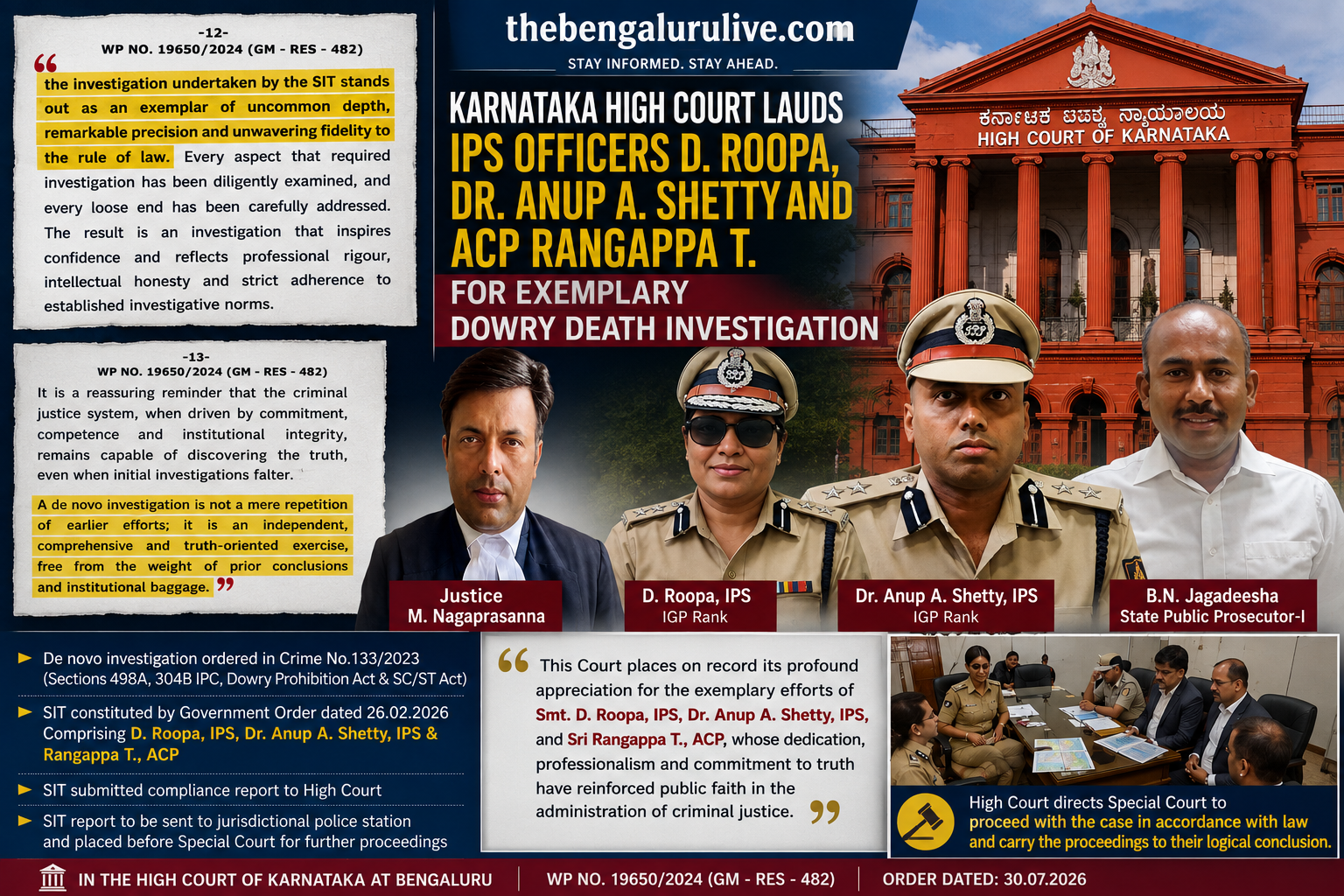
Karnataka High Court Lauds IPS Officers D. Roopa, Dr. Anup A. Shetty and ACP Rangappa T. for Exemplary Dowry Death Investigation
Bengaluru: The Karnataka High Court has lauded the work of a three-member Special Investigation Team (SIT) that conducted a de novo investigation into a dowry death case, describing its probe as one of “uncommon depth, remarkable precision and unwavering fidelity to the rule of law.” The Court observed that the investigation had restored confidence in the criminal justice system and directed that the SIT’s final report be placed before the jurisdictional Special Court for further proceedings.
Justice M. Nagaprasanna, while passing the order in Writ Petition No. 19650/2024 (GM-RES-482) on July 30, 2026, noted that the petition had been filed by the de facto complainant seeking not merely a change of the investigating agency but a fresh investigation into Crime No. 133/2023, alleging that the earlier probe had failed to inspire public confidence. The case pertains to offences under Sections 498A and 304B of the Indian Penal Code, read with Sections 3 and 4 of the Dowry Prohibition Act, 1961, along with provisions of the Scheduled Castes and Scheduled Tribes (Prevention of Atrocities) Act, 1989.
The Court recorded that one of the accused was a police officer, which had led the petitioner to express apprehensions over the fairness of the original investigation. Accepting these concerns, the High Court had earlier, on January 30, 2026, partly allowed the writ petition and ordered a de novo investigation by a three-member Special Investigation Team headed by a woman IPS officer not below the rank of Inspector General of Police. The Court had also directed that all investigation papers be handed over to the SIT, the fresh probe be completed within four months, and the final report be submitted before the competent court. Proceedings in the pending Special Case No. 1921/2023 were stayed until submission of the SIT report.
Pursuant to those directions, the Karnataka Government constituted the SIT through an order dated February 26, 2026, comprising Smt. D. Roopa, IPS, Dr. Anup A. Shetty, IPS, and Sri Rangappa T., ACP. The team undertook a comprehensive reinvestigation and submitted its compliance report before the High Court.
In its latest order, the High Court observed that the compliance report reflected an investigation carried out with exceptional professionalism. Justice Nagaprasanna said the probe demonstrated “uncommon depth, remarkable precision and unwavering fidelity to the rule of law,” adding that every aspect requiring investigation had been diligently examined and every loose end carefully addressed. The Court further noted that the report reflected professional rigour, intellectual honesty and strict adherence to established investigative norms.
The Court further remarked that the work undertaken by the SIT was a reassuring reminder that the criminal justice system, when driven by commitment, competence and institutional integrity, remains capable of discovering the truth despite deficiencies in earlier investigations. It observed that a de novo investigation should not be treated as a mere repetition of previous efforts but as an independent, comprehensive and truth-oriented exercise, free from earlier conclusions and institutional baggage.
Justice Nagaprasanna placed on record the Court’s “profound appreciation” for the exemplary efforts of D. Roopa, IPS, Dr. Anup A. Shetty, IPS, and Rangappa T., ACP, stating that such investigations reinforce public faith in the administration of criminal justice and uphold the constitutional promise that truth should not become a casualty of circumstances. The Court also appreciated the assistance rendered by State Public Prosecutor-I B.N. Jagadeesha during the post-investigation proceedings.
The High Court directed that the SIT report be transmitted to the jurisdictional police station through the competent authority for placing it before the jurisdictional Special Court, particularly in view of the offences under the SC/ST (Prevention of Atrocities) Act. It further directed the Special Court to proceed with the case in accordance with law and carry the proceedings to their logical conclusion.
About the Author