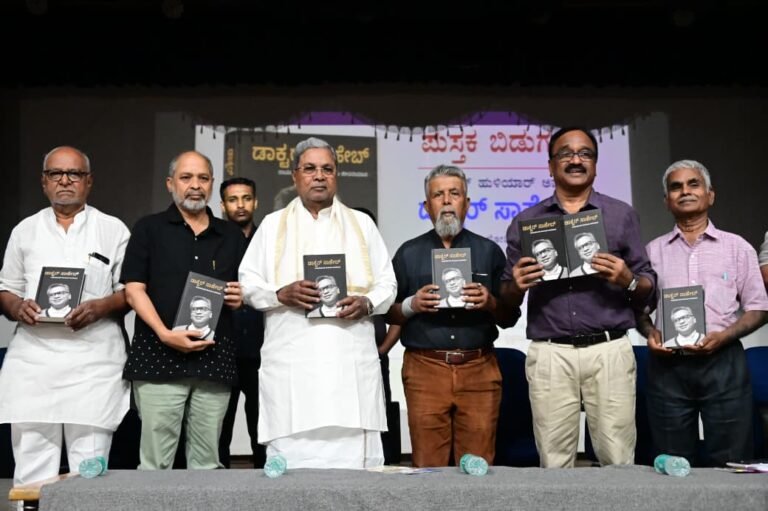
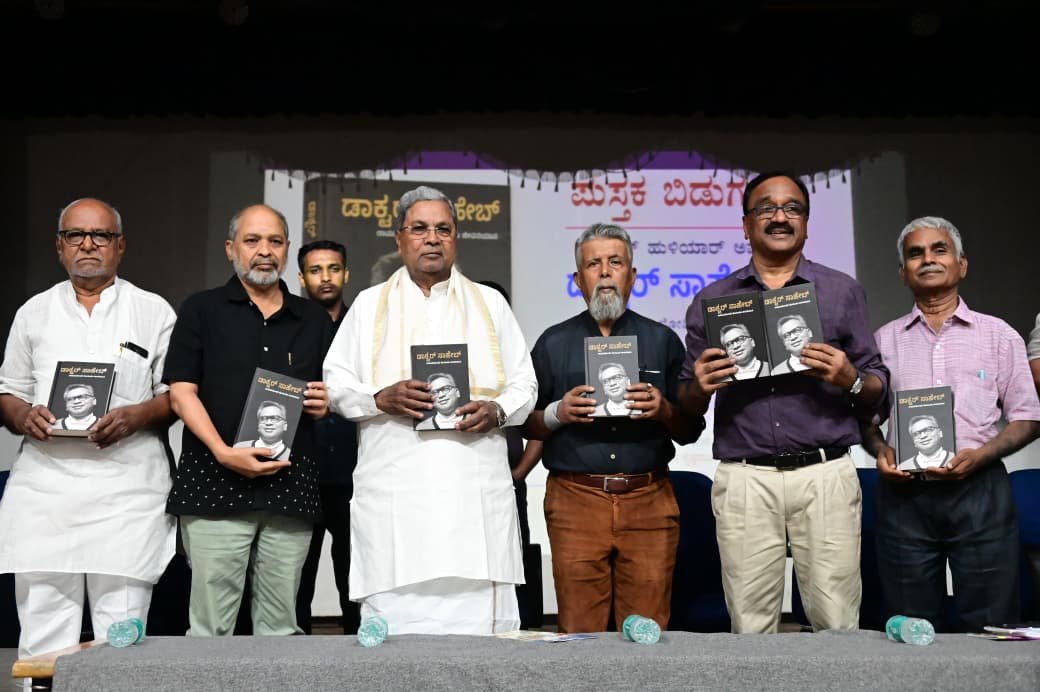
Siddaramaiah at the launch of Doctor Saheb in Bengaluru.
Bengaluru: Former Karnataka Chief Minister Siddaramaiah said his government’s guarantee schemes were an effort to reduce economic inequality and put Ram Manohar Lohia’s ideas into practice, arguing that an equal society cannot be built without tackling caste discrimination and unequal access to opportunities.
Speaking at the October 12 launch of writer and critic Dr Nataraj Huliyar’s book Doctor Saheb, on Lohia’s life, Siddaramaiah said social and economic empowerment was essential to changing a caste system that had resisted reform for centuries.
Social justice through equal opportunities
Although he was in the Congress, Siddaramaiah said he had tried to bring Lohia’s socialist thinking into governance. He identified decentralisation of power, removal of gender discrimination, social equality and justice for disadvantaged communities as central aims of that thinking.
He said backward classes, Dalits, women, Adivasis and minorities needed adequate representation in political parties and governments. Referring to B.R. Ambedkar’s ideas, he stressed education, economic empowerment and social representation for communities denied opportunities.
In his assessment, movement between economic classes was possible, but caste restricted social mobility. The guarantee schemes, he said, were part of an attempt to narrow economic gaps and create conditions for greater equality.
Nanjundaswamy’s influence on his political journey
Siddaramaiah recalled meeting Professor Nanjundaswamy in 1971 while studying at Sharada Vilas Law College in Mysuru. Discussions with students on politics, society and social change influenced him, and Nanjundaswamy encouraged him to enter politics and introduced him to Lohia’s ideas.
He said he joined the Samajwadi Yuvajana Sabha through Nanjundaswamy and sold Manava, the Kannada edition of the Lohia-edited journal Mankind, in Mysuru. Those experiences helped shape his political outlook.
Recounting his career, he said he became a lawyer in 1972, remained with the Socialist Party until 1977 and later worked as the Janata Party’s Mysuru district general secretary and in its taluk-level organisation. He recalled financial difficulties during his 1980 Lok Sabha contest and his election to the Assembly as an independent in 1983.
He expressed the view that the Janata Party could have retained a stronger political base in Karnataka had it not split.
A call to young people, students and women
Siddaramaiah recalled Lohia’s links with Karnataka, including his 1951 visit to Kagodu, and the influence of socialist thought on political, literary and social figures in the state.
Invoking Basavanna’s message of inclusion, he said caste discrimination persisted despite the message being roughly 850 years old. People denied opportunities could not fairly be judged on ability alone, he argued.
He urged young people to understand the ideas of Ambedkar, Jayaprakash Narayan and Vinoba Bhave alongside socialist thought. Social change required an understanding of society’s internal inequalities, he said.
Congratulating Huliyar for three years of work on the book, Siddaramaiah said the author was a thinker with a deep understanding of society. He hoped the book would encourage students, young people and women to reflect on social change and work towards Lohia’s vision of an equal society.
About the Author