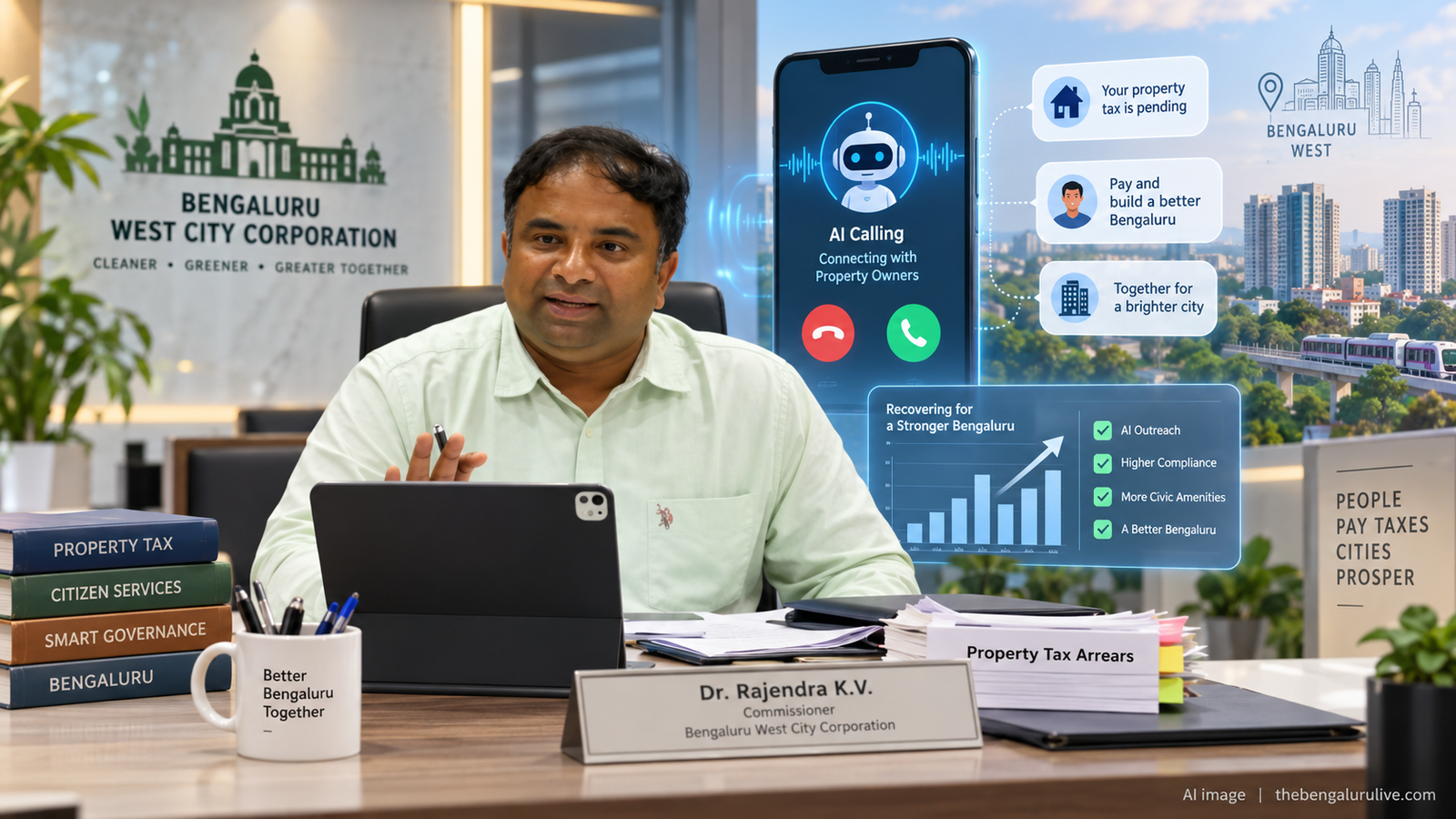
AI image | thebengalurulive.com
Bengaluru: Bengaluru West City Corporation has deployed artificial intelligence at an unusual scale to chase property-tax arrears, making 4,54,908 automated calls across 64 wards and getting 26,962 property owners to commit to payments linked to ₹35.11 crore in outstanding dues.
The AI-led recovery campaign, conducted between March and June, reached 59,604 property owners in Kannada and explained how much tax they owed, from which year the amount had been pending and how the dues could be paid online.
The corporation said the initiative was designed for three kinds of taxpayers: those who did not know they had pending property tax, those who had forgotten to pay and those who had allowed arrears to remain unpaid for several years.
Instead of relying entirely on officials to make repeated calls, the corporation used an AI voice agent capable of contacting defaulters twice a day.
The scale is significant: 4,54,908 calls were made within Bengaluru West City Corporation alone, covering 64 wards from the earlier 198-ward structure.
26,962 Owners Agree to Pay
The strongest outcome from the campaign was the response from property owners who agreed to clear their dues.
According to the corporation, 26,962 property owners committed to paying outstanding tax amounting to ₹35.11 crore.
Among them, 10,303 gave a specific date by which they would make the payment, while 5,747 said they would pay soon.
The AI system therefore worked not only as a reminder mechanism, but also as a first-level recovery interface that could identify taxpayers willing to pay and separate them from cases requiring deeper follow-up.
AI Takes Over First-Level Follow-Up
The corporation said that identifying defaulters was not the main challenge. Reaching them individually, repeatedly and within one tax cycle was the bigger administrative problem.
Making lakhs of calls manually would have required a call centre larger than the entire tax establishment and could have diverted Assistant Revenue Officers from field surveys, verification and recovery work.
By shifting the first stage of follow-up to AI, officers could focus on more complex and high-priority cases instead of spending time on routine reminders.
This is one of the most important operational changes in the programme: AI is being used as a filtering layer before human intervention.
Database Cleanup Becomes a Side Benefit
The campaign also helped the corporation clean up its property-tax contact database.
During the exercise, 17,314 inactive phone numbers were identified.
Another 6,315 numbers were found to belong to other people, including previous property owners, allowing those records to be flagged for correction.
The exercise also established that 4,577 properties had no outstanding tax dues.
That meant those taxpayers could be spared unnecessary notices and follow-up.
The AI campaign therefore produced a second benefit beyond recovery: it exposed outdated contact information and incorrect tax-status records.
Kannada Calls Explain Exact Dues
The automated calls were conducted in Kannada, allowing the corporation to reach property owners in their own language.
The voice agent explained the exact outstanding amount, the period from which the tax had remained unpaid and the online payment process.
Bengaluru West City Corporation Commissioner Dr. Rajendra K.V. said the administration already knew who the defaulters were, but needed technology to speak to them individually and convincingly within a tax cycle.
“We knew who the defaulters were, but we needed technology to speak to them individually, convincingly and in their own language within a tax cycle. That has now become possible,” he said.
Rajendra said many property owners did not know the exact amount they owed or how simple online payment had become.
He contrasted a demand notice with a conversation, saying a notice merely informs a citizen while a conversation can persuade and explain.
Bengaluru Startup VocalLabs Built the System
The AI voice system was developed by Bengaluru-based startup VocalLabs.
According to the corporation, the company was founded by Nilesh Kumar, Mrityunjay Das and Raag Sanil, all former IIT Madras students.
The corporation said the startup quickly understood the revenue-recovery problem and designed a solution suited to local language requirements and operating conditions.
The system enabled personalised communication at scale without requiring the corporation to create a huge manual calling setup.
Fraud Warning to Taxpayers
The corporation has also issued an important warning alongside the AI calling programme.
It said it will never ask citizens to make a payment over the phone.
It will also never ask for OTPs, card numbers, UPI PINs or bank details.
Any caller seeking such information should not be treated as an official corporation representative, the civic body said.
Residents have been advised not to share financial information and to report suspicious calls.
Property-tax payments should be made only through the official online portal or at the relevant ward or Assistant Revenue Officer office.
A 4.54-Lakh-Call Experiment in One City Corporation
The September 30 release makes it clear that the 4,54,908 calls relate specifically to Bengaluru West City Corporation and not to all five city corporations under the Greater Bengaluru Authority.
Within Bengaluru West alone, however, the numbers show the scale of the experiment: more than 4.5 lakh AI calls, nearly 60,000 property owners reached, over 26,000 payment commitments and ₹35.11 crore linked to those commitments.
The campaign marks a shift from conventional demand notices and manual follow-up towards automated, language-based conversations, while allowing revenue officials to concentrate on cases that require field action or closer scrutiny.
About the Author