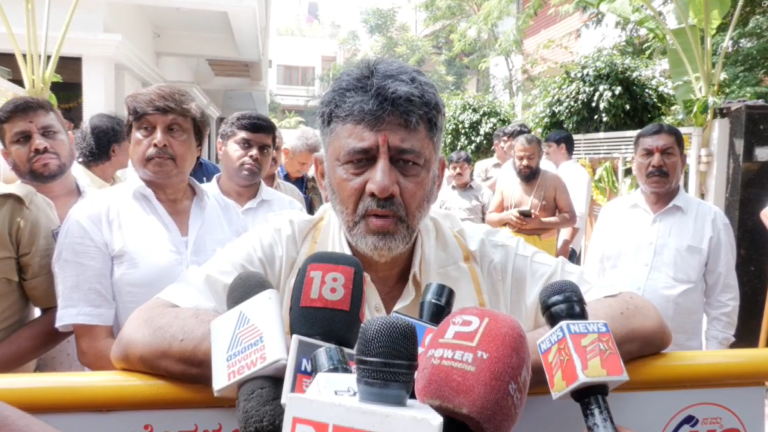
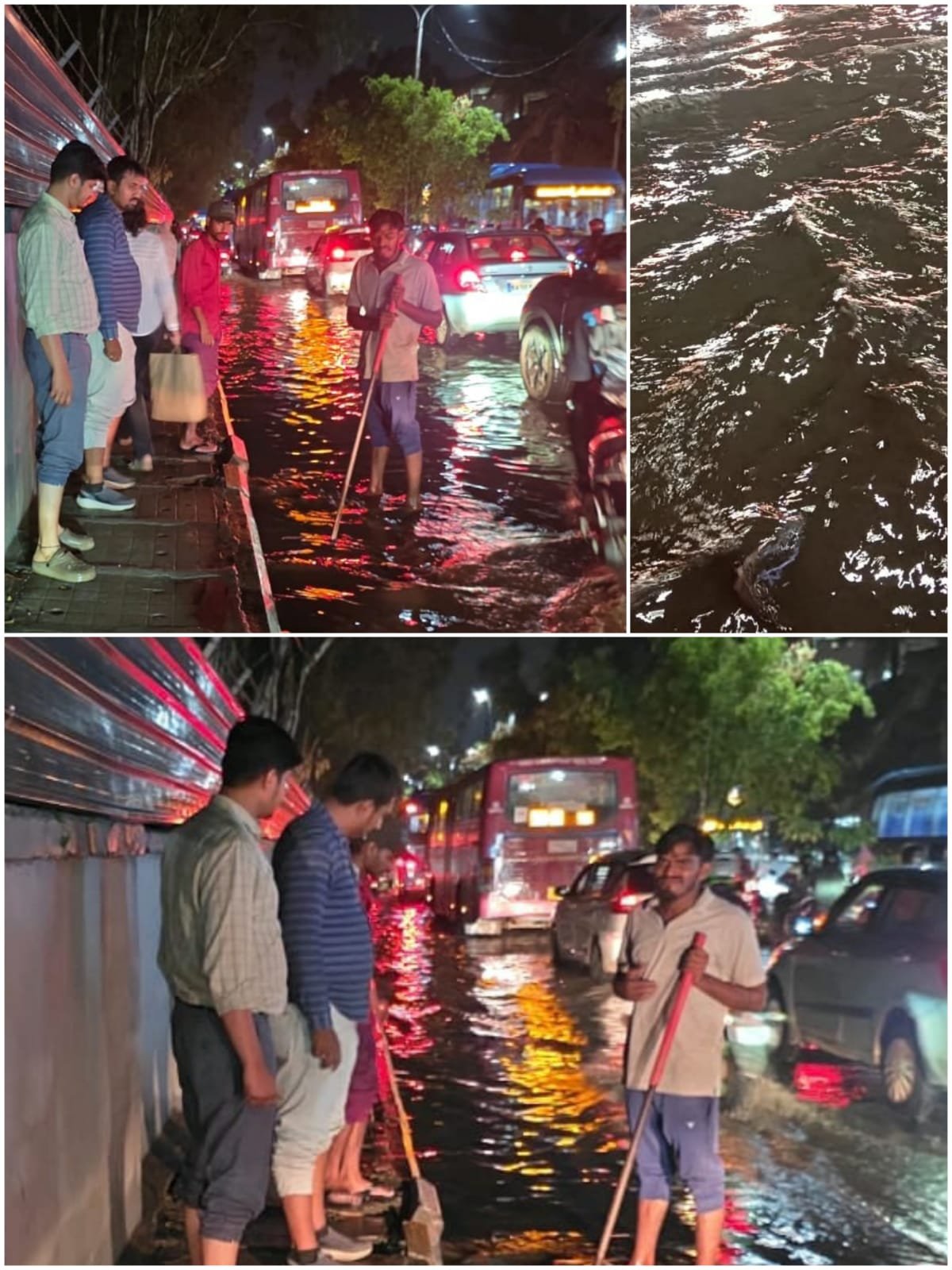
Rainwater clearance work at Kundalahalli Colony in Garudacharpalya, as shown in photographs shared by Bengaluru East City Corporation on September 30. Photograph supplied.
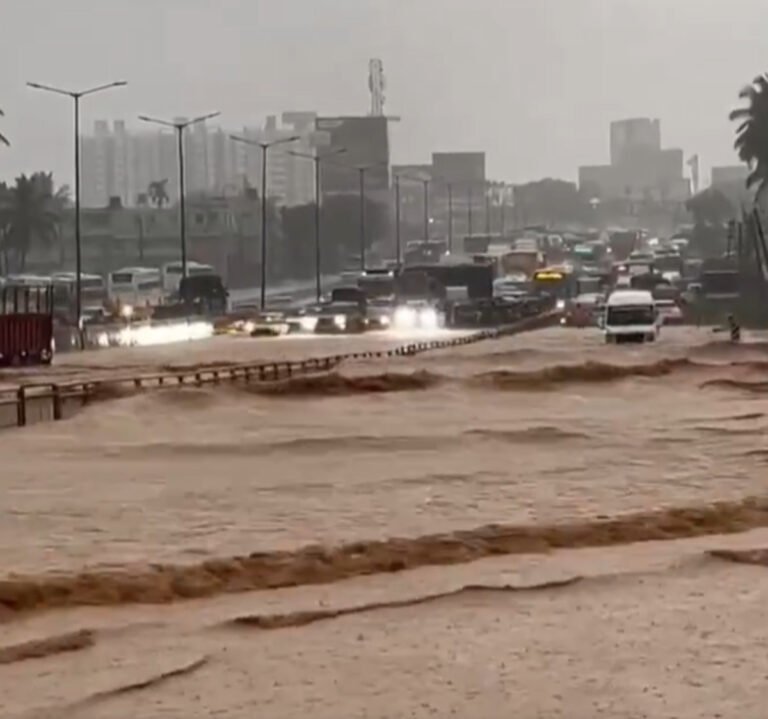
Bengaluru: Rain disrupted traffic across Bengaluru’s eastern and northern corridors on Wednesday, September 30, with waterlogging reported on routes towards Varthur, the airport and Hebbal, even as civic officials identified blocked drain openings, railway construction and missing drainage connections behind several recurring trouble spots.
The disruption coincided with an India Meteorological Department forecast of more showers, heavy at times, and gusty winds of 30–40 kmph for Bengaluru city and its neighbourhood through the morning of October 2. HAL Airport recorded 17.1 mm between 8.30 am and 5.30 pm on September 30, while the City observatory recorded 0.4 mm over the same period.
Bengaluru East City Corporation Commissioner D.S. Ramesh said the corporation was combining immediate pumping and clearance work with location-specific permanent solutions. Several of those longer-term measures remain at the planning, approval or inter-agency coordination stage.
Where traffic slowed: Whitefield, airport route and north Bengaluru
Bengaluru Traffic Police reported slow movement because of waterlogging from Rainbow Hospital towards Karthik Nagar, from Yelahanka BSF towards the airport, and from Mahadevapura towards Lowry Junction.
A separate advisory identified the Vidyashilpa railway underpass in Yelahanka and the Rashrotthana flyover area at Chowdappa Layout, Thanisandra. Waterlogging near Yogishwara Nagar also affected traffic heading towards Hebbal Ring Road.
Whitefield Traffic Police warned of slow traffic from Thubarahalli towards Varthur Kodi and advised motorists to proceed cautiously and use an alternative route. On Vibgyor Road connecting Balagere Road, police urged commuters to allow additional travel time. Related posts in the same official thread also flagged the Siddapura–Varthur Kodi stretch and Panathur railway underbridge.
A fallen tree near Vidyasoudha School slowed traffic from the school towards S.M. Road, according to another city traffic police advisory. These are locations flagged in September 30 updates; they should not be read as a confirmation that every stretch remained waterlogged or obstructed later in the night.
What civic teams cleared—and where relief was reported
The Greater Bengaluru Authority said Bengaluru East teams removed waste obstructing drainage near the K.R. Pura railway underpass at Pillar No. 114 and opened additional shoulder drains to help rainwater flow away.
At Kundalahalli Colony in Garudacharpalya, Bengaluru East City Corporation said teams cleared waste blocking the passage of rainwater into drains. The corporation shared photographs of the clearance operation amid waterlogged traffic.
In Bengaluru North, GBA reported that waterlogging on the Kalyana Nagar Junction service road had been cleared and movement restored. Workers were also clearing blocked shoulder drains at Telecom Layout.
K.R. Pura Traffic Police shared footage and a photograph of personnel working in rain and waterlogging. In a subsequent reply to that post, the station said the water at the junction shown had drained and traffic was moving smoothly. That update applies to the location in the post, rather than to all affected roads in K.R. Pura.
Panathur and Hoodi: railway works and constrained drainage
In its detailed explanation of recurring flooding, Bengaluru East City Corporation attributed a major part of the Panathur railway underbridge problem to an obstruction to water flow arising from railway double-line work. It also identified issues involving B-SMILE buffer-road work and the alignment of the stormwater drain.
Ramesh said land availability and acquisition constraints had complicated the provision of a suitable drain alignment. The corporation was coordinating with the departments concerned to establish a permanent passage for rainwater.
At Hoodi railway underbridge, water was being pumped out as an interim measure. Railway officials had been asked to clear silt from a pipeline obstructing the flow. According to the commissioner, a permanent solution requires replacing the existing pipe with a larger-diameter one and correcting the slope, in coordination with the railways.
Spice Garden: two of three drain openings blocked
The corporation said two of the three openings in the stormwater drainage structure at Spice Garden were blocked by rubbish, debris and a fallen slab, leaving only one opening functioning. This had reduced the capacity to carry water.
The proposed remedial work includes complete desilting, reopening the blocked vents and thoroughly clearing a stretch of about 2–3 metres. The statement described these as works to be undertaken, rather than a completed permanent fix.
Samhita Serenity: missing outfall; Geddalahalli: narrow culvert
Around Samhita Serenity Apartments, officials identified the absence of a properly designed and connected stormwater drainage system. Some paying-guest accommodation owners had created their own drainage arrangements without an adequate final outlet, the corporation said.
An estimate has been prepared for road and drain work with a suitable alignment. A proposal to lay a pipeline through an approximately 1.5-foot-wide passage on private property near Ferns Habitat and connect it to the main stormwater drain has been sent for government approval, Ramesh said.
Near the Geddalahalli railway bridge on Hennur–Bagalur Road, around half a foot of water had accumulated. The corporation attributed this to a narrow culvert opening and proposed a new culvert about 20 metres beyond the bridge. The High Density Corridor division has been given directions, while pumping will continue when required until permanent work is completed.
Sai Layout, Vaddarapalya, Kothanur and Doddanekkundi
The commissioner claimed an almost complete improvement in the earlier flooding problem at Sai Layout following completion of the Geddalahalli railway vent work. At low-lying Vaddarapalya, however, about half a foot of water had accumulated during the recent rain, and measures were being taken to improve the outflow.
At Kothanur, stormwater from a main drain had flowed back towards a house in a low-lying area. A joint site inspection with Bengaluru Development Authority officials is planned before the permanent work is decided.
At Doddanekkundi underpass, the corporation said an earlier one-foot-diameter pipe that repeatedly choked had been replaced, with railway permission, by a three-foot-diameter Hume pipe and new chambers. It said this had addressed the main drainage problem, while small amounts of rubbish, bottles and other debris at the gutter were cleared to restore flow during rain. These assessments are the corporation’s account of the works and their impact.
Bengaluru rainfall: why the station and time window matter
IMD’s September 30 daytime readings cover 8.30 am to 5.30 pm IST. They show sharply different rainfall totals at individual stations and are not a single citywide rainfall figure. They also do not include rainfall after 5.30 pm.
| Station | Rainfall, 8.30 am–5.30 pm, September 30 |
|---|---|
| HAL Airport | 17.1 mm |
| Bengaluru City observatory | 0.4 mm |
| Kempegowda International Airport | Trace |
| GKVK Bengaluru AWS/ARG | 8.5 mm |
| Bengaluru AWS/ARG entry | 0.5 mm |
The separate “Bengaluru” AWS/ARG entry and the Bengaluru City observatory are retained as distinct readings in the supplied data; 0.5 mm and 0.4 mm should not be merged or treated as competing citywide totals.
The morning daily weather report uses a different period: the preceding 24 hours ending at 8.30 am on September 30. For that window, Bengaluru City recorded 15.3 mm, GKVK 15 mm, KIAL 0.4 mm and HAL a trace. The report also listed Hesaraghatta and Nelamangala at 3 cm each and T.G. Halli at 2 cm in its rounded chief-rainfall summary. Those figures relate to the earlier observation window.
IMD forecast: heavy spells possible through October 1
The September 30 IMD bulletin places Bengaluru Urban and Bengaluru Rural under a yellow “watch—be prepared” rainfall warning for September 30 and October 1, with heavy rain at one or two places, thundershowers and gusty winds of 30–40 kmph. Each daily warning runs until 8.30 am IST the following day.
For Bengaluru city and its neighbourhood, the forecast valid until the morning of October 2 calls for generally cloudy skies and light to moderate rain or thundershowers, heavy at times, during both the next 24-hour and 48-hour outlook periods. Maximum and minimum temperatures are expected to be around 31°C and 20°C.
For October 2–4, the district forecast indicates light to moderate rain at a few places in Bengaluru Urban and Rural. The bulletin reports an active southwest monsoon over South Interior Karnataka and notes a north–south trough from the region to the Gulf of Mannar across Tamil Nadu, along with a circulation over north coastal Tamil Nadu and neighbouring areas.
Helplines and precautions
Ramesh said the corporation’s urban flood-management team was working round the clock on rain-related problems and appealed to residents to report emergencies rather than rely on rumours. GBA lists 1533 for civic complaints; police list 112 for emergencies.
IMD advises residents to follow traffic advisories, avoid waterlogged areas and river fronts, take shelter during thunderstorms and move to safer places if they are in vulnerable locations. Its bulletin flags the possibility of reduced visibility, traffic disruption from waterlogging and fallen trees, and flooding in low-lying areas. Commuters should check the latest official route update before travelling, particularly where an earlier alert may have been followed by a clearance notice.
October 1 morning follow-up: Doddagubbi records 138.5 mm as waterlogged roads slow the morning commute — read the station-wise rainfall data, fresh police advisories and North Corporation’s response.
About the Author