He paid tribute to Bharat Ratna Prof. C.N.R. Rao for his lifelong contribution to scientific excellence, saying his vision continues to inspire generations of researchers.
Bengaluru, August 4: Karnataka Chief Minister D.K. Shivakumar on Tuesday said Bengaluru, which established India’s global reputation in information technology, must now lead the country’s next technological revolution by emerging as a global deep-tech capital.
Inaugurating the 14th Bengaluru INDIA NANO 2026 conference, organised by the Department of Science and Technology and the Vision Group on Nanotechnology at The Lalit, Shivakumar said Karnataka is positioning itself at the forefront of advanced technologies, including nanotechnology, artificial intelligence, semiconductors, biotechnology, quantum technologies and advanced materials.
“Bengaluru has put India on the world IT map. It is now time to put India on the world deep-tech map,” the Chief Minister said, calling it the next defining chapter in Karnataka’s innovation journey.
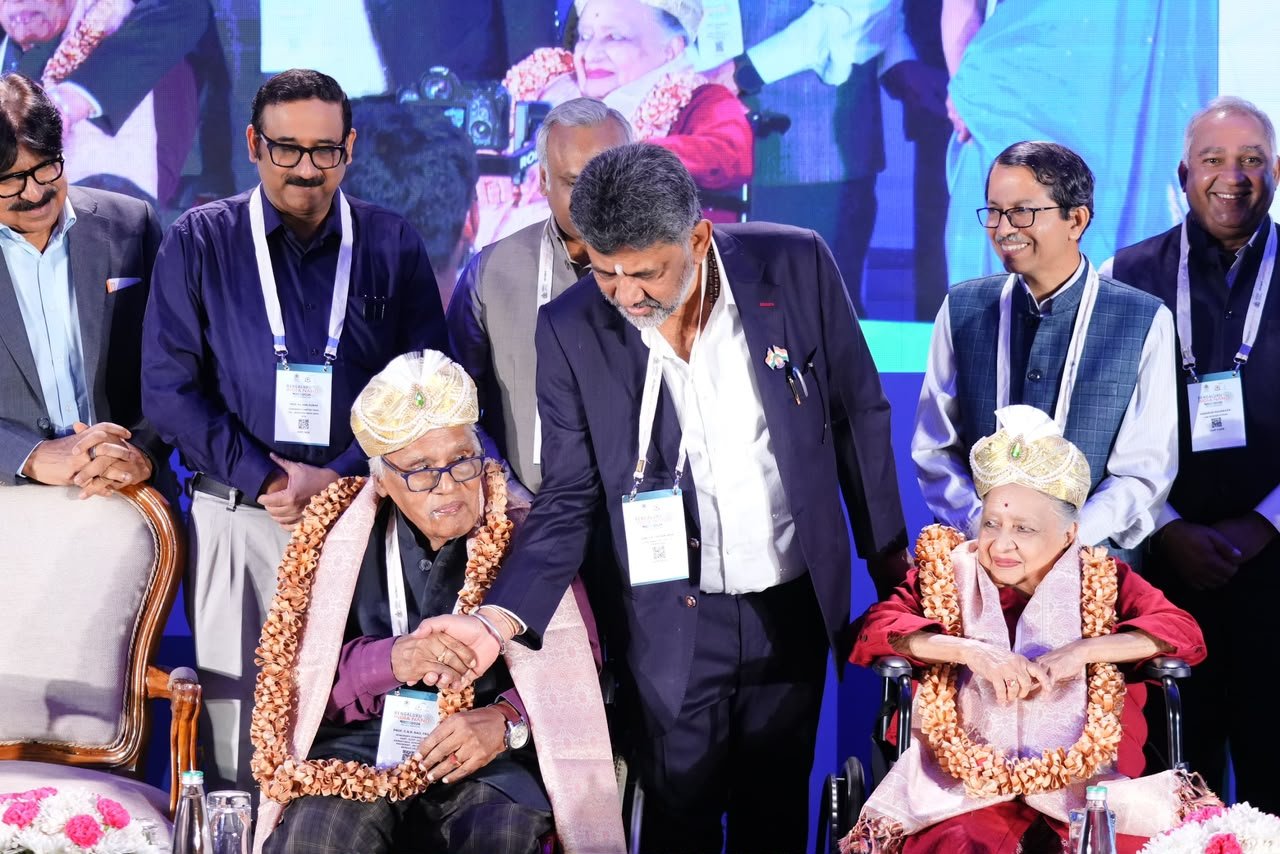
The event was attended by IT-BT and E-Governance Minister Priyank Kharge, Bharat Ratna Prof. C.N.R. Rao, Indumati Rao, LAM Research India Managing Director Rangesh Raghavan, Chief Minister’s Economic Adviser L.K. Atheeq, Electronics, IT-BT Department Secretary Dr. N. Manjula and senior scientists, industry leaders and researchers.
Shivakumar said Karnataka’s unique ecosystem of premier research institutions, global capability centres (GCCs), universities, multinational R&D facilities and startups provides the state with a strong competitive advantage to become a global destination for deep-tech innovation.
He noted that nanotechnology has evolved beyond research laboratories and is now transforming healthcare, electronics, agriculture, mobility, aerospace, defence, energy and advanced manufacturing.
“The future will be shaped by the convergence of artificial intelligence, nanotechnology, biotechnology, semiconductors, quantum technologies and advanced materials. Karnataka intends to remain at the forefront of this technological transformation,” he said.
Highlighting Bengaluru’s scientific legacy, the Chief Minister recalled the historic meeting between industrialist Jamsetji Tata and Swami Vivekananda aboard a ship travelling from Japan to the United States in 1893. Their discussions on scientific research and nation-building eventually led to the establishment of the Indian Institute of Science (IISc), made possible through the support of the erstwhile Mysore Kingdom under Maharaja Krishnaraja Wadiyar IV, who provided land and financial assistance.
He said global competition today extends far beyond attracting investments, with countries increasingly competing for scientific leadership.
“Whoever leads in advanced materials, nanoelectronics, semiconductor technologies and AI-driven manufacturing will shape the global economy of the coming decades. Karnataka intends to be among those leaders,” he said.
Shivakumar said the state government is committed to building an ecosystem where scientific discoveries move quickly from laboratories to industries and from research papers to commercially viable products through stronger collaboration between academia, startups and industry.
He highlighted the transformative potential of nanotechnology in targeted drug delivery, precision medicine, smart agriculture, efficient water management, clean energy, sustainable manufacturing and resilient infrastructure.
Urging multinational companies to deepen their research presence in Bengaluru, the Chief Minister said Global Capability Centres must evolve beyond back-office operations.
“The GCCs of the future should file patents here, not merely close tickets here,” he said, while encouraging universities and research institutions to prioritise patent generation and industry partnerships that address real-world challenges.
Shivakumar described collaboration between government, academia, industry and entrepreneurs as Karnataka’s greatest strength and said innovation can thrive only when all stakeholders work together.
He paid tribute to Bharat Ratna Prof. C.N.R. Rao for his lifelong contribution to scientific excellence, saying his vision continues to inspire generations of researchers.
Addressing young scientists and students, Shivakumar encouraged them to pursue ambitious scientific goals and assured them of the state’s continued support for research and innovation.
He also stressed that technological advancement must remain human-centric by improving quality of life, generating employment, promoting sustainable development and protecting the environment.
Concluding his address, the Chief Minister said Bengaluru’s next phase of global leadership would be driven by deep technologies such as nanotechnology, semiconductors, quantum science, artificial intelligence and advanced manufacturing.
He formally inaugurated Bengaluru INDIA NANO 2026 and congratulated the Karnataka Science and Technology Promotion Society (KSTePS), Jawaharlal Nehru Centre for Advanced Scientific Research, the Department of Science and Technology, scientists, industry partners and organisers for hosting the conference.
About the Author