
Karnataka Issues Fresh Guidelines for Multi-Pair Kidney Swap Transplants to Boost Patient Access
Bengaluru: In a significant move aimed at improving access to life-saving organ transplants, the Government of Karnataka has issued comprehensive administrative guidelines permitting multi-pair kidney paired exchange (swap) transplantations across the state.
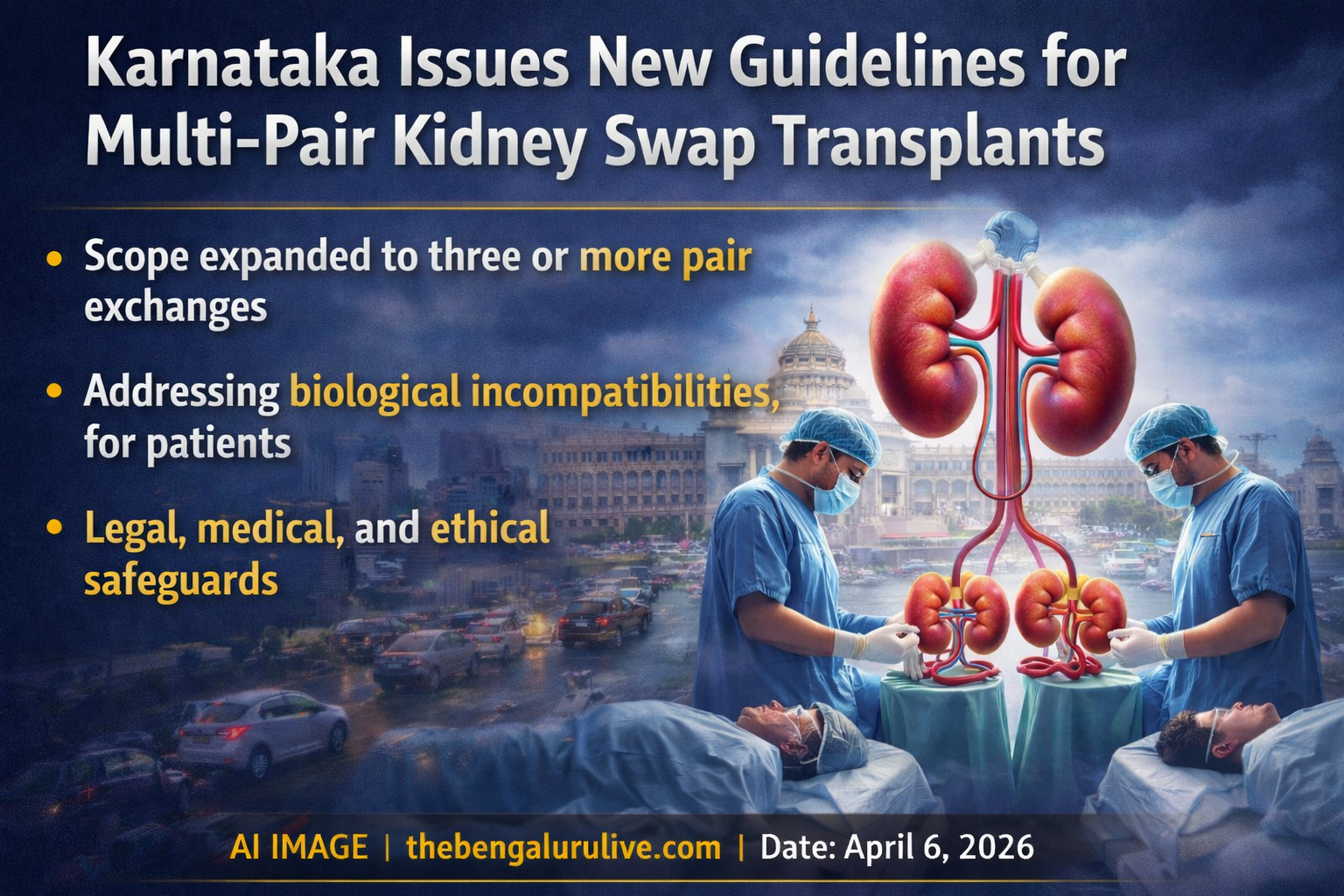
The new framework, notified under Government Order No. HFW 70 FPR 2026 dated April 4, 2026, expands the scope of kidney swap transplants beyond traditional two-pair exchanges to include three-way and higher multi-pair combinations.

The decision comes in response to a growing number of patients unable to undergo kidney transplantation due to biological incompatibility issues such as ABO blood group mismatch, positive crossmatch, or HLA incompatibility. The government noted that kidney paired exchange transplantation is an internationally recognized and scientifically validated method to address such challenges.

Published In Public Interest by thebengalurulive.com
Legal Backing and Framework
The guidelines are issued under the Transplantation of Human Organs and Tissues Act (THOTA), 1994, and its 2014 Rules. While Section 9(3A) of the Act explicitly allows swap donation between two donor-recipient pairs, the government clarified that there is no legal prohibition on multi-pair exchanges. The move is also aligned with the Supreme Court’s 2025 judgment supporting broader implementation of such provisions.
Key Provisions of the Guidelines
The policy introduces strict eligibility and procedural norms:
Donors must be near relatives of the intended recipients.
Each donor-recipient pair must have documented biological incompatibility.
All donors must be compatible with their respective swap recipients.
A single joint agreement among all participants is mandatory.
All medical, legal, and psychological evaluations must be completed.
Any form of commercial transaction is strictly prohibited.
Approval and Monitoring Mechanism
Every multi-pair transplant will require prior approval from the Authorization Committee, with the State-Level Authorization Committee having jurisdiction over complex cases involving multiple pairs or hospitals. Decisions must be taken within 24 hours of committee meetings.
Hospitals are also required to submit detailed documentation, including compatibility reports, medical fitness certificates, and video-recorded interviews of donors and recipients to ensure transparency and compliance.
Operational and Ethical Safeguards
The guidelines mandate that transplant surgeries within a swap group should ideally be conducted simultaneously or in a closely coordinated sequence. A designated transplant coordinator will oversee the process, especially in multi-hospital cases.
Strict ethical safeguards have been built into the system, including verification of voluntary consent, prohibition of middlemen, and scrutiny of financial backgrounds to prevent commercial exploitation.
Data Reporting and Oversight
All transplant data must be reported to the State Organ Transplant Organization (SOTTO) and the National Registry. Hospitals are also required to maintain post-transplant follow-up records and submit periodic reports to the government.
Special Provision for Initial Cases
Given the novelty of multi-pair transplants in Karnataka, initial cases will be treated as special cases, with additional oversight and possible government review to ensure proper implementation.
The government emphasized that these guidelines serve as an administrative framework and do not override the provisions of the Act or Rules. Authorities retain the power to impose additional safeguards wherever necessary.
This policy is expected to significantly increase transplant opportunities for patients facing compatibility barriers, while maintaining strict ethical and legal standards.
About the Author