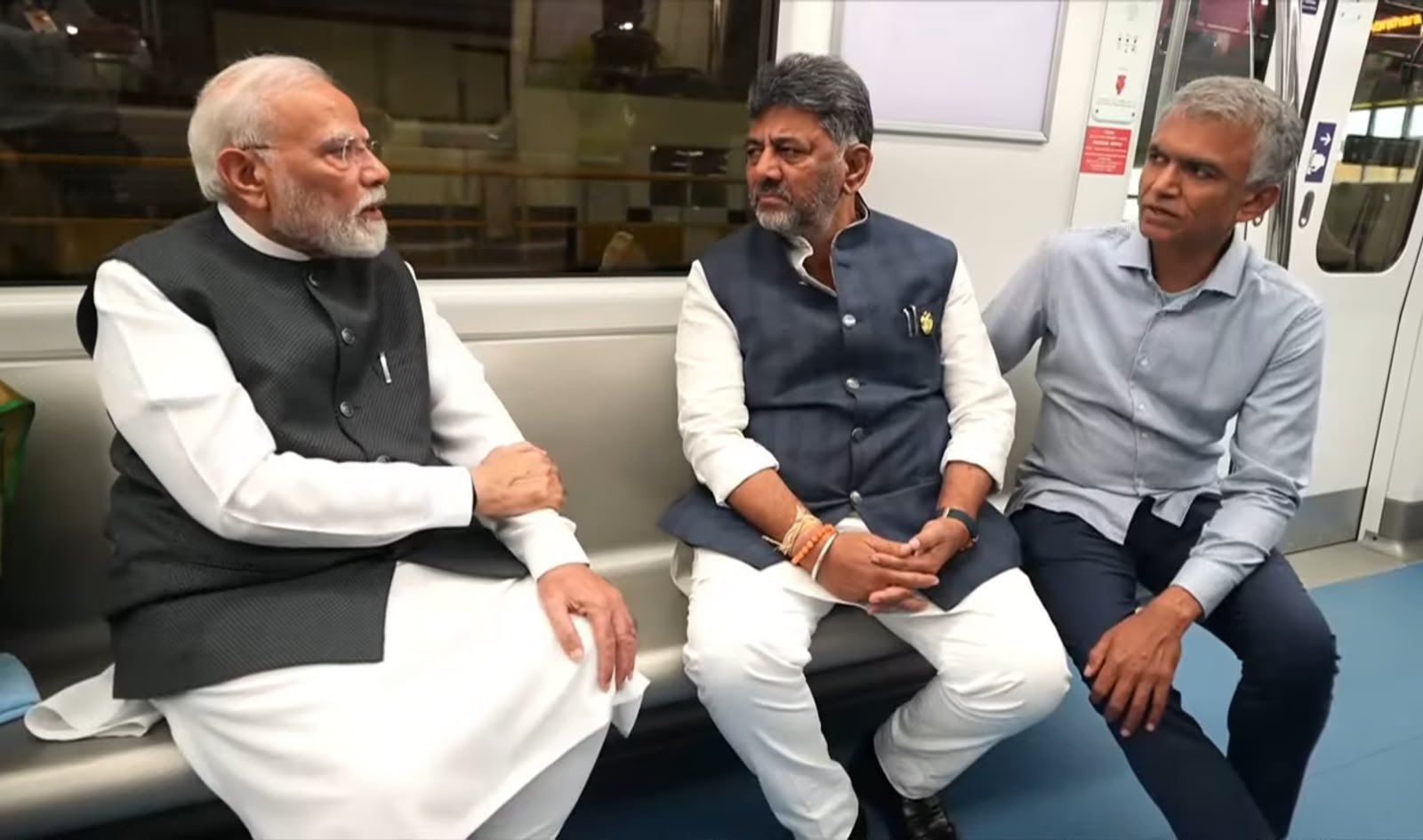
Prime Minister Narendra Modi and Chief Minister D.K. Shivakumar travel on a Namma Metro Pink Line train in Bengaluru. Image: Karnataka CMO
Bengaluru: Chief Minister D.K. Shivakumar on Friday urged Prime Minister Narendra Modi to introduce a more equitable Centre-State funding mechanism for Metro rail projects, to speed up approvals and to share the financial burden of infrastructure development, as he set out Bengaluru’s ambition to expand its Metro network to 500 km in the coming years.
Speaking at the inauguration of the Namma Metro Pink Line at the Indian Institute of Management Bangalore (IIMB), in the presence of Prime Minister Narendra Modi, Governor Sudha Yadav, Bengaluru Development Minister Krishna Byregowda and Bengaluru South MP Tejasvi Surya, he said the inauguration marked a significant milestone in Bengaluru’s public transport journey, taking the Namma Metro network beyond 100 km.
Describing Karnataka as a state with an unmatched legacy of pioneering achievements, Shivakumar recalled that Shivanasamudra generated Asia’s first electricity in 1902 to power the Kolar Gold Fields, Bengaluru was India’s first electrified city, and Karnataka was home to the country’s first aircraft manufacturing facility, set up by Hindustan Aeronautics Limited (HAL). He also cited Karnataka’s distinction as the first state to introduce an industrial policy and a dedicated startup policy, while Bengaluru hosted India’s first global R&D centre of Texas Instruments and the country’s first iPhone assembly plant.
He said Bengaluru was home to the world’s second-largest AI and machine learning talent pool, Asia’s second-largest AI-native cluster after Beijing and India’s largest chip-design ecosystem. More than 1.5 lakh engineers graduate annually from Karnataka, and women’s participation in the state’s industrial workforce stands at 37 per cent, compared with the national average of 18 per cent. Karnataka also leads the country in overall exports and positive talent balance and ranks second in GST collections and cumulative foreign direct investment inflows over the last five years, he said.
Turning to Bengaluru’s infrastructure requirements, Shivakumar said Metro connectivity was among the most critical components of the comprehensive strategy drawn up to address the city’s traffic congestion. However, he pointed out that although Metro projects were structured as 50:50 partnerships between the Centre and the States, the actual financial burden on State governments was considerably higher. In the case of Bengaluru Metro, Karnataka bears the cost of land acquisition, shifting of utilities, 50 per cent of Central taxes, 100 per cent of State taxes, repayment of the entire foreign loan and most cost escalations, he said.
“The benefits of Metro are shared by everyone. So, the financial responsibility must also be shared fairly,” he said, urging the Centre to reconsider the existing funding arrangement.
The Chief Minister sought time-bound approvals for Metro projects, regular reviews under the PRAGATI mechanism and the Prime Minister’s direct intervention to address delays in planning, approvals and construction. He also called for project costs to be assessed on actual city-specific conditions rather than uniform national averages, pointing out that detailed project reports often become two to three years old by the time they receive Central approval.
Shivakumar proposed that additional costs arising from approval delays be shared equitably, with each government bearing its respective tax burden. He also sought a mechanism for the Centre and States to share operational cash losses and foreign exchange risks arising from external loans, citing the Delhi Metro funding arrangement as an example. He further advocated affordable long-term loans in Indian rupees through national financial institutions.
He proposed establishing a single national technical institution for Metro projects. Such an institution could maintain a list of approved technologies and systems from which Metro projects across the country could make selections based on technical committee recommendations, helping accelerate approvals, promote indigenous technology and ensure passenger safety, he said.
Setting an ambitious target, Shivakumar said Karnataka intended to expand Bengaluru’s Metro network to 500 km in the coming years. Quoting former President A.P.J. Abdul Kalam’s words, “Dream, dream, dream”, he said the vision had to be translated into reality through proper planning and timely decisions. “A better Metro network means less time in traffic and more time with families,” he said.
Raising three other important issues concerning Karnataka, the Chief Minister urged the Prime Minister to expedite drought relief assistance to the State. He said Karnataka was facing a severe drought, having received the second-lowest rainfall in 70 years. Of the State’s 240 taluks, 226 had been declared drought-affected, and nearly 58 lakh hectares of crops had suffered damage, with estimated losses of ₹62,482 crore. The State had sought ₹22,400.58 crore in assistance under the National Disaster Response Fund (NDRF), and Shivakumar appealed to the Prime Minister to ensure its early approval and release to support affected farmers.
He also drew the Prime Minister’s attention to the concerns of sugarcane farmers in Karnataka. Farmers were demanding ₹5,500 per tonne against the Fair and Remunerative Price (FRP) of ₹3,650 per tonne for the 2026-27 season, he said. He also pointed out that the minimum support price of sugar had remained unchanged at ₹31 per kg since 2019 and sought a fair share of ethanol allocation for Karnataka.
Emphasising the need for greater cooperation between the Centre and States, Shivakumar said Karnataka was ready to fulfil its responsibilities and work closely with the Union Government. Invoking the philosophy of Kayakave Kailasa and the Bhagavad Gita’s message of performing one’s duty with sincerity, he said the Pink Line inauguration reflected the hard work and dedication of thousands of engineers, workers and officials. Quoting Kuvempu’s vision of Vishwamanava, he called for governments to rise above narrow boundaries and work towards the welfare of all.
“A Metro line connects two places, but cooperation connects governments and people. When the Centre and States move together, the nation moves forward,” he said.
Concluding his address, Shivakumar said the people’s mandate gave political parties the responsibility to govern, but their ultimate goal should always be to serve the people and improve the quality of life of every citizen of the country.
Related coverage:
- PM Modi and CM Shivakumar Flag Off Namma Metro Pink Line at Tavarekere Station
- Karnataka Memorandum to PM Modi Seeks Red Line Approval, Double-Decker Flyovers and Review of Western Ghats Notification
- Shivakumar Urges PM Modi to Fast-Track Sarjapur–Hebbal Metro Approval
About the Author