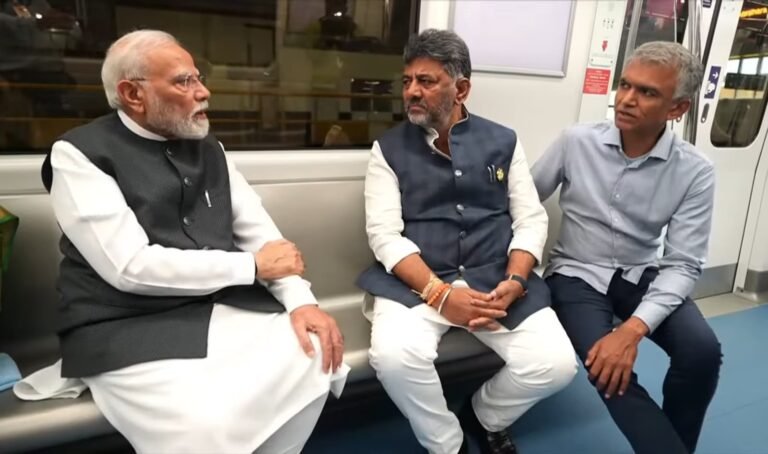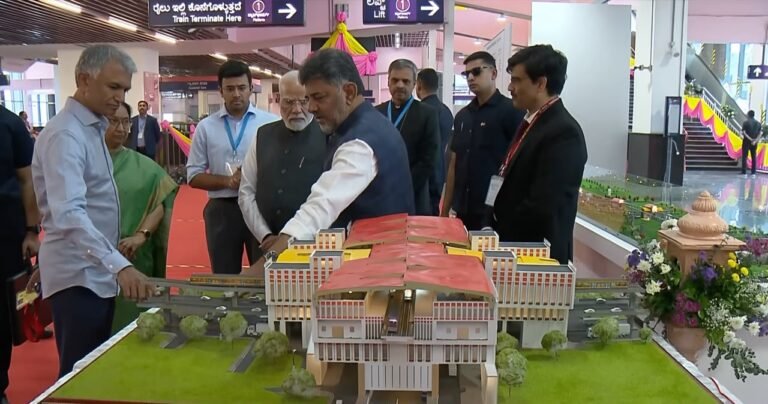
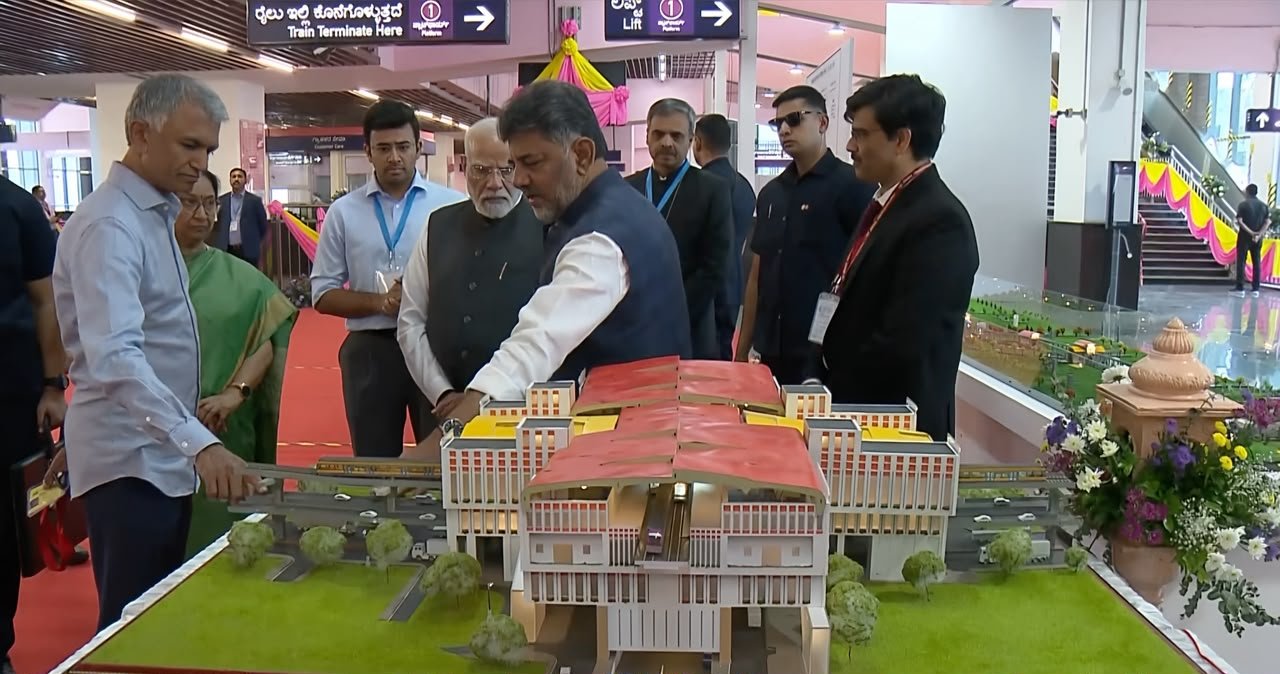
Prime Minister Narendra Modi and Chief Minister D.K. Shivakumar look at a model of a Namma Metro station in Bengaluru. Image: Karnataka CMO
Bengaluru: Chief Minister D.K. Shivakumar has written to Prime Minister Narendra Modi in a five-page memorandum, dated 13 November, seeking reforms in Metro rail funding, early approval for the Red Line (Phase 3A) of Namma Metro and permission for double-decker infrastructure, besides drought relief, a better price for sugarcane farmers and a rethink on the draft Western Ghats notification.
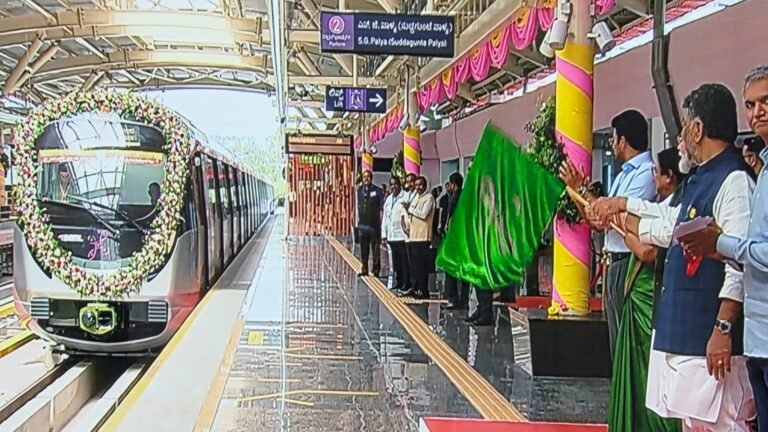
With the inauguration of 7.5 km of the Pink Line, Namma Metro will cross 103 km, making Bengaluru’s the second-largest Metro in the country, the memorandum says. Calling Bengaluru the fastest-growing metropolis in the country, it says the city needs a Metro of at least 500 km and sets a goal of reaching 500 km in the next 10 years.
Metro projects are implemented through a special purpose vehicle in a 50:50 partnership between the Centre and the State, but the actual financial burden on States is much higher, the memorandum says. As the State bears the entire cost of land acquisition and shifting of utilities, 50 per cent of Central taxes, 100 per cent of State taxes, repayment of the entire foreign loan and most cost increases, Karnataka’s financial burden of building and running the Metro goes beyond 80 per cent.
The memorandum asks for time-bound Metro approvals with regular PRAGATI reviews and the Prime Minister’s direct attention, saying delays in approval add to the cost. It points out that the Centre approves projects on a detailed project report costed at old prices, with cost escalation beyond the date of submission not allowed, and that the Government of India uses benchmarked rates, which are averages of Metros across the country, to mark down estimates. Karnataka wants state-specific realistic rates, with the Centre arriving at independent costing for each city.
The Chief Minister also asks the Centre to share the cost of foreign-exchange risks on external loans, as has been agreed in the case of Delhi Metro, and to take a share of the operational losses of Metros. With loans from multilateral foreign banks becoming costlier because of rising interest rates and a depreciating rupee, he asks the Government of India to consider affordable, long-term domestic loans in Indian rupees through national financial institutions.
Delays are also caused in inspections and safety certification by agencies in other Ministries such as Railways, the memorandum says, and it asks the Union Ministry of Urban Development to create a National Technical Institution for Metros. Metro projects could then choose from its list of approved technologies based on technical committee recommendations, which would speed up approvals, support Indian technology and ensure passenger safety.
On double-decker infrastructure, the memorandum says only 8-9 per cent of Bengaluru is covered by roads, whereas a city needs at least 18-20 per cent. Karnataka had planned road flyovers below elevated Metro lines to save expensive and limited land. While similar structures exist in Nagpur and Pune, Karnataka’s proposal for double-decker infrastructure along the 42-km Phase 3 stretch has been significantly reduced. The State has committed to bear the additional expenditure on the elevated road under the Metro and seeks permission to take up double-decker structures wherever it is technically feasible, safe and economically justified.
On the Red Line (Phase 3A), the memorandum says the proposal connecting Sarjapur and Hebbal was submitted to the Government of India in January 2025 and revised with reduced costs at the Centre’s request. The corridor connects major residential and employment centres and improves access towards the airport, and there is an urgent need to approve it to avoid further cost escalation and to start work, it says.
Besides Metro, the memorandum raises three other issues. On drought, it says Karnataka has received the second-lowest rainfall in 70 years, 226 of its 240 taluks have been declared drought-affected and nearly 58 lakh hectares of crops have been damaged, with estimated losses of ₹62,482 crore. Villages face drinking water shortages and fodder for cattle is becoming scarce. The State has sought ₹22,400.58 crore under the National Disaster Response Fund (NDRF), and the memorandum notes that the Government of India has also obtained field reports through Inter-Ministerial Study teams. It asks for early approval and release of the assistance.
On sugarcane, the memorandum says farmers in Karnataka are demanding ₹5,500 per tonne against the Fair and Remunerative Price (FRP) of ₹3,650 per tonne for 2026-27. The minimum support price of sugar has remained at ₹31 per kg since 2019 while open market prices are much higher, and the memorandum seeks a revision considering the cost of production of sugarcane and sugar. It also asks for policy decisions so that the FRP is fixed more realistically and returns from by-products such as ethanol and power are accounted for in giving fair prices to farmers.
On the Western Ghats, the memorandum says the Union Ministry of Environment and Forests has issued a draft notification, based on the Kasturirangan Report, that identifies 20,668 square kilometres across 1,449 villages in 10 Karnataka districts as Ecologically Sensitive Areas. The State supports the protection of forests and wildlife, but the livelihoods of generations of farmers and families in the Western Ghats must also be protected, it says, adding that declaring the entire area eco-sensitive will severely affect the lives and livelihoods of people in about 1,500 villages.
Karnataka has been requesting a ground-level survey for over a year, and the State Legislature has passed a unanimous resolution on the issue, the memorandum says. It asks the Centre to consider the concerns of the people and the Legislature’s resolution and to reconsider the notification in consultation with Karnataka. The memorandum is signed by the Chief Minister “on behalf of the People of Karnataka”.
Related coverage:
- Shivakumar Urges PM Modi for Fairer Centre-State Metro Funding, Sets 500 km Target for Bengaluru
- PM Modi and CM Shivakumar Flag Off Namma Metro Pink Line at Tavarekere Station
About the Author