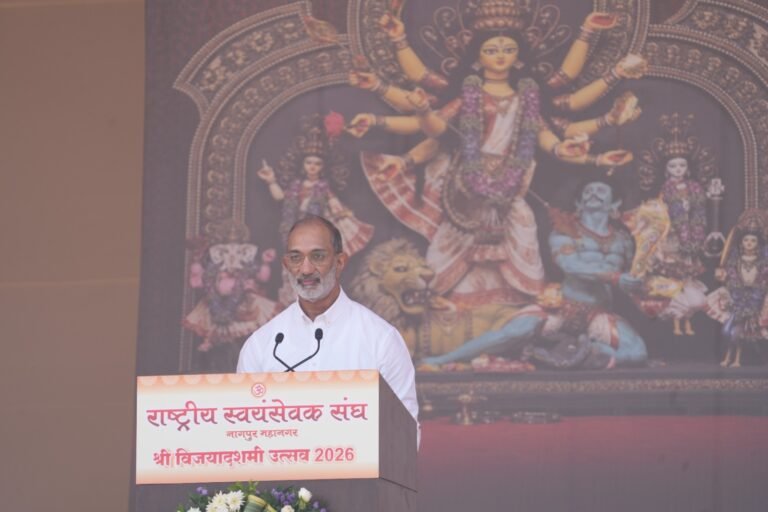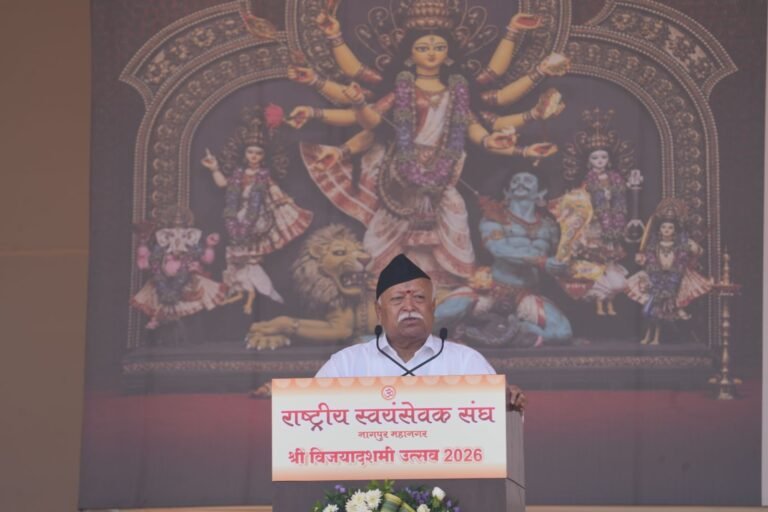
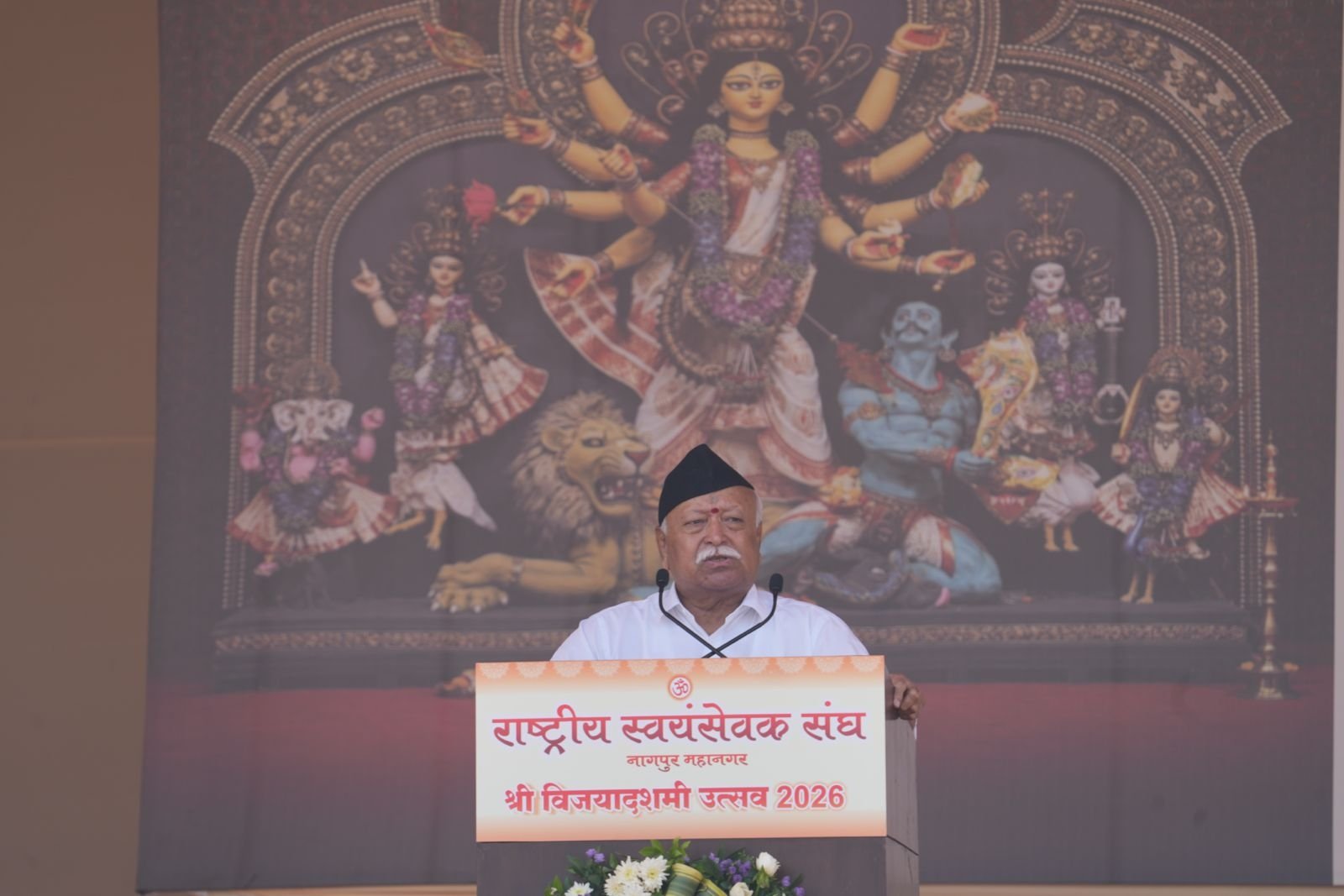
Mohan Bhagwat delivers the RSS Vijayadashami address in Nagpur. Photo: RSS.
Nagpur: RSS chief Mohan Bhagwat urged the government to consider safeguards concerning OTT platforms and called for a nationwide social effort against drug addiction, putting young people’s judgment, social cohesion and responsible use of technology at the centre of his Vijayadashami address.
Speaking in Nagpur on October 20 at the close of the Sangh’s centenary programmes, Bhagwat argued that unrestricted access to information must be accompanied by the ability to distinguish appropriate from harmful influences. His remarks were an appeal for action and changes in behaviour, not an announcement of new government regulations.
श्री विजयादशमी उत्सव 2026 में पूजनीय सरसंघचालक जी का उद्बोधन।
— RSS (@RSSorg) October 20, 2026
OTT platforms, digital judgment and addiction
Bhagwat said several countries had responded to the adverse effects of social media with restrictions and discipline. He said a similar need was being felt in India, particularly in relation to OTT platforms, and asked the government and administration to consider it.
Alongside any official response, he placed responsibility on parents and elders to help young people develop discernment. He described drug addiction as a serious national problem requiring timely efforts by government, administration and society.
He said swayamsevaks would work to bring together those engaged in addressing addiction and build a nationwide resistance to the problem. The address did not lay out a launch date, funding arrangement or operational timetable for that effort.
Support for science, with ethical limits on its use
Bhagwat welcomed advances in science and technology as tools that could improve material well-being and strengthen reason-based conduct. But he cautioned that technology remained a means whose consequences depended on human judgment.
He cited the misuse of artificial intelligence for deception and fraud, and contrasted clean energy with destructive weapons as possible outcomes of scientific knowledge. His argument was for ethical and practical discipline alongside technical progress.
Referring to the tragedy in Nepal, he linked damage in the Himalayan region to what he characterised as one-sided development. That was his assessment of the disaster’s causes. He called for a balanced approach that considered development and the environment together, rather than judging progress only by consumption and material convenience.
Agitations must seek solutions and respect constitutional limits
The RSS chief acknowledged that a large society had problems and that systems could have serious shortcomings. Agitations arising from them were natural, he said, but should aim at solutions.
He applied his appeal for restraint to protesters, political leaders and the authorities maintaining public order. Even when emotions ran high, he said, action should remain within the Constitution and the law and should not create hatred, resentment or divisions.
He also urged officials and others implementing policies or campaigns to behave courteously and respect citizens’ dignity. Historical suspicions should be addressed without creating fresh grievances, he said, warning against provocations over small issues.
In a separate political argument, Bhagwat alleged that forces seeking to weaken India exploited divisions and that some ambitious leaders assisted them. He did not identify particular organisations or individuals in that passage; the allegation formed part of his warning against allowing political advantage to override social goodwill.
Five changes presented as a continuing way of life
Bhagwat described Panch Parivartan as a sustained change in daily conduct, rather than a programme confined to the centenary year. Its five themes were social harmony, family awareness, environmental responsibility, self-awareness and swadeshi, and civic discipline.
He said repeated constructive acts should develop into habits and be carried into personal, family, social and professional life. In his account, this was how ordinary citizens could participate in national service without waiting for every problem to be solved by government or agitation.
As an example of community participation, he cited work involving about 1,296 rural schools across 210 districts in 21 organisational regions. He said pupil attendance, learning and parental participation had improved where villagers and volunteers worked together, with communities also supporting infrastructure, sports and cultural activities.
Unity, diversity and Vande Mataram
Bhagwat said India’s diversity of faiths, languages, regions, castes and ways of life required an outlook that accepted and respected those differences. He described the relationship among Indians and with the country as unconditional.
He defended the RSS’s work towards an organised Hindu society as compatible with respect for all faiths and national unity. He characterised the Hindu outlook in terms of spirituality, humanity and universal fellowship, rather than a compulsory form of worship, diet, language or political ideology.
Invoking the movement against Bengal’s partition, he called for Vande Mataram to be sung in full with pride and without hesitation or opposition. He presented devotion to the country, respect for shared ancestors and Indian cultural values as foundations of unity that could coexist with distinct identities.
Centenary outreach and the road ahead
In figures attributed to the RSS’s centenary outreach, Bhagwat said volunteers had contacted 10,19,88,511 households across 4,61,527 villages and 41,076 urban settlements. He also cited youth participation of 39,25,225. These were the organisation’s reported figures.
He opened the speech by recalling Sant Ravidas, Swami Shraddhanand, Swami Lakshmanananda Saraswati and Raj Narayan Basu, and connected their legacies with service, social harmony and cultural self-awareness.
Looking beyond the centenary programmes, Bhagwat said the Sangh would work towards an organised and capable society. He argued that national progress and a constructive global role required sustained individual effort, with no shortcut.
Related report: Sanjay Gupta puts civic duty at the centre of his RSS address.
About the Author