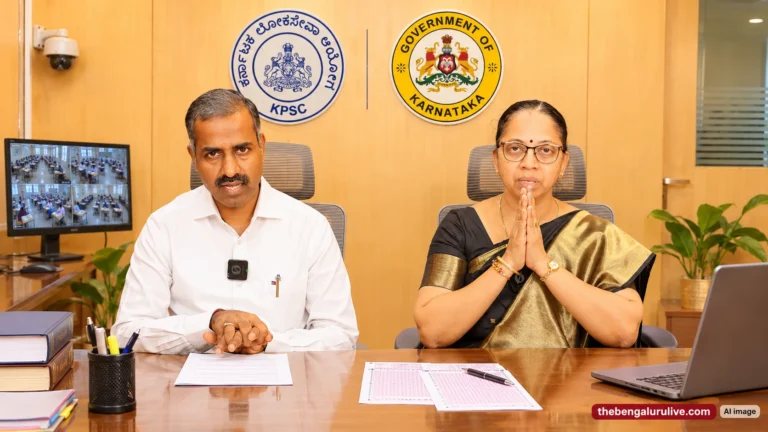
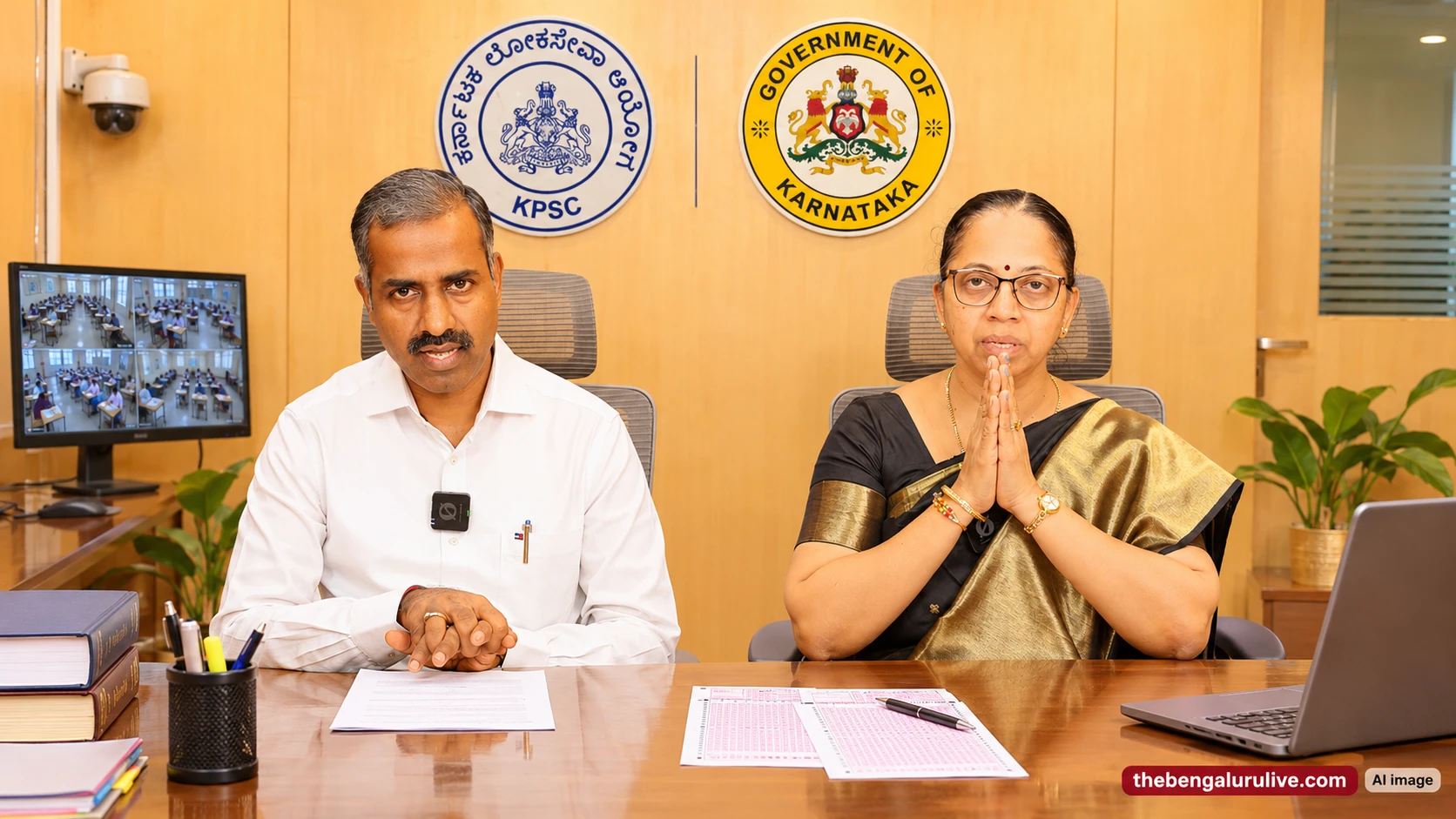
AI image: Representational illustration of KPSC examination preparations; not a photograph of the officials or the event.
Bengaluru: The Karnataka Public Service Commission (KPSC) has said the Gazetted Probationers preliminary examination scheduled for November 15, 2026, will go ahead as planned, while unveiling a series of tighter safeguards aimed at making the recruitment process more transparent, secure and time-bound.
In a video message to candidates, KPSC Secretary Jyothi K, IAS, said the Commission and the state government were determined to ensure that shortcomings seen in earlier examinations were not repeated. She said preparations for the November 15 preliminary examination were in the final stage and urged candidates not to harbour confusion, fear or doubts about the conduct of the examination.
Jyothi said KPSC was sticking to the examination calendar announced earlier and was working towards conducting the main examination at the earliest and preparing the final selection list by June 2027.
She said the Commission’s priority was to protect candidates’ interests while balancing transparency with confidentiality in the examination process. Question papers and other confidential material would be moved through the district administration, while examination centres would be placed under strict monitoring.
The Commission has also made arrangements for CCTV surveillance and immediate scanning and uploading of OMR answer sheets after the examination, she said.
KPSC Controller of Examinations Prasanna H, IAS, who detailed the new measures, said the November 15 examination for 319 posts would be held in two shifts across 15 districts.
Prasanna said KPSC had introduced several safeguards that had not been implemented in the same manner in earlier examinations.
At the entry point of examination centres, candidates’ identity will be verified through facial verification using a mobile application or laptop. Candidates will also undergo frisking using HHMD and DFMD equipment before being permitted to enter.
KPSC has decided to deploy two invigilators for every room of 24 candidates, instead of the earlier practice of one invigilator. One will handle question paper and OMR-related responsibilities, while the second will assist in frisking, monitor the functioning of jammers and keep watch from the rear of the examination hall.
Jammers will be installed and their functioning monitored continuously. CCTV cameras will cover the examination centres, with monitoring also being carried out at district-level command centres.
A major reform concerns the OMR system. KPSC is introducing personalised OMR sheets and a three-copy arrangement.
One copy will be used for scanning and sent to KPSC, a carbon copy will be retained by the candidate, while a third carbon copy will be packed at the examination centre in the presence of candidates and kept separately as an additional safeguard.
Prasanna said the additional copy could prove useful if questions were later raised about possible tampering or alteration of OMR sheets between the examination and scanning stages.
The Commission has also introduced a fifth circle on the OMR sheet for unanswered questions.
Candidates will continue to receive the full two hours to answer 100 questions. After the final bell, an additional five minutes will be provided to mark the fifth circle against questions that have intentionally been left unanswered, according to Prasanna.
He said candidates who do not know an answer need not mark any of the four answer choices during the examination. They can use the additional five minutes to indicate such unanswered questions through the fifth circle.
OMR sheets will also be packed in tamper-evident covers inside the examination room before being moved to the designated room, where they will be opened and consolidated under CCTV surveillance in the presence of authorised officials.
Prasanna said KPSC had also changed the post-examination scanning system.
Earlier, OMR sheets from across Karnataka were brought to Bengaluru and scanning could continue for several days or weeks. Under the new arrangement, scanning will be carried out in most examination districts under the supervision of district authorities.
He said the Commission was working towards making scanned OMR sheets available online within a short period after the examination so that candidates and their families could view them.
KPSC is also aiming to declare the preliminary examination result as quickly as possible. Prasanna indicated that, if feasible, the process could be completed within about 15 days, followed by the main examination at the earliest.
Both officials appealed to candidates to concentrate on preparation and said further practical and immediately implementable suggestions for improving the examination process could be submitted in writing to the KPSC Secretary.
Prasanna said candidates were justified in demanding transparency and reforms, but urged them not to be distracted by unverified narratives or repeated demands for postponement when the Commission was implementing new safeguards.
The video statement was issued by the Karnataka Public Service Commission.
About the Author