KJ George Revisits Elevated Pod Mobility, Studies Sharjah String Transport for Hampi and Karnataka Tourism Sites
Sharjah/Bengaluru: Nearly nine years after Bengaluru explored an elevated pod-based transport network during K.J. George’s tenure as Bengaluru Development Minister, George — now holding the Energy and Tourism portfolios — has again turned his attention to above-ground mobility technology, this time examining its possible use at Karnataka’s major tourism destinations, including Hampi.
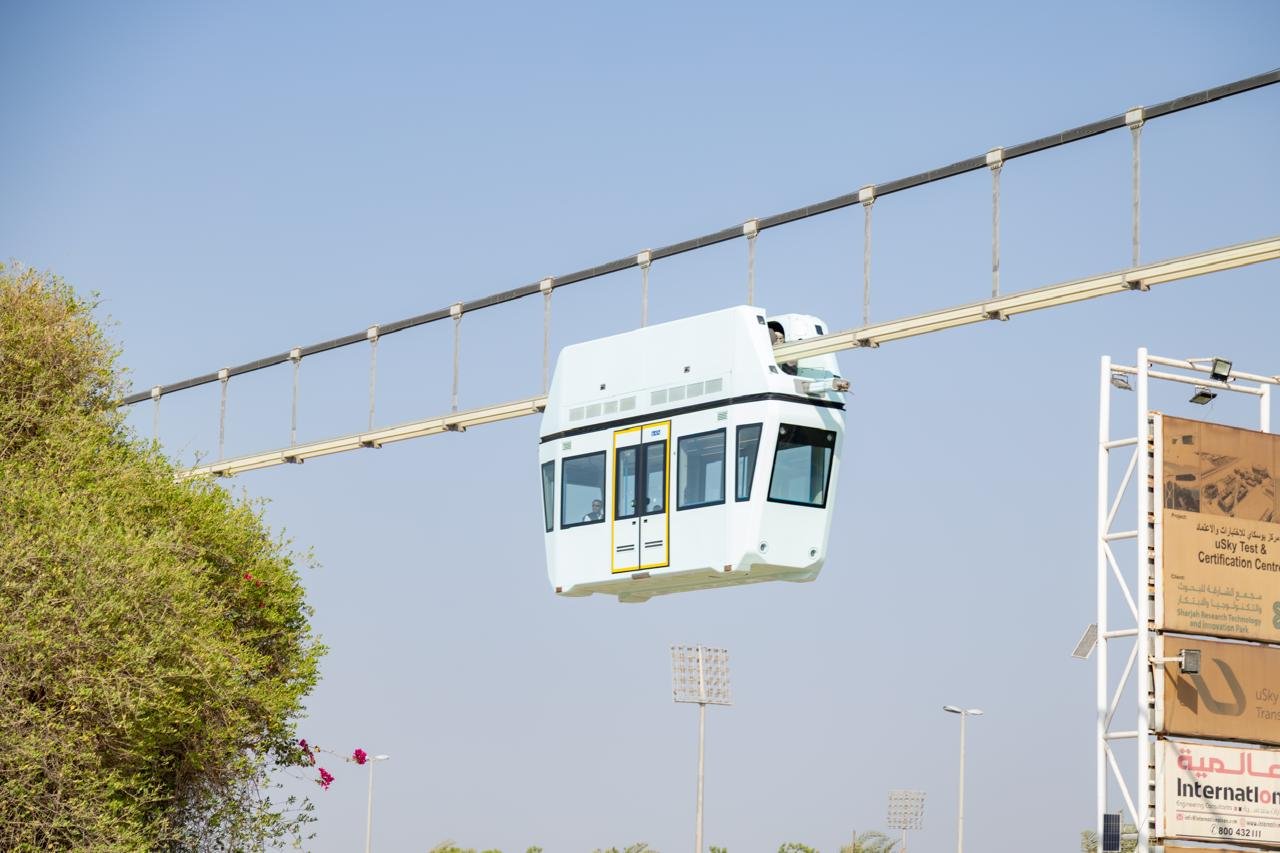
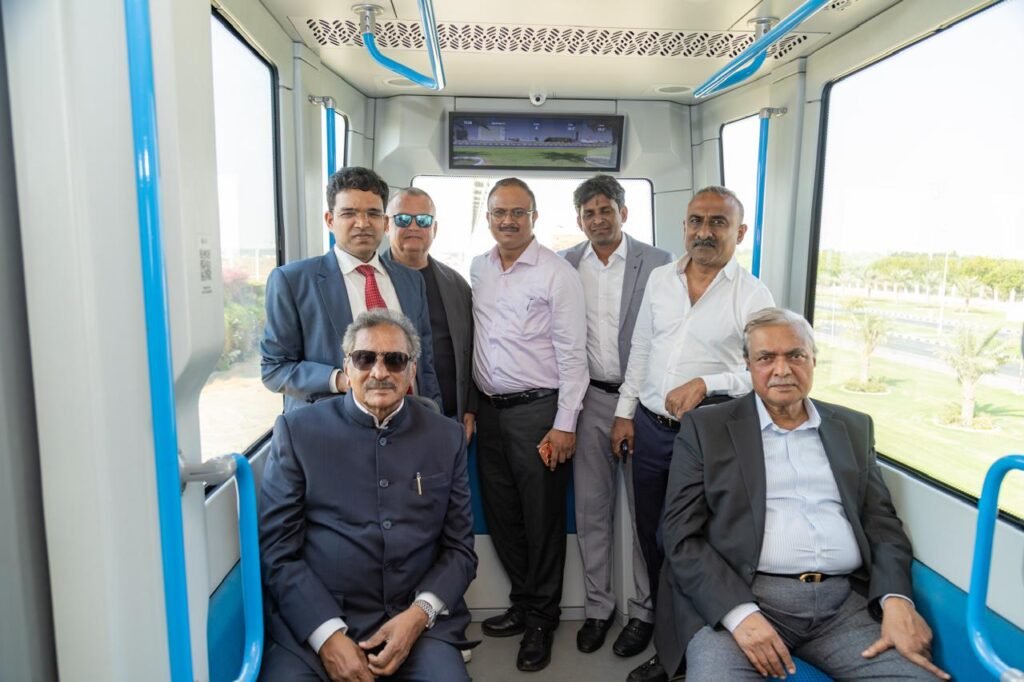
A Karnataka Tourism delegation led by George visited Sharjah to study the String Transport/Elevated Pod Transport System, examining its technical design, operational model, passenger-carrying capacity, safety features and ability to provide connectivity while requiring relatively little ground-level land.
The present initiative is at an exploratory stage. The Tourism Department has not announced a project, route, cost or implementation decision. Instead, the government intends to assess whether the technology could be suitable for internal mobility at large tourism destinations, last-mile connectivity, hill destinations, tourism sites adjoining urban areas and locations where land acquisition is difficult.
The Sharjah system operates on an elevated alignment, allowing passenger vehicles to move above the ground while leaving much of the surface below available for other uses. The Karnataka delegation’s interest is particularly focused on whether that characteristic could help at tourism destinations where conventional road widening or new ground-level transport corridors may be constrained.
Hampi is among the locations specifically identified for further examination. The government is also looking at hill destinations and other large or space-constrained tourism zones.
The latest initiative has an important Bengaluru connection.
In 2017, when George was Bengaluru Development Minister, Bengaluru’s civic administration was pursuing a Personal Rapid Transit (PRT), or pod taxi, proposal intended primarily to provide last-mile connectivity and offer an alternative to congested road travel. Global tenders were announced for a system to be developed under a Design-Build-Finance-Operate-Transfer model through a public-private partnership.
The earlier Bengaluru proposal was not identical in every technical respect to the String Transport system now being examined in Sharjah, and the two should not be treated as the same project. Both, however, belong to the broader family of elevated, pod-based mobility concepts intended to move passengers above congested or land-constrained ground corridors.
There is an even more direct historical link to String Transport technology. In July 2017, a Belarus-based Skyway company met George and presented an elevated transport system described at the time as similar to the pod concept. The company invited a delegation to visit Belarus for a first-hand look at the technology. Bengaluru officials said at the time that the city would provide right of way rather than government investment and that a revenue-sharing model would be required.
The String Transport technology currently demonstrated in Sharjah traces its development to Unitsky String Transport, whose test and certification facility in Sharjah uses elevated string-rail tracks and unmanned pod-type vehicles. The developer describes its Sharjah facility as a testing and demonstration centre rather than a conventional citywide public transport network.
That distinction is important because Karnataka’s present exercise is a technology study and feasibility exploration, not approval of a commercial transport system.
Bengaluru’s earlier pod taxi proposal had progressed considerably beyond an initial idea.
The civic body had identified several corridors for a PRT system aimed at connecting Metro stations and major employment and residential areas. The routes initially examined included links between the MG Road/Trinity area and Leela Palace, Leela Palace and Marathahalli, Marathahalli and Whitefield, the central Bengaluru area and Koramangala, Jayanagar and JP Nagar, and Koramangala and Indiranagar Metro.
By early 2018, the proposal before the authorities envisaged a substantially larger network. One proposed corridor would have connected the Whitefield area with Trinity Metro station over about 35 km with 43 stations, while another proposed 28-km corridor would have connected Baiyappanahalli Metro station, Nagawara, Manyata Tech Park and KR Puram Metro station with 38 stations.
The Bengaluru project was proposed as a privately financed DBFOT initiative. Contemporary reports said the civic body estimated infrastructure costs at about Rs 50 crore per kilometre and expected the private bidder to finance construction, with the system intended to function in part as a Metro feeder.
The project, however, ran into controversy and eventually did not materialise.
Only one consortium submitted a bid in the tender process — comprising Smart Personal Rapid Transit Systems Pvt Ltd, Ultra PRT Ltd and Embassy Property Developments Pvt Ltd. Questions were raised at the time because of George’s business association with the Embassy group. George publicly said he had not known Embassy Property Developments was participating as a consortium partner and maintained that the bidding process was fair and that he had no role in Embassy’s business.
The proposal subsequently faced delays. By March 2018, reports indicated that although the Infrastructure Development Corporation of Karnataka had cleared technical aspects of the proposal, it was unlikely to secure the necessary government approval before the approaching Assembly election.
Later that year, the state government shelved the pod taxi proposal. The Urban Development Department informed the then BBMP that stretches identified for the PRT system overlapped with the proposed elevated corridor and Metro expansion, and priority was instead given to those projects.
The circumstances surrounding today’s tourism-focused exploration are therefore significantly different.
The earlier Bengaluru proposal was conceived as an urban public transport and Metro-feeder network across some of the city’s busiest corridors. The current exercise is looking primarily at mobility within or around tourism destinations, where the ability to cross difficult terrain or provide connectivity without requiring extensive ground-level space could be a central consideration.
George said tourism development should address not only the quality of destinations but also how easily visitors can reach them and move within them.
“Tourism development is not only about improving destinations. It is equally important to ensure that visitors can reach destinations easily and move within them conveniently. Our objective is to study emerging transport technologies being used across the world and assess which models are suitable for Karnataka,” George said.
He said the state would examine the technical, financial, safety and operational feasibility of the system studied in Sharjah before exploring its possible application at selected locations.
Tourism Department Secretary Dr. Ram Prasath Manohar said transport technologies that provide connectivity with a lower land footprint could be useful at selected tourism destinations in Karnataka.
A comprehensive feasibility study would examine local geography, passenger volumes, cost, maintenance and safety before suitable locations are identified or any proposal is taken forward, he said.
For Hampi, the potential attraction of an elevated system lies in the possibility of moving visitors across a large tourism zone while reducing dependence on additional ground-level transport infrastructure. However, the government has not yet announced a route, station plan, capacity, project cost or implementation model for Hampi.
The same approach could potentially be studied for hill destinations, tourism sites on the edges of cities and other places where acquiring land for conventional roads or transport infrastructure presents difficulties, according to the Tourism Department.
The Sharjah visit therefore represents a return to a mobility concept George had encountered during his earlier Bengaluru Development portfolio, but with a different policy objective: rather than attempting to create a citywide commuter network in Bengaluru, Karnataka is now studying whether elevated pod technology can solve specific visitor-mobility and land constraints at selected tourism destinations.
The system inspected in Sharjah is part of a String Transport testing and development facility. According to the technology developer, its test infrastructure uses elevated string-rail structures designed for passenger and cargo pods, while the Sharjah centre has been used for testing, certification and demonstrations to visiting delegations.
The Karnataka government has made no commitment to adopt the technology at this stage. Any deployment would depend on the proposed feasibility assessment covering geography, expected passenger demand, construction and operating costs, maintenance, safety and financial viability.
KSTDC Chairman Srinivas M.; Tourism Department Secretary Dr. Ram Prasath Manohar; Tourism Commissioner and KSTDC Managing Director Shivaprasad P.R.; and Tourism Minister’s Advisor Dr. Santrupt H.V. were present during the Sharjah visit.
The renewed examination of elevated pod mobility comes almost a decade after Bengaluru’s earlier experiment remained on paper. This time, the focus has shifted from tackling metropolitan commuter congestion to examining whether a low-ground-footprint transport system can improve access and internal movement at Karnataka’s tourism destinations without immediately committing the state to another large transport project.
About the Author