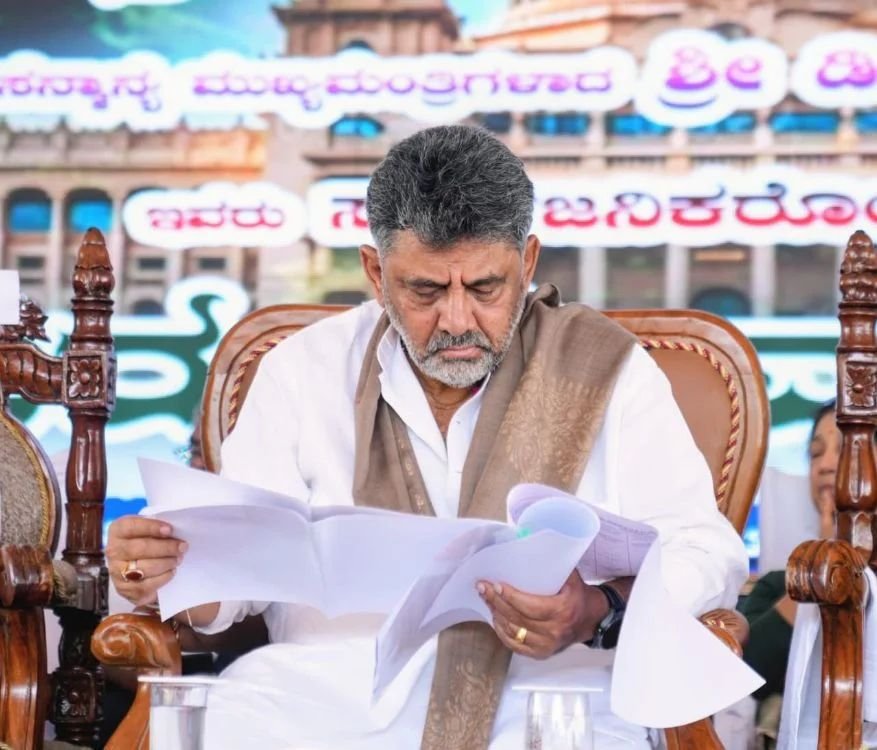
Chief Minister D.K. Shivakumar reviews documents during the public interaction on the Kasturirangan report in Sakleshpur. Image: Karnataka Information Department
Sakleshpur: Karnataka will decide its position on the Kasturirangan report only after directly consulting farmers, residents living near forest areas and other local communities, Chief Minister D.K. Shivakumar said on Sunday.
Speaking to reporters in Sakleshpur, Shivakumar said the government would place the issue before both Houses of the state legislature for a detailed discussion before communicating Karnataka’s stand to the Union government.
He said the state had earlier rejected the report, but the Centre had once again sought Karnataka’s opinion by September 27. The government was therefore consulting elected representatives and members of the public in the regions likely to be affected.
“The Opposition may be focused on politics; for us, people’s lives are important,” Shivakumar said.
State’s opposition to Kasturirangan report continues
Shivakumar said Karnataka had consistently opposed the Kasturirangan report, including during the earlier government led by Siddaramaiah. Since the matter had been referred back to the state, the next decision would take account of public opinion, he said.
The government was examining the report’s possible impact on livelihoods, farmers and communities living around forest areas, he added.
Public consultations across affected districts
The Chief Minister said discussions had already been held with legislators and public representatives from different districts. Public opinion had been gathered in Udupi, Chikkamagaluru and Shivamogga, and the government had now reached the Sakleshpur region of Hassan district.
At a public interaction held at the APMC Yard in Sakleshpur, Shivakumar heard concerns relating to the Kasturirangan report and the lives of people in and around ecologically sensitive and forested areas.
He said concerns raised in the remaining affected regions would also be heard and considered before the government finalised its position.
Special session to discuss report and public concerns
Shivakumar said the special session had been convened to discuss major issues affecting the public, including the Kasturirangan report. Members of the Legislative Assembly and Legislative Council would be given an opportunity to present their views in detail.
“We will understand the feelings of the people, the farmers and those living next to forests, and then discuss the matter in the legislature,” he said.
Responding to a question on whether drought and farmers’ problems could also be raised during the special session, Shivakumar said the legislature had already provided opportunities to discuss farmers’ issues through regular proceedings, including Question Hour and calling-attention notices. Members would be allowed to participate in accordance with the purpose of the special session, he said.
Government at people’s doorstep
The Chief Minister said his government wanted to reduce the distance between citizens and the administration.
“The wall between the government and the people must be broken. We will try to resolve as many problems as possible,” he said.
Ministers and legislators had been instructed to meet people every Saturday and receive grievances, while officials had been directed to cooperate in resolving them. The government had also launched the ‘Praja Seva’ system to address problems in phases, he said.
Wild elephant conflict in Sakleshpur
Shivakumar also acknowledged the seriousness of the wild elephant problem in Sakleshpur, saying it had persisted for about a decade. He said the issue would be discussed comprehensively along with the Kasturirangan report, farmers’ difficulties and the concerns of people living near forests.
“Let the legislators and ministers speak. Everyone should participate. We will decide the next course of action keeping people’s problems in mind,” he said.
Ministers Shivalinge Gowda, MPs Shreyas Patel and G.C. Chandrashekhar, legislators Cement Manju and T.D. Rajegowda, Chief Minister’s political secretary A.S. Ponnanna, BDA chairman N.A. Haris, Hassan Deputy Commissioner Latha Kumari and several former legislators and local leaders attended the interaction.
About the Author