
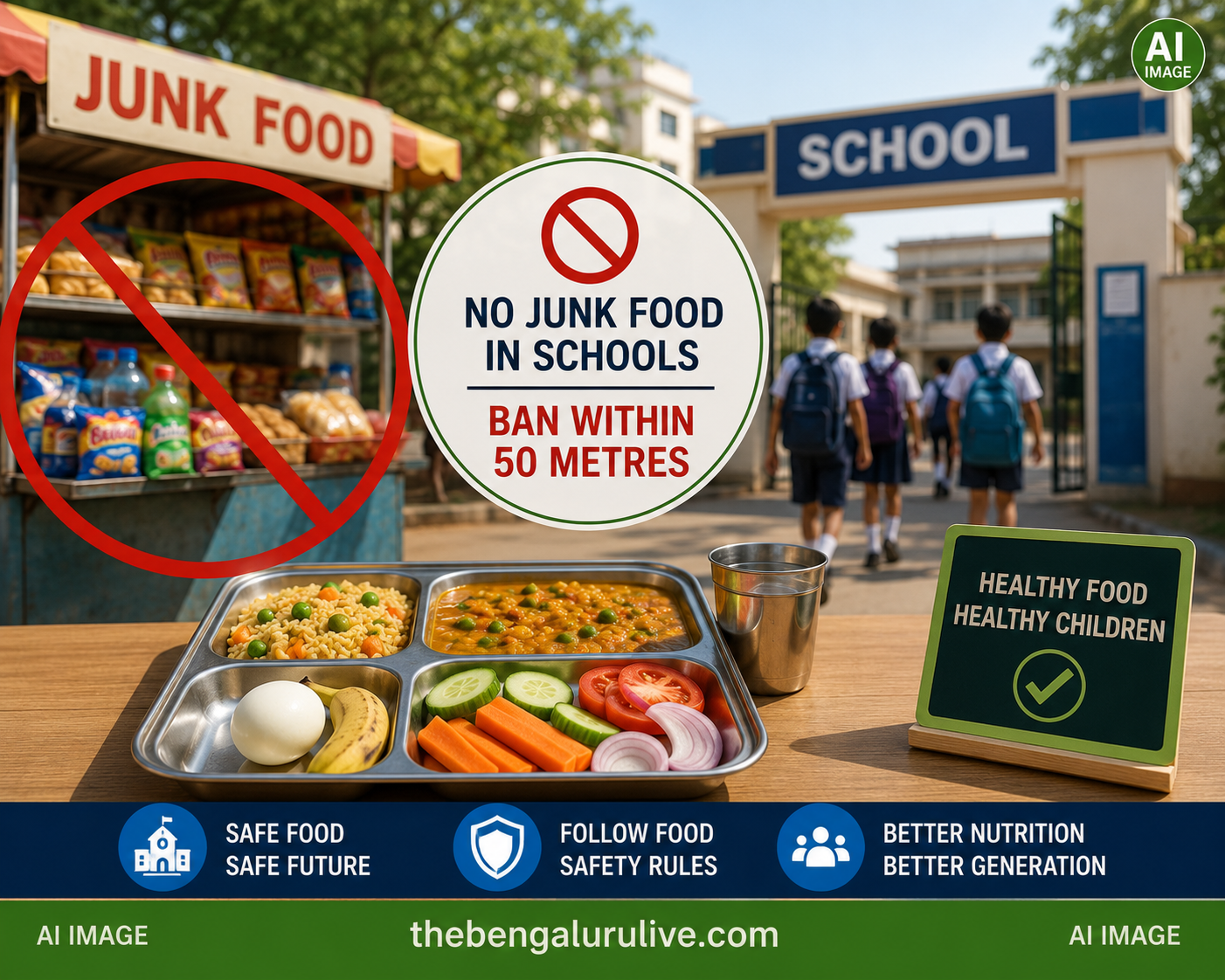
Karnataka Bans Sale of Junk Food in Schools, Colleges and Within 50-Metre Radius
Bengaluru: The Karnataka Food Safety and Drug Administration (FDA) has prohibited the sale, free distribution, advertisement and promotion of food products high in fat, sugar and salt (HFSS) within school and college premises and within a 50-metre radius of educational institutions. The advisory, issued on July 24, 2026, directs strict enforcement of food safety regulations to promote healthier eating habits among children.
The advisory states that inspections conducted by the department found that food served to children in some schools contains excessive refined carbohydrates such as white bread, pasta and processed snack foods, which can lead to rapid spikes in blood sugar levels. It emphasises the need to balance meals with lean proteins and healthy fats to provide sustained energy and improve students’ concentration throughout the day.
Issued under the Food Safety and Standards Act, 2006 and the Food Safety and Standards (Safe Food and Balanced Diets for Children in School) Regulations, 2020, the advisory makes compliance mandatory for Food Business Operators (FBOs), school and college managements, and Food Safety Officers.
Under the directions, the sale, distribution, advertising and promotion of HFSS food products are prohibited inside educational institutions and within a 50-metre radius. School managements have been instructed to ensure that such products are not sold on their campuses and to prominently display warning signboards at key locations. Authorities have also directed that necessary action be taken to prevent the sale of HFSS foods around schools.
The advisory mandates that food establishments located near schools, including food stalls, hotels, bakeries, canteens and other food businesses, obtain the required registration or licence under the Food Safety and Standards Act, 2006 and strictly adhere to hygiene and food safety standards. Food Safety Officers have been directed to conduct regular inspections of vendors operating around schools and colleges and initiate legal action wherever violations are detected.
Food business operators found violating the regulations will face action under the Food Safety and Standards Act, 2006 and the Food Safety and Standards Rules and Regulations, 2011. Penalties may include improvement notices, suspension or cancellation of licences, seizure of food products and judicial proceedings wherever necessary.
The advisory also directs school managements to promote healthy eating habits among children, create awareness about nutritious food and organise programmes discouraging the consumption of junk food. Meals served in schools and colleges must comply with the Food Safety and Standards (Safe Food and Balanced Diets for Children in School) Regulations, 2020.
Schools have been instructed to ensure that students receive safe drinking water free of cost and that weekly menus include cereal-protein combinations and micronutrient-rich meals. The recommended menu includes whole grains such as wheat, rice and millets, pulses, milk and milk products, eggs, fruits, vegetables, nuts and oilseeds. The advisory also recommends the use of seasonal and locally available produce, moderate use of cooking oil or ghee, avoidance of reheated oils and the use of fortified wheat flour, rice, milk, edible oil and double-fortified salt in accordance with prescribed standards.
The guidance further encourages the inclusion of freshly prepared cooked foods, soups, porridges, steamed snacks and cereal- or pulse-based dishes such as idli, upma, poha, khichdi, dhokla and cheela. At the same time, schools, hostels and educational institutions have been directed not to make available food products high in saturated fat, trans fat, added sugar or sodium.
The Commissioner of Food Safety and Drug Administration said the advisory has been issued to inform school and college managements, food business operators and the public about the measures being implemented to improve children’s nutrition and ensure safer food environments in and around educational institutions.
About the Author