Greater Bengaluru Authority Proposes Paid Parking Rules, Tax Incentives for Off-Street Facilities; Public Feedback Open Until September 10
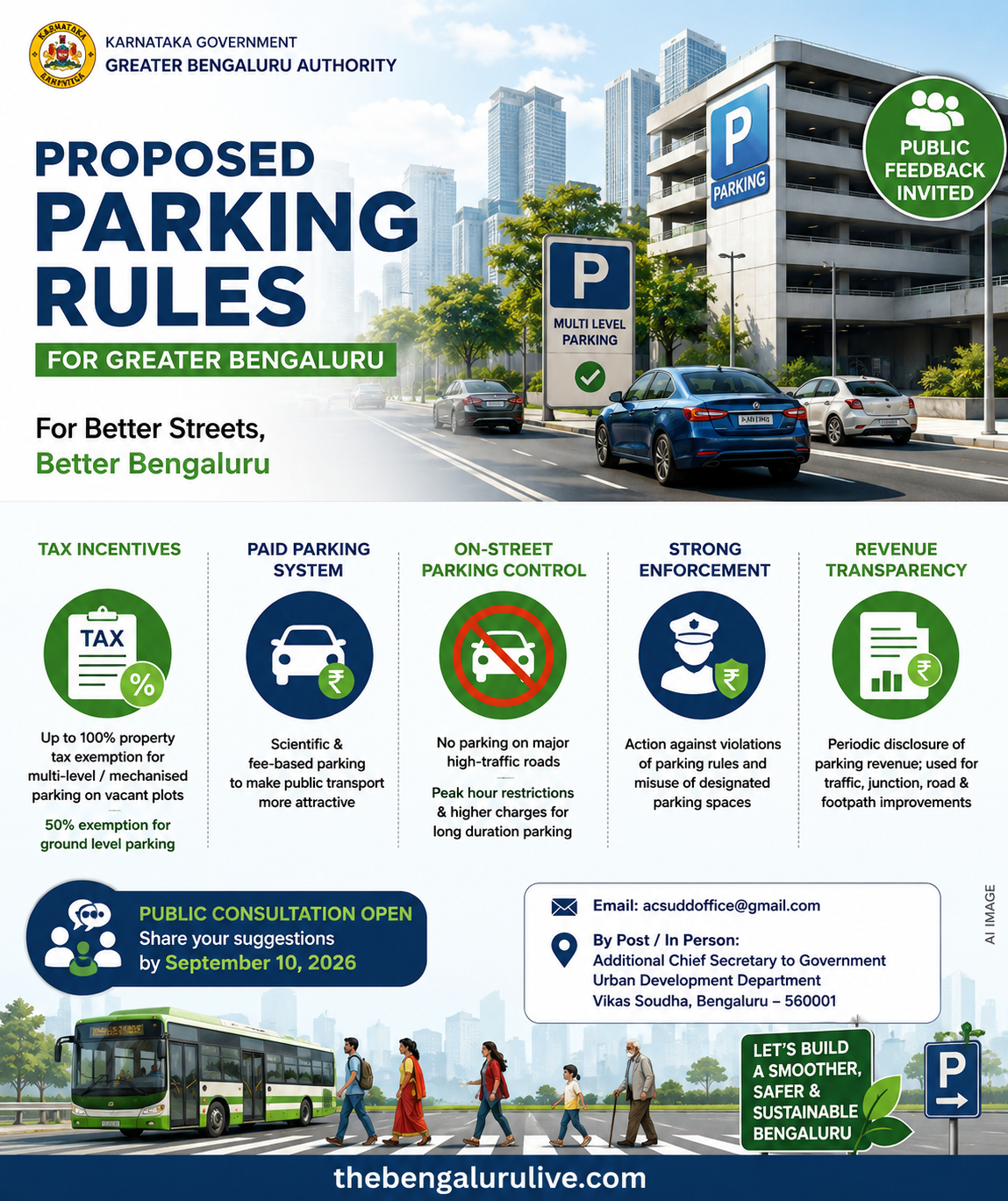
Bengaluru: The Greater Bengaluru Authority (GBA) has proposed comprehensive parking rules for the Greater Bengaluru area that include scientific fee-based parking, restrictions on on-street parking, property tax incentives for vacant plots used as parking facilities, stronger enforcement against misuse of designated parking spaces in buildings, and periodic disclosure of parking revenue. The draft rules have been opened for public suggestions, with comments invited on or before September 10, 2026.
According to a note issued by the Karnataka government’s Urban Development Department and the GBA, Bengaluru currently has more than 1.28 crore registered vehicles, besides an estimated 15 lakh to 20 lakh vehicles registered elsewhere but being used in the city. The government estimates that Bengaluru therefore has around 1.5 crore vehicles.
The note states that vehicles remain parked for about 95% of the time at homes, offices or other locations, making parking management a major urban challenge. The government had formulated a parking policy in 2021 and has now prepared draft rules under that policy while inviting suggestions from the public and elected representatives.
The government said the shortage of road space, narrow roads and rising traffic congestion have compounded the problem. A substantial portion of roads built for vehicle movement is being occupied by parked vehicles, reducing road carrying capacity and contributing to congestion and longer travel times.
Unregulated parking also obstructs pedestrians and particularly affects children, senior citizens, women and the general public, the note said. Roads in residential areas intended for safe use by local residents, children and elderly people are increasingly being occupied by private vehicles, while public road space is being used substantially for private purposes.
The government said roads are valuable public assets over which everyone has equal rights. It argued that the use of such public assets for parking private vehicles needs to be regulated to ensure equitable access. Providing parking for private vehicles is primarily the responsibility of vehicle owners, and public rights over public spaces should not be subordinate to private parking requirements, the note said.
The document said the average speed of vehicles on major city roads during peak hours is around 15 kmph, while the average speed of government buses is around 10 kmph. Unregulated vehicle parking has been identified as one of the major factors worsening traffic conditions.
The parking issue was discussed at a meeting on March 19, 2026, chaired by the then Deputy Chief Minister and present Chief Minister, with Bengaluru’s elected representatives in attendance, according to the note. The meeting unanimously agreed on the need to regulate parking, for which a parking policy and an implementation framework were considered necessary.
The government said Bengaluru’s rapidly increasing population and vehicle numbers are intensifying the parking problem. While multi-level and other parking facilities are required, such facilities would not be viable without regulating indiscriminate on-street parking. A regulatory framework is also needed to create additional parking capacity, it said.
The proposed framework seeks to increase organised parking facilities, encourage conversion of vacant plots into parking spaces, promote compliance with parking practices, prevent violations of building rules and misuse of designated parking areas, scientifically regulate and price on-street parking, and strengthen enforcement.
The note warned that the problem would grow as vehicle ownership increases and said failure to regulate parking could adversely affect
About the Author