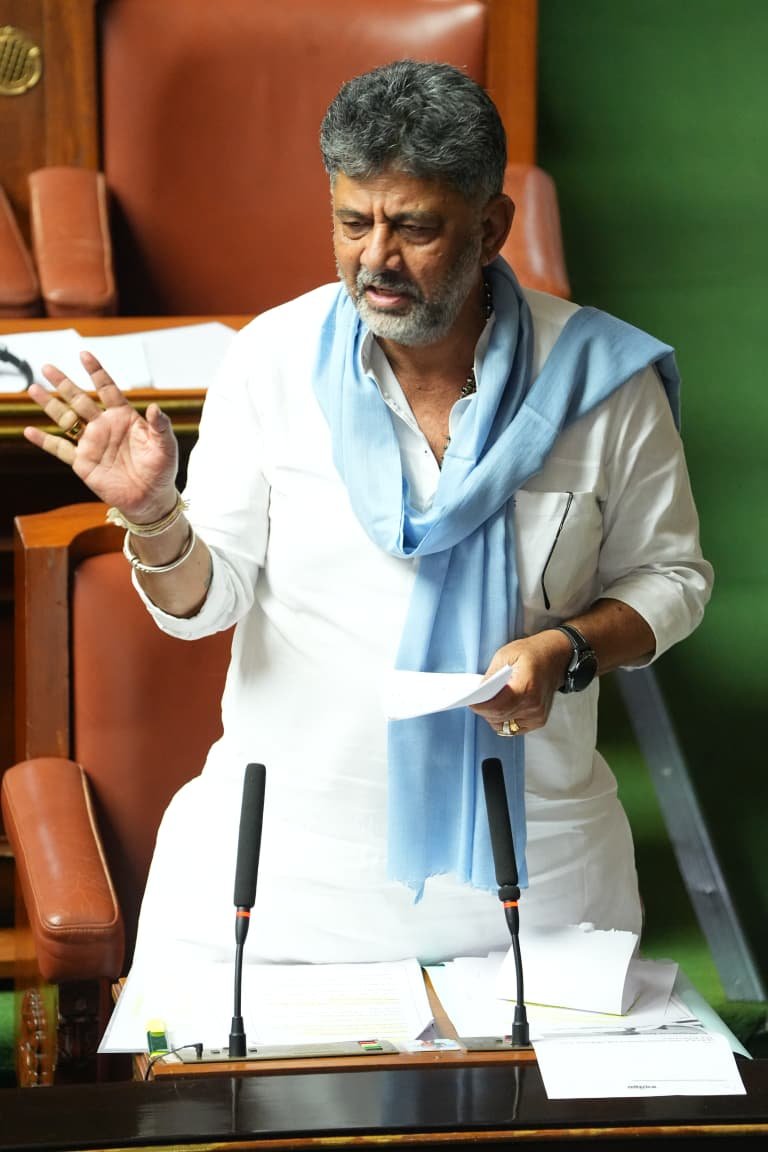
DK Shivakumar speaks during the drought debate in the Karnataka legislature.
Bengaluru: Karnataka is ready to bear its share of a farm loan waiver if the Union government agrees to waive farmers’ debts amid drought, Chief Minister DK Shivakumar said, urging opposition leaders to join an all-party delegation to Prime Minister Narendra Modi.
Replying to Leader of the Opposition R Ashok during the drought debate in the legislature, Shivakumar said he was open to a 50:50, 60:40 or 70:30 cost-sharing formula. He asked the opposition to help secure a contribution from the Centre and said he would, if necessary, stop other programmes to prioritise farmers.
The remarks were a conditional offer for a Centre-state arrangement, rather than the announcement of an implemented loan-waiver scheme or a decision already taken to suspend programmes.
All-party delegation to seek Central support
Shivakumar argued that the Centre should waive farmers’ loans, alleging that industrialists had received loan waivers running into lakhs of crores. He recalled farm loan waivers under Manmohan Singh at the Centre and under Siddaramaiah and HD Kumaraswamy in Karnataka.
Referring to the Congress-supported coalition government, he said Kumaraswamy’s waiver had been enabled by Congress support, citing the parties’ respective strengths of 80 and 38 legislators.
Welcoming Ashok’s willingness to accompany the delegation, Shivakumar said he would write to Modi seeking an appointment and also try to contact him. He urged opposition leaders to use their own channels to secure a meeting and asked MPs to join the effort.
He said Karnataka had obtained about ₹3,000 crore in drought relief after approaching the Supreme Court on an earlier occasion. Describing this as significant in a federal system, he criticised MPs for not pressing the state’s case then, while promising to give opposition leaders due respect in the proposed joint effort.
Drought, fodder and electricity pressures
Shivakumar said he had held divisional meetings in Belagavi, Kalaburagi and Chitradurga and visited districts to assess drought. Fodder shortages and milk procurement prices were among the issues raised by legislators, he said.
Claiming that Tamil Nadu had raised milk prices by ₹11, he said milk from Karnataka’s border areas was flowing to the neighbouring state. He also referred to changes in rural employment funding, saying the earlier 90:10 sharing ratio had become 60:40 under the scheme he identified as VB Gram G, and that drought areas had scope for 50 additional days of employment.
On electricity, he said Energy Minister KJ George faced the difficulty of purchasing power at ₹22 a unit. He put annual growth in Karnataka’s electricity demand at 10% and cited high purchase costs in Tamil Nadu and Kerala as well.
Recalling the Pavagada solar project, Shivakumar said it had been developed without purchasing farmers’ land. He argued that renewable energy had become important after constraints on coal-based generation.
Tungabhadra and irrigation commitments
Shivakumar said silt occupying about 30 TMC of capacity in the Tungabhadra reservoir was a concern for farmers in Ballari and Koppal. He said he had raised the issue with Union minister CR Patil and received cooperation from V Somanna and Basavaraj Bommai.
According to him, the chief ministers of Karnataka, Andhra Pradesh and Telangana had discussed a parallel reservoir and desilting during a Tungabhadra gate inauguration and reached agreement on the way forward. Rejecting criticism linking his decisions to real estate interests, he said the measures were intended to help farmers.
He also defended consultations with legislators and residents on the Kasturirangan report, saying he had sought a collective decision and asked forest officials not to harass farmers.
On finances, Shivakumar cited irrigation works worth ₹1.25 lakh crore against an allocation of ₹20,000 crore. He said a decision to pay ₹40 lakh an acre to people affected by submergence under the Upper Krishna project would require ₹70,000 crore. Later in the speech, he separately referred to ₹16,000 crore being available while describing contractors’ payment difficulties.
Welfare benefits and political cooperation
Shivakumar said welfare delivery should not depend on how beneficiaries vote. Citing free electricity, food support and Gruha Lakshmi, he argued that assistance continued even in areas where Congress candidates had not won.
He said he preferred cooperation to confrontation and was willing to correct shortcomings in the drought response. He also defended engagement with investors, responding to Sunil’s remarks about Adani by saying contractors and business representatives routinely meet governments.
Shivakumar said Bengaluru’s investment, employment and revenues supported spending in rural Karnataka, while criticising the Centre over GST. He urged members to focus their collective efforts on securing support for farmers.
About the Author