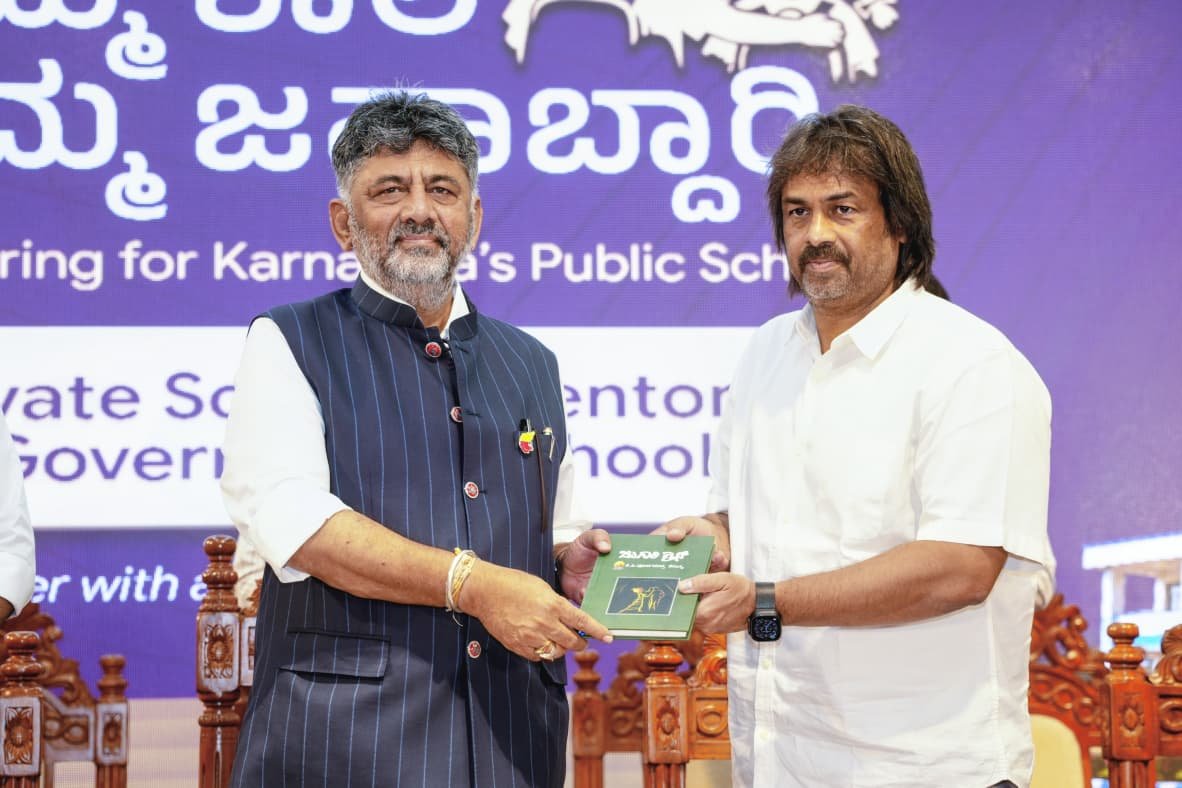
Bengaluru: Chief Minister D K Shivakumar on Wednesday inaugurated the ‘Namma Shale Namma Javabdari’ (Our School, Our Responsibility) programme at a meeting of Institutional CSR (corporate social responsibility) representatives at the Banquet Hall of Vidhana Soudha.
Deputy Speaker Mankal Vaidya, School Education Minister Madhu Bangarappa, Rajya Sabha member Mansoor Ali Khan, the Chief Minister’s Principal Adviser G C Chandrashekar, Chief Secretary Dr Shalini Rajneesh, the Chief Minister’s Additional Chief Secretary Tushar Girinath, School Education Additional Chief Secretary Rashmi Mahesh, Commerce and Industries Principal Secretary Dr S Selvakumar and School Education Commissioner K Vidyakumari were among those present.
Announcing the government’s new CSR policy, Shivakumar called on all private school managements in the state to adopt government schools in rural areas or help develop them.
1,000 schools to be paired first
He said the aim is to pair 1,000 government schools with private schools initially, with a thought of eventually pairing about 2,000. The state has divided its 6,000 panchayats into three categories, he said, calling this “only a beginning” with results expected in four to five years.
The government will not choose which schools a private management takes up; managements can decide according to their convenience and finances, he said. Those who cannot spend ₹5 to ₹10 crore on buildings can send their own teachers to government schools and pay their salaries, he suggested, or give school buses, lab equipment and computers instead of selling old buses.
CSR funds and examples
Shivakumar said Karnataka has ₹8,800 crore in CSR funds every year and that he has asked company managements to make rural primary schools the first priority; some have already started work. He said he and the Chief Secretary met Union Finance Minister Nirmala Sitharaman about companies that register in Karnataka but spend the money elsewhere, and asked for curbs on the practice.
In Bengaluru South district, CSR-funded work has begun in 30 schools, he said, putting 10 per cent of the work as complete, work under way in 8 schools and agreements concluded with 12. Toyota is helping build 23 schools in Ramanagara district, investing ₹10 to ₹15 crore in each, with building plans provided by the government. The government will not take CSR money under any circumstances, he said.
Private schools that develop a government school can add their name to its name; the government school at Heggunur on the Tamil Nadu border has been allowed to be called Heggunur Government Toyota School, he said.
Appeal to private managements
Shivakumar said the government takes a soft approach towards private schools and knows they charge fees of ₹50,000 to ₹2 lakh. Extending a part of their quality to government schools would reduce the migration of rural students to cities, he said, adding that a private school can adopt up to three schools and that adopting and developing government schools is their duty.
He said the government has taken a ₹2,000 crore World Bank loan for infrastructure in KPS schools and pays government school teachers ₹70,000 to ₹1.5 lakh a month, though quality still has to improve. A separate department has been set up for global investment, and people abroad have already come forward to develop schools in their villages, he said.
On Bengaluru, he said road expansion is about 8 per cent against 18 to 20 per cent in Mysuru, children take an hour to reach school, and employment and education are the causes of congestion. If rural children get education in their villages, the pressure on Bengaluru will ease, he said. He also said 38 of the country’s 140 international-standard schools are in Karnataka, and that he was impressed by government school students’ cultural programme at the Rajyotsava event in Kanteerava Stadium.
A later government release described the meeting as the Individual CSR meeting. It said Ministers S Madhu Bangarappa, M B Patil, Priyank Kharge and Rudrappa Lamani, Chief Minister’s Principal Adviser G C Chandrashekar, Chief Secretary Dr Shalini Rajneesh, the Chief Minister’s Economic Adviser L K Atheeq, School Education Additional Chief Secretary V Rashmi Mahesh, Commerce and Industries Principal Secretary Dr S Selvakumar and School Education Commissioner K Vidyakumari were present. Agreements were signed with various companies and institutions for the development of Karnataka Public Schools in the Chief Minister’s presence.
An updated government copy of the Chief Minister’s speech said 15 agreements worth ₹206.10 crore were signed for the development of 56 schools at the meeting, which it described as a meeting of institutional CSR representatives and individual CSR contributors.
At the district level, Deputy Commissioners, DDPIs and Chief Executive Officers have been empowered to sign MoUs directly with companies, according to the updated copy of the speech. Shivakumar also said a separate Department of Global Investors and NRIs has been launched to ease doing business and employment for global investors and NRIs; he said ministers decide on proposals up to ₹500 crore, larger ones come to him, and incentives of up to 30 per cent have been approved in the last four to five months for companies investing ₹10,000 crore.
The release added that the names of the participating organisations will appear on the adoption certificates given to schools and students.
About the Author