
Karnataka Govt Defends Temporary Closure and Conditional Reopening of Bandipur–Nagarahole Safari
Bengaluru: Karnataka Forest, Wildlife and Environment Minister Eshwar B. Khandre has defended the government’s decision to temporarily suspend safari operations in Bandipur and Nagarahole National Parks last November, stating that the move was taken to protect human lives after a series of wildlife attacks.
Speaking in the Legislative Assembly during the Question Hour, Khandre responded to Opposition Leader R. Ashoka, who criticised the decision and said that more than 4,000 people had lost their livelihood due to the suspension of safari activities.
The minister clarified that the safari was not stopped abruptly. In November, three serious wildlife attack incidents occurred within a span of 15 days, resulting in three deaths and one person being permanently disabled. In addition, tigers had begun venturing out of the forest and attacking people in nearby areas. The government therefore took the precautionary step of suspending the safari temporarily.
Farmers Raised Safety Concerns
Khandre said that during a review meeting held in Chamarajanagar, several farmer organisations had expressed concern that safari operations were continuing till late hours, with heavy vehicle movement and increased tourist inflow disturbing wildlife and forcing animals to move out of forest areas.
Following another tiger attack that killed a person within a week, the government decided to temporarily halt safari operations and redeploy safari vehicles and staff for monitoring activities in forest-fringe villages.
Strengthened Surveillance
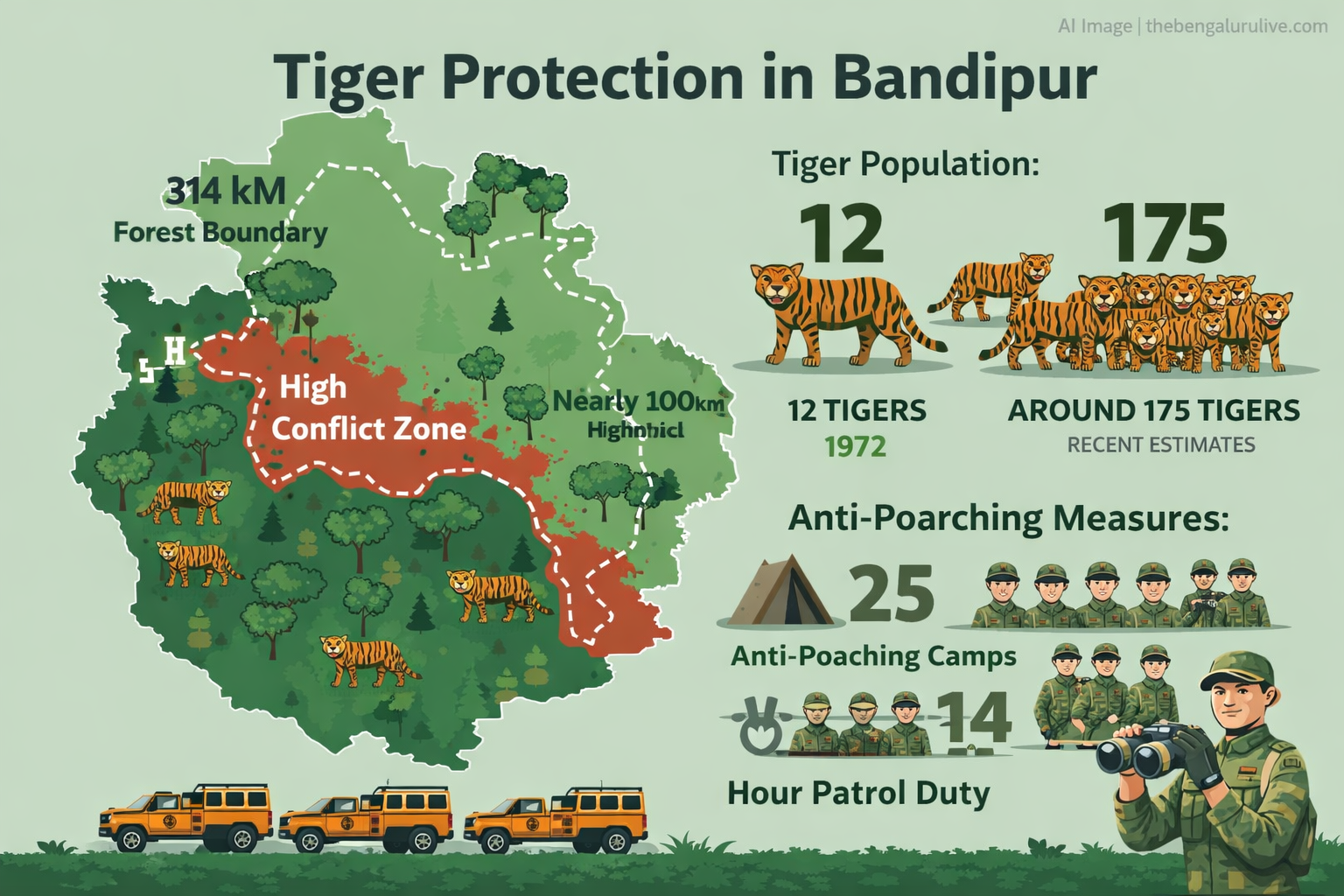
The minister informed the Assembly that Bandipur has a forest boundary of about 314 km, of which nearly 100 km is considered a high conflict zone. To strengthen monitoring, the government set up 25 anti-poaching camps in the vulnerable areas and deployed staff for 14-hour patrol duty.
A centralised command centre was also established to monitor wildlife movement and prevent further incidents. Safari operations were resumed only after these precautionary measures were put in place.
Expert Committee Review
The issue was also discussed in the State Wildlife Board meeting chaired by the Chief Minister, after which an expert committee including representatives from the Wildlife Institute of India was constituted. Safari operations were restarted based on the committee’s preliminary recommendations, the minister said.
Tiger Population Rising
Khandre also highlighted the growth in Bandipur’s tiger population. While there were only 12 tigers in 1972, recent estimates show the number has increased to around 175 tigers.
He added that an expert committee has been asked to assess the carrying capacity of the forest, noting that forest area is shrinking while wildlife numbers are increasing.
Revenue for Local Development
The minister said that after the safari was resumed, 35% of the revenue generated from safari tourism will be used for development of forest-fringe villages, including education, infrastructure and livelihood opportunities.
The government hopes these measures will balance wildlife conservation, tourist activity and local community welfare, he said.
ಇದನ್ನೂ ಓದಿ: ಬಂಡೀಪುರ–ನಾಗರಹೊಳೆಯ ಸಫಾರಿ ತಾತ್ಕಾಲಿಕ ಬಂದ್ ಹಾಗೂ ಪುನಾರಂಭ: ಸರ್ಕಾರದ ಸಮರ್ಥನೆ
About the Author