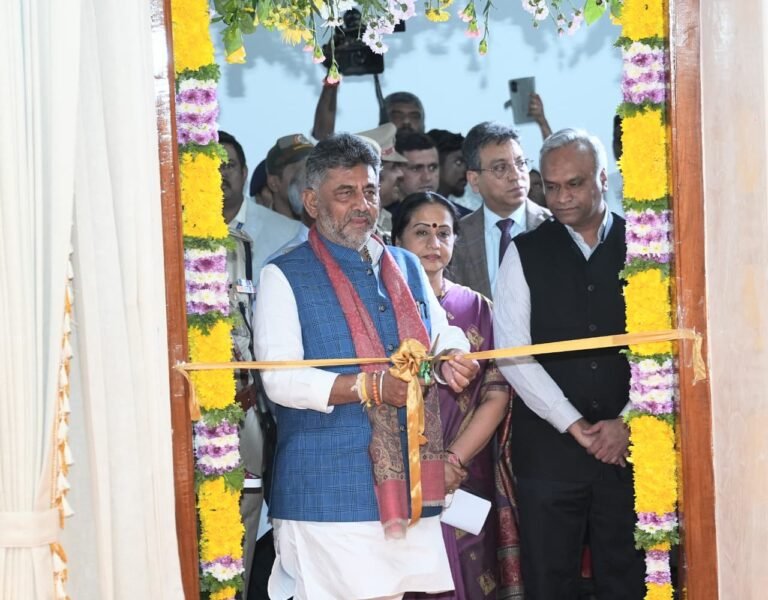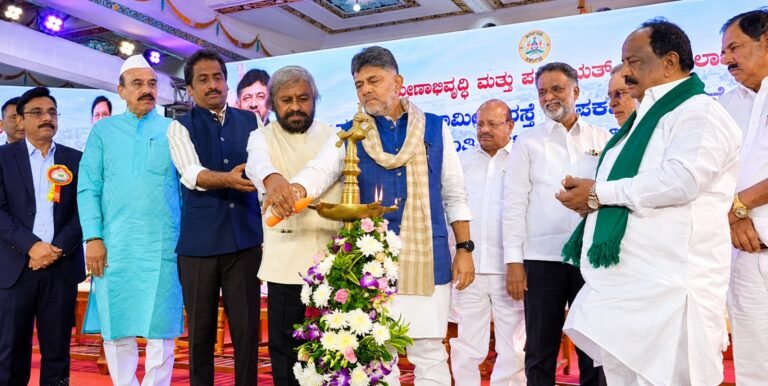
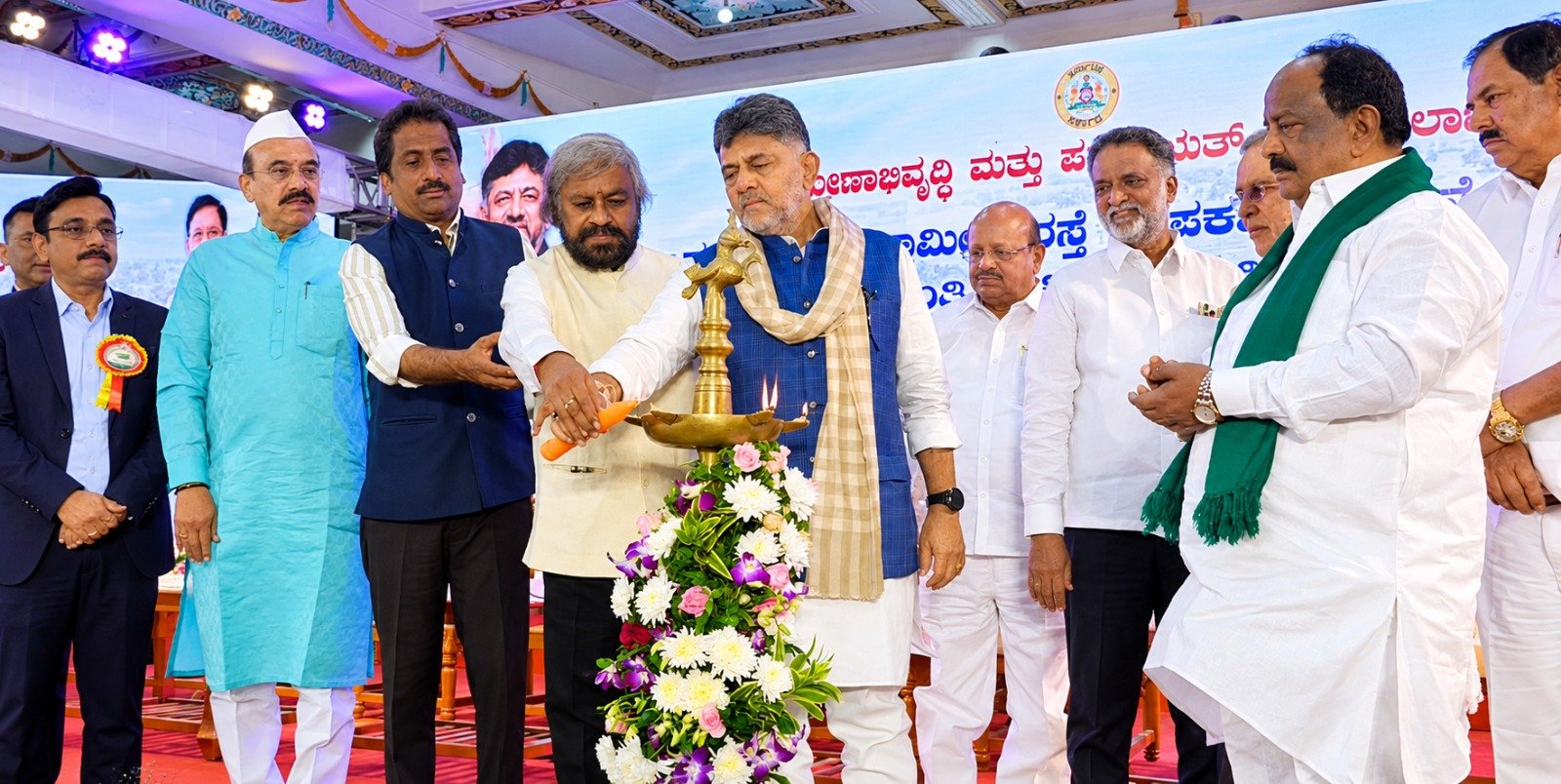
Dignitaries lighting the lamp at the launch of the rural road connectivity and rural development schemes at Vidhana Soudha in Bengaluru on Friday.
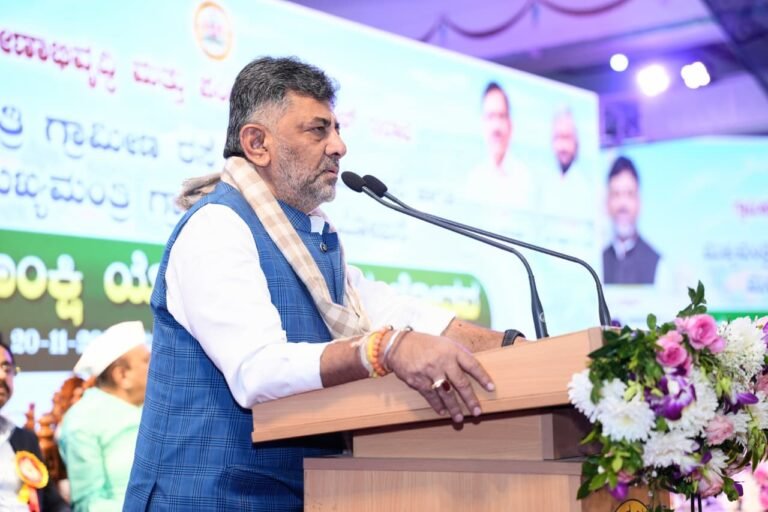
Bengaluru: Rural Development and Panchayat Raj Minister Eshwar B. Khandre on Friday announced that a special task force will be formed to clear encroachments on rural lakes, saying 11,671 acres of encroachment remain on 4,828 lakes under the ownership and maintenance of gram panchayats. He was speaking at the launch of works worth Rs 16,000 crore under the Chief Minister’s Rural Road Connectivity Scheme and the Chief Minister’s Rural Development Scheme at the Banquet Hall of Vidhana Soudha, according to a release.
There are 32,504 lakes in the limits of 5,927 gram panchayats, of which 11,498 lakes had 26,873 acres of encroachment, Khandre said. Encroachments on 6,670 lakes covering 15,201 acres have been cleared, and encroachments on the remaining 4,828 lakes covering 11,671 acres are yet to be cleared, he said. If encroachments on rural lakes are cleared, the lakes are desilted and obstructions in rajakaluves and storm water drains are removed, the lakes will fill in the monsoon and groundwater levels will rise, he said, asking everyone to cooperate in the clearance.
Recalling Mahatma Gandhi’s remark that India is a land of villages and that the country cannot develop without village development, Khandre said the Cabinet chaired by Chief Minister D.K. Shivakumar had approved the Rs 16,000 crore plan, which he called a historic decision for rural development, and thanked the Chief Minister, the Deputy Chief Minister and Cabinet colleagues. Read the report on the Chief Minister’s launch speech.
Good roads are a ladder of progress that speed up goods transport and help farmers take produce to markets, strengthening the rural economy, Khandre said. Karnataka has 1,99,458 km of rural roads, and some of the bituminous roads have been damaged by rain and traffic, he said. Existing bituminous roads have been classified as bad, average and good, and Rs 7,000 crore is being spent on developing the damaged roads, with the worst affected taken up first, while Rs 3,000 crore is being spent on re-asphalting major rural roads, which will be developed with a responsibility to maintain them for three years, he said.
Chief executive officers of the panchayats were called to the meeting because the government has already given administrative approval for 15,000 km of roads, so they do not need to send proposals again for government approval, Khandre said. They should prepare designs and detailed project reports at their own level, build quality roads, complete the works in 15 months and dedicate them to rural Karnataka, he said.
To keep the roads at the required quality, works will be inspected three times, twice while in progress and once after completion, he said. Zilla Panchayat chief executive officers must physically inspect 10 per cent of the works, and taluk panchayat executive officers must do the same for 10 per cent of works in their jurisdiction, and bills must be uploaded in the NGSK software with the inspection report, he said. The government is separately providing Rs 6,000 crore for quality CC roads and drains in gramathana areas and for new rural roads that are not in the DRRP, he added.
Under VB-G RAM G, 2.68 crore person-days of work had been created until Thursday, which means an average of about two and a half lakh unskilled workers work every day, helping prevent migration during a severe drought, Khandre said. A plan has also been drawn up to build 1,000 bus shelters at 1,000 bus stops in rural areas where many passengers travel, under VB-G RAM G, he said.
Khandre said there is a rainfall deficit this year due to the El Nino effect, 217 taluks have been declared drought-hit, drinking water is scarce and most rural lakes have dried up, and he appealed to all citizens to use water judiciously. He said the government is giving greater priority to village sanitation, that scientific disposal of solid, wet and hazardous waste is the need of the hour, and that single-use plastic must be completely stopped.
Karnataka is a leading state in water budgeting, Khandre said, adding that with groundwater levels falling, water budgeting is being done as a short-, medium- and long-term plan by estimating how much water homes, industries, schools, colleges and hospitals will need for the population over the next 30 years and how available surface water can be supplied. Work on the stalled Jal Jeevan Mission single-village and multi-village drinking water schemes has been speeded up again, he said.
About the Author