


New Delhi: In a significant breakthrough in its ongoing probe into Lashkar-e-Taiba’s (LeT) 2023 prison radicalisation network, the National Investigation Agency (NIA) on Tuesday arrested three key accused during multiple searches across Karnataka. The arrested individuals include a prison psychiatrist, a City Armed Reserve policeman, and the mother of a wanted terror operative.
The arrested have been identified as Dr Nagaraj, a psychiatrist at the Central Prison, Parappana Agrahara, Bengaluru; ASI Chan Pasha, a City Armed Reserve officer; and Anees Fathima, the mother of absconding accused Junaid Ahmed.

The arrests followed raids at five locations across Bengaluru and Kolar districts, during which investigators seized digital devices, cash, gold, and several incriminating documents.
According to the NIA, Dr Nagaraj allegedly smuggled mobile phones into prison for inmates, including Tadiyandaveed Naseer alias T Naseer, a convicted terrorist serving a life sentence. He was reportedly assisted by another suspect named Pavithra.
Meanwhile, Anees Fathima was found to have been involved in relaying instructions from Naseer to her son Junaid, facilitating terror funding and logistics for the group’s operations within the prison system.
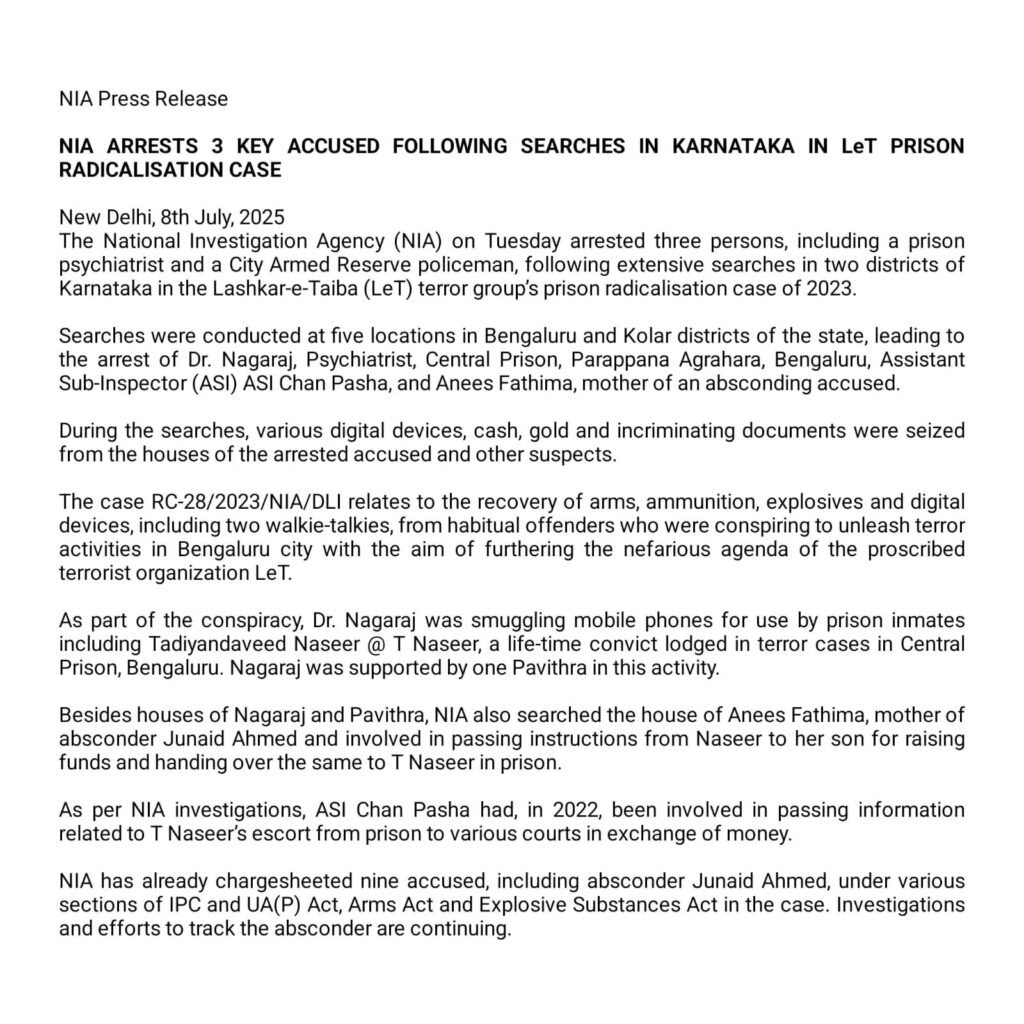
Further, ASI Chan Pasha, who was posted in the City Armed Reserve in Bengaluru, was accused of leaking details regarding Naseer’s movement between prison and court in exchange for money, as per the NIA’s findings.
This case, registered as RC-28/2023/NIA/DLI, stems from the earlier seizure of arms, ammunition, explosives, and digital devices — including walkie-talkies — from habitual offenders in Bengaluru. The group allegedly conspired to orchestrate terror attacks in the city under the LeT banner.
The NIA has already chargesheeted nine accused, including absconding operative Junaid Ahmed, under various sections of the IPC, UA(P) Act, Arms Act, and Explosive Substances Act. Efforts are ongoing to trace remaining suspects and dismantle the larger network.
This crackdown underscores the growing threat of radicalisation and terror facilitation networks operating within prison ecosystems, and the extent of infiltration by extremist groups like LeT.
About the Author