Hebri/Bengaluru, September 18: Chief Minister D.K. Shivakumar on Friday assured residents and representatives of Coastal Karnataka that the government would discuss with officials a demand for a physical ground survey of areas covered by the Kasturirangan report before deciding its position, after local organisations and elected representatives pressed for a Kerala-model assessment to distinguish inhabited areas from forests.
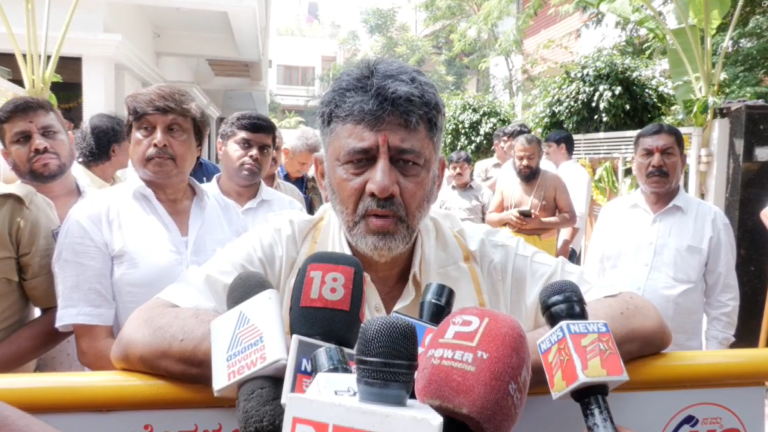
Shivakumar gave the assurance during an interaction with local residents at Hebri in Udupi district on the implications of the Kasturirangan report. Representatives at the meeting argued that reliance on satellite and GPS-based assessment had resulted in inhabited areas being brought within the proposed environmentally sensitive zone and urged the state to constitute an expert committee and undertake a physical survey.
“You have suggested conducting a physical survey in connection with the Kasturirangan report. I will discuss this with the officials and take a decision,” Shivakumar said.
The Chief Minister said the government had come to the region to understand people’s concerns over the Kasturirangan report and the proposed eco-sensitive areas before finalising its position.
“You have explained the Kasturirangan report and the eco-sensitive zone and drawn my attention to the problems you are facing. We have to send our decision to the Centre by the 27th. We have come here because your opinion should become our opinion,” Shivakumar said.
He said participants had proposed adopting the Kerala model and recommended the constitution of an expert committee. The government had taken note of those suggestions and would also discuss the issues during the legislature session, he added.
Kasturirangan Issue to Be Taken Up on First Day of Special Session
Shivakumar said a three-day special session had been convened to discuss the Kasturirangan report along with farmers’ issues and the drought situation.
According to the Chief Minister, the Kasturirangan report would be taken up for discussion on the first day of the session on Monday.
Before that discussion, Shivakumar said he would also visit Shivamogga and Chikkamagaluru to hear the views of people in those regions.
The Chief Minister said his visits were intended to understand the ground realities and people’s concerns before the government arrived at its position.
Speaking to the media before the interaction, Shivakumar said he had come to understand people’s sentiments on the Kasturirangan report, hear their views directly and work towards a solution.
Organisations Seek Kerala-Model Expert Committee and Physical Survey
Representatives of several organisations and elected representatives used the Hebri meeting to place a series of demands before the government.
Those who spoke included senior advocate T.B. Shetty; Malekudiya community state president Sridhar Gowda; Udupi Raitha Sangha representative Uday Kumar Vandse; former gram panchayat president Naveen Adyanthaya; former Nadpal Gram Panchayat president Dinesh Hegde; industrialist Muniyalu Uday Kumar Shetty; MP Kota Srinivas Poojary; and MLA Sunil Kumar.
According to representations made during the meeting, around 20,000 sq km in Karnataka has been included under the Kasturirangan framework, compared with around 13,000 sq km in Kerala.
The representatives told the Chief Minister that Kerala had conducted a physical survey through a high-level committee to distinguish inhabited areas from forests and demarcate boundaries.
They claimed this process reduced the area falling within the Kasturirangan framework in Kerala to around 9,000 sq km and freed about 3,200 sq km from its ambit.
The speakers argued that adopting a similar process in Karnataka could potentially exclude around 5,000 sq km from the report’s coverage. These figures and projections were presented by representatives at the interaction and formed part of their case for a physical survey.
Residents Raise Concerns Over Satellite-Based Assessment
Participants argued that lakhs of people had been living in the affected regions for generations and contended that a physical survey was necessary to accurately distinguish settlements and other inhabited areas from forests.
They told the Chief Minister that the Kasturirangan committee’s assessment had relied on satellite and GPS-based surveys rather than a physical survey on the ground.
According to the representations made at the meeting, this had created discrepancies between the classification and the actual situation in several areas.
Participants claimed that under the criteria they cited from the Kasturirangan report, a village should be considered for inclusion in the sensitive zone only where its population is below 100. They alleged, however, that areas with populations exceeding 100 had also been included following the GPS-based assessment.
They also claimed that the report contemplated a 20% protected-forest threshold, while some areas in their region with around 5% protected forest had been brought within its ambit.
These claims were raised by local representatives during the interaction as reasons for demanding an expert committee and an on-ground physical survey.
Fear of Displacement Raised
Representatives said there was anxiety among residents that implementation of the Kasturirangan recommendations could lead to displacement.
They urged the government to provide clear information to the public about the actual implications of the report and address what they described as uncertainty among people living in the affected areas.
Forest-dwelling communities argued that they had themselves played a role in protecting forests over generations and that forest conservation laws should not result in hardship for people who depend on and live in these areas.
The representatives urged the government to constitute an expert committee, conduct a physical survey and use the findings to place Karnataka’s position before the Union government and, where relevant, before the Supreme Court and the National Green Tribunal.
Forest Rights Act: Government to Consider Uniform 25-Year Requirement
Shivakumar also addressed concerns relating to the Forest Rights Act.
He said the existing framework had different requirements of 25 years for some categories and 75 years for others. The state government would, in the coming days, take a decision seeking a uniform 25-year requirement and send it to the Union government, he said.
The Chief Minister said he had instructed Forest Department officials not to trouble people residing in forest areas.
He also referred to bagair hukum cultivation and the government’s approach towards providing land to cultivators.
‘We Are Not Doing Politics Over Sentiments’
Shivakumar said the government was not seeking to conduct politics merely on people’s sentiments and that its concern was their livelihoods.
“We do not do politics over sentiments. We care about your lives,” he said.
He said important decisions concerning fisheries had been taken by the Cabinet and that representatives from the region had also sought a zonal management plan and a taluk hospital at Hebri.
The government would discuss those demands with officials before taking decisions, he said.
Shivakumar said he did not want to make announcements before the public only for them to be forgotten later.
He said he would use the opportunity available to him to serve people and would return to Udupi for further discussions with elected representatives.
‘People of Tulu Nadu Are an Asset to the Country’
Describing the people of Tulu Nadu as an asset to the country, Shivakumar said he would return to seek their suggestions and would hear their representatives during the legislature session.
“This government is with you,” he said.
The Chief Minister said the government had consulted MLAs and elected representatives from different political parties before holding the special Cabinet meeting in Mangaluru.
According to Shivakumar, 60 decisions were taken at the Cabinet meeting, of which 40 related to the coastal districts.
He also referred to the Cabinet’s decision concerning Tulu, saying the government had decided to recognise the mother tongue of the region as an additional official language in two districts.
Shivakumar said the government had also formulated a policy giving priority to tourism in Coastal Karnataka and Malnad and approved several projects aimed at development and attracting investment.
The objective was to create opportunities locally and prevent people from having to migrate from the region, he said.
CM Highlights Education, Banking Legacy of Coastal Region
Shivakumar described the region as historic and its people as educated, aware and religious.
He said people from elsewhere travelled to the region on pilgrimages and highlighted the banking institutions that originated there and later developed into institutions recognised across the country.
He also emphasised the region’s role in education and healthcare, saying a large number of doctors were trained in Tulu Nadu and that more than four lakh students were pursuing pre-university education.
Shivakumar said the government intended to use the opportunity available to it to serve the people, while reiterating that the views gathered during his visits to the coastal and Malnad regions would feed into the forthcoming discussion on the Kasturirangan report.
About the Author