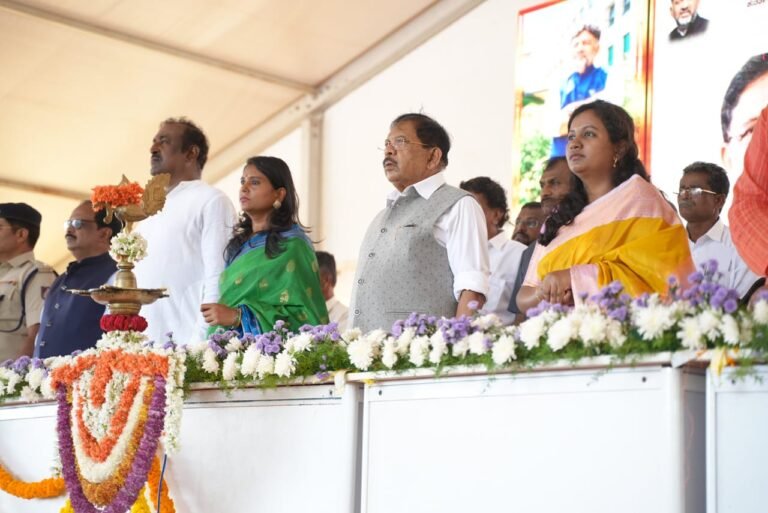
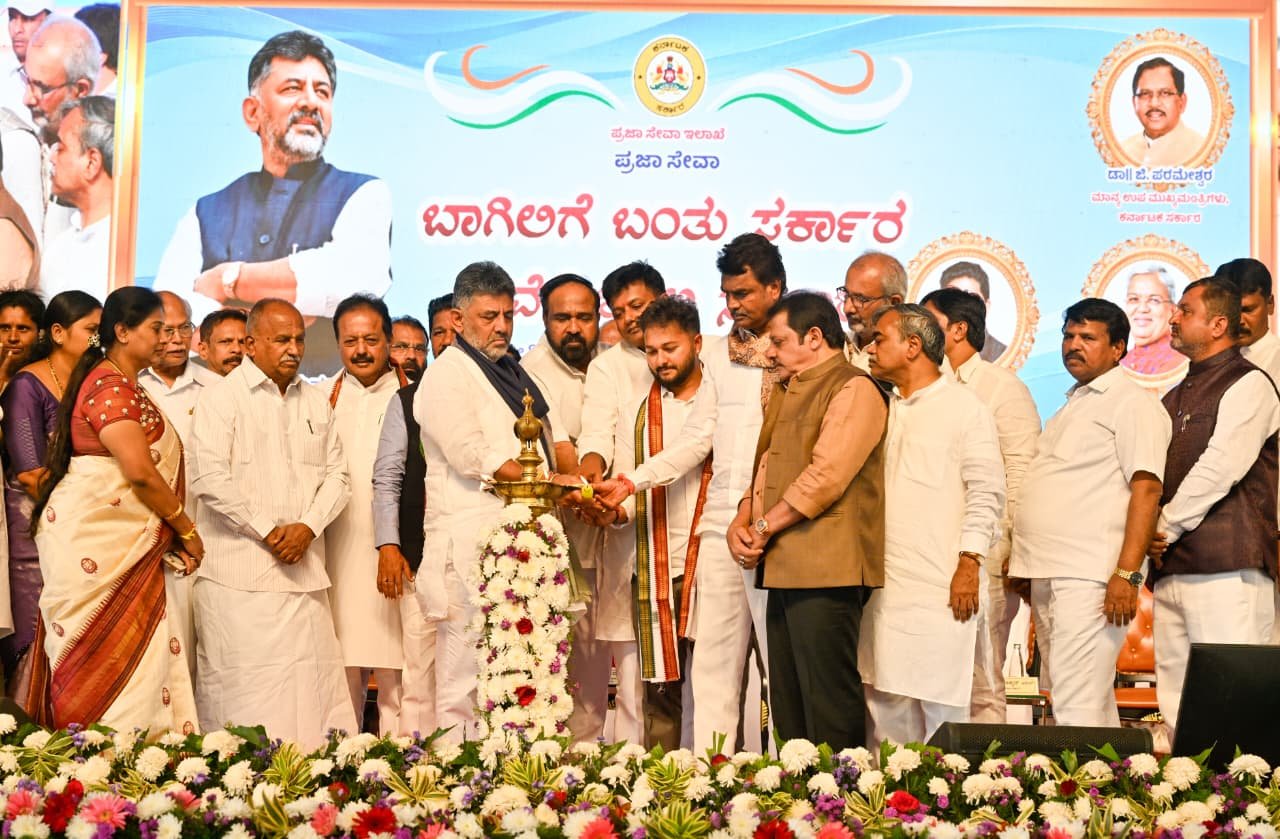
Chief Minister D.K. Shivakumar lighting a lamp at the Praja Seva Abhiyana event on Saturday.
Bengaluru: The Karnataka Cabinet has approved a plan under the Bhooguarantee scheme to distribute 15 lakh free residential sites across the state and to build one lakh new houses at an estimated Rs 2,241 crore, according to a government press release issued on Saturday. The decisions were taken at the 26th meeting of the Cabinet, chaired by Chief Minister D.K. Shivakumar on November 19, to provide homes to poor and vulnerable families without sites, including former soldiers.
The government estimates that about 14.4 lakh people in the state’s population of about 7.2 crore have no residential site of their own, and has set a target of developing 15 lakh sites in rural and urban areas. About 45,000 acres is to be earmarked for nine lakh rural sites, while around 5,000 acres will be used to house five lakh beneficiaries in urban areas in G+3 buildings. District administrations have been told to identify and reserve suitable government land under Section 71 of the Karnataka Land Revenue Act, 1964.
Around 23,500 acres of government land has been identified in all 31 districts so far, which can yield about 4.70 lakh sites, the release said. In the first phase, five lakh sites are to be developed on about 25,000 acres at an estimated Rs 20,000 a site, or Rs 1,000 crore in all. Of this, 40 per cent, or Rs 400 crore, is to be pooled from sources including the VB-G RAM G scheme, the Scheduled Castes and Tribal sub-plans, the District Mineral Foundation, the Kalyana Karnataka and Malnad development boards and MP and MLA local area development funds. The Finance Department has asked the Housing Department to raise funds from various sources this year and has indicated that Rs 200 crore may be provided in the 2027-28 Budget.
Under a proposed plot scheme under the Sainik Samman Yojana, former soldiers and other eligible landless families will get free sites, with a proposed 3 per cent reservation for ex-servicemen. Priority will also go to senior citizens, widows, widowers, divorced persons, single mothers, persons with disabilities and transgender persons. The proposal provides 19.5 per cent reservation for Scheduled Castes and 7.5 per cent for Scheduled Tribes, though the Rajiv Gandhi Housing Corporation has cited a model of 17.15 per cent and 6.95 per cent. Horizontal reservation is proposed at 3 per cent for ex-servicemen, 2 per cent for senior citizens, 3 per cent for widows, widowers and divorced persons, 5 per cent for persons with disabilities and 1 per cent for transgender persons. The Chief Minister has asked the department to take steps to extend reservation to backward classes as well.
One site will be given to each eligible family holding a Priority Household (PHH) or Antyodaya Anna Yojana (AAY) ration card. Annual family income should not exceed Rs 1.20 lakh in rural areas and Rs 2 lakh in urban areas. Couples must apply jointly and ownership records will be issued in both names, while widows, widowers, divorced persons, single mothers, persons with disabilities and transgender persons can apply individually.
Fresh online applications will be invited through Nadakacheri, Bapuji Seva Kendras, Grama One and Karnataka One centres, with Aadhaar-based e-KYC to prevent fake and duplicate applications. About 5.8 lakh rural applications have been pending with the Rajiv Gandhi Housing Corporation since 2018, and the government has decided to re-verify them, but those already on the old list will not be dropped for not reapplying, and their eligibility will be confirmed during field verification. Applicant details will be cross-checked through the Bhoomi Monitoring Cell software against records including Ashraya, e-Swathu, e-Aasthi, Section 94-D, Jal Jeevan Mission and Gruha Jyothi data.
Roads, drains and other infrastructure will be developed in the layouts, boundary stones will be placed at all four corners of each site, and village administrative officers will capture geo-tagged photographs through a mobile app. Tahsildars will issue digital ownership documents under Section 94-D of the Land Revenue Act, and stamp duty and registration charges will be fully waived when registering through Kaveri 2.0, with e-Swathu automatically generating Form 9 and Form 11A afterwards.
Separately, the Cabinet approved building one lakh new houses in 2026-27 on a beneficiary-led construction basis under the Basava Vasati, Dr B.R. Ambedkar Nivas, Devaraj Urs Vasati and Vajpayee Nagara Vasati schemes, at an estimated Rs 2,241 crore. Aid has been raised from Rs 1.20 lakh to Rs 2 lakh for the general category, and from Rs 2 lakh to Rs 3 lakh for Scheduled Caste and Scheduled Tribe beneficiaries, an extra Rs 80,000 and Rs 1 lakh respectively, and the higher rates apply only to the new one lakh houses.
Of the one lakh houses, 68,000 are for rural and 32,000 for urban areas, based on a count of about 14.89 lakh homeless families in the 2018 rural survey and 2016 urban housing demand survey. Scheduled Castes get 17,150 houses (Rs 514.50 crore), Scheduled Tribes 6,950 (Rs 208.50 crore), minorities 15,000 (Rs 300 crore) and the general category 60,900 (Rs 1,218 crore). The Finance Department agreed subject to conditions: the 2026-27 cost will come from the Rs 987.50 crore already available, and the remaining Rs 1,253.50 crore will be found in later years. The department has been asked to review earlier sanctioned houses where work has not begun and, if needed, cancel them and use the savings for the new target.
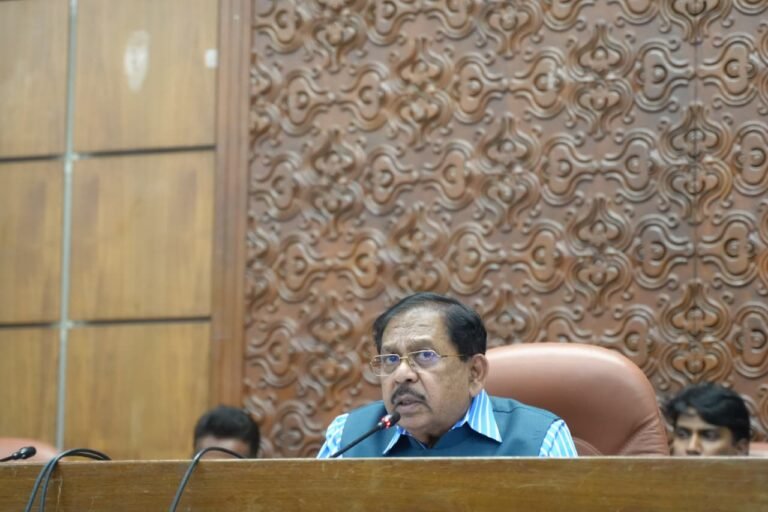
Deputy Chief Minister G. Parameshwara said earlier that five lakh sites will be distributed in the first phase, with distribution beginning in January.
About the Author