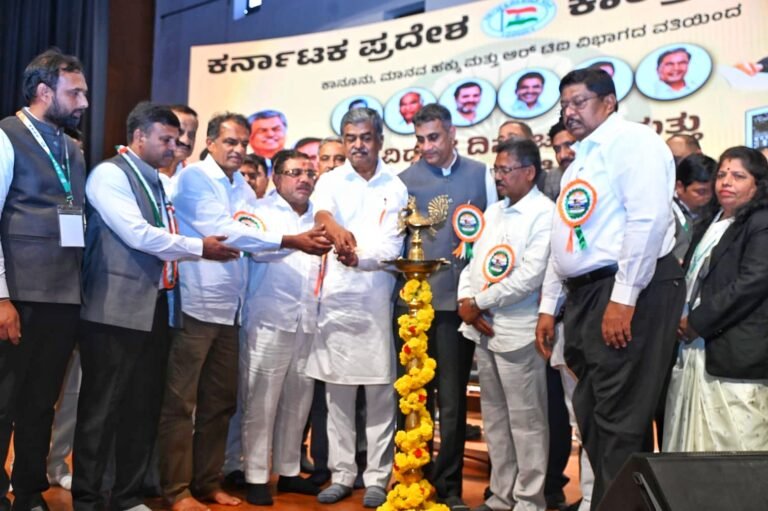
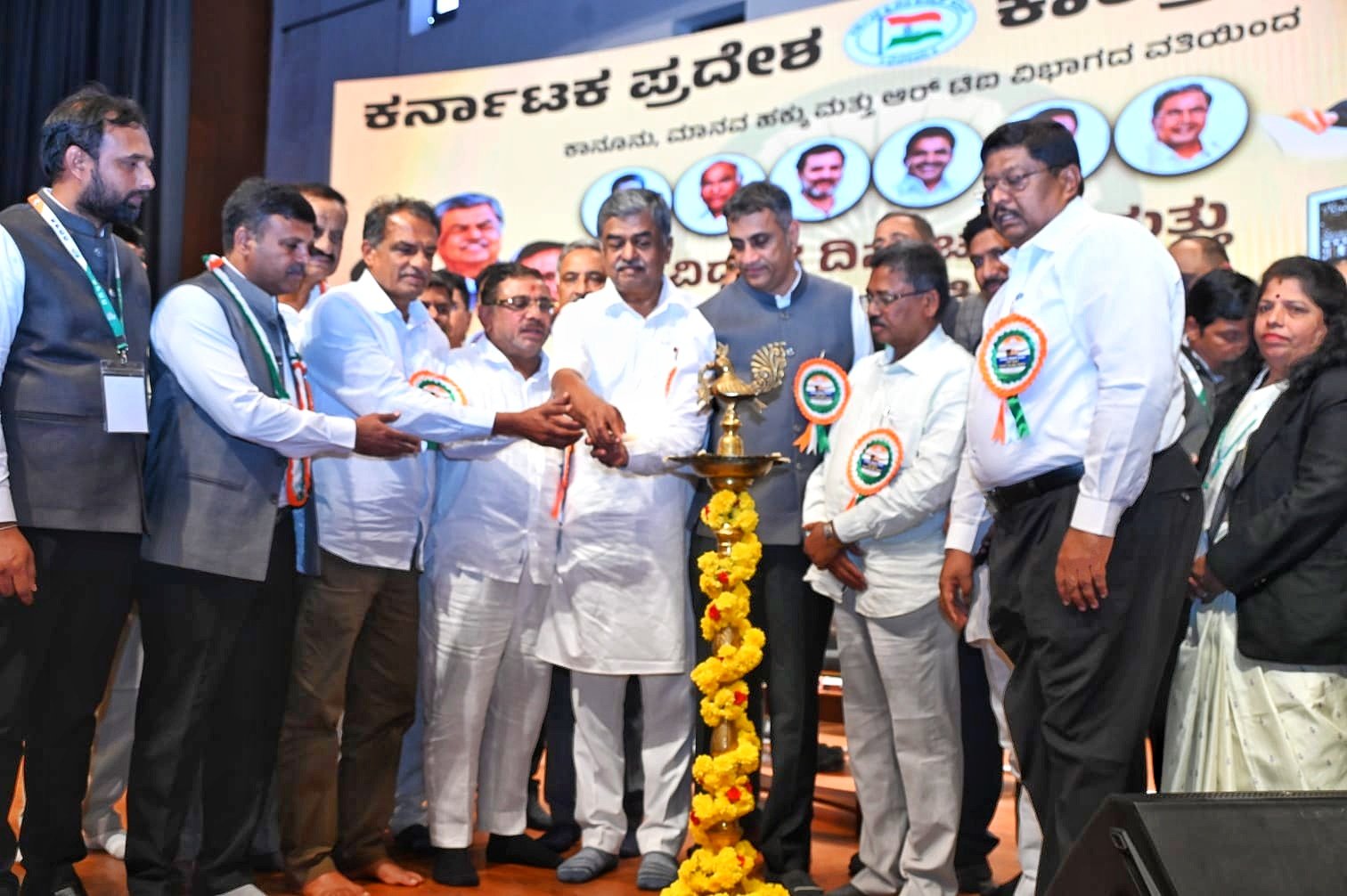
Leaders lighting the lamp at the Constitution Day programme and seminar on “Constitution and Contemporary Politics” at the KPCC office in Bengaluru. Image: KPCC
Bengaluru: The Constitution and democracy exist for the last person in society, not for the well-off, KPCC president B.K. Hariprasad said on Wednesday. No religion protects the Constitution, but the Constitution protects all religions, and that is the greatness of the Indian Constitution, he said.
He was speaking at a Constitution Day programme and a seminar on “Constitution and Contemporary Politics” organised by the KPCC Legal Cell at the Bharat Jodo Hall of the KPCC office in Bengaluru. Chief Minister’s political secretary A.S. Ponnanna, Legislative Council chief whip of the ruling party Manjunath Bhandari, KPCC Legal Cell president C.M. Dhananjaya, KPCC Media and Communication Department chairman Ramesh Babu and former MP V.S. Ugrappa were among those present.
Addressing law students who had come to discuss the Constitution, Hariprasad said they should study its spirit deeply, as it is a question of the country’s future and not only of the present. He said law and the Constitution are different things in India and laws are made within the framework of the Constitution, which was framed after discussions lasting two years, 11 months and 18 days.
Constitution is for the last person: Hariprasad said the Constitution and democracy are meant for the last person in society, and that democracy can become strong only when vote and note are separated. He said the basic spirit of the Constitution is equality. There had been a proposal to begin the Preamble in the name of God instead of “We, the people of India”, but the country has believers, non-believers and rationalists, and a separate Constitution cannot be framed for those who believe in God and those who do not, he said. He said religion is a private matter, while in public life the Constitution is the supreme and sacred book.
Ambedkar’s contribution: Hariprasad said Dr B.R. Ambedkar’s contribution to the making of the Constitution is immense, and that B.N. Rau, the Constitutional Adviser, also helped the process. He alleged that the Sangh Parivar is spreading lies that the Congress did not let Ambedkar frame the Constitution, and said leaders of the freedom movement believed Indians had people capable of framing a Constitution.
Against socialism: He said the basic aim of socialism is to reduce the gap between the rich and the poor, and alleged that opponents of the Constitution are also opposing the ideals of socialism. He said the country has moved beyond theocracy, monarchy and dictatorship to democracy, in which the people are supreme, and that the Constitution gives citizens the power to form and remove governments. However good a Constitution is, he said, its ideals will not be realised if the mindset of those implementing it is not right, and he named Dr Manmohan Singh as a good administrator who could govern in line with its ideals.
Reservation is not a poverty programme: Hariprasad alleged that the RSS is indirectly criticising the Constitution and portraying it as merely about reservation. He said reservation is not a poverty-alleviation programme but a system to provide representation and social justice to communities that have been exploited and denied opportunities for centuries.
Ambedkar and women’s rights: He alleged that the RSS is spreading wrong information that Ambedkar resigned from the Union Cabinet against the Congress. He said Ambedkar had sought equal rights for women in ancestral property and the right to divorce through the Hindu Code Bill, that Jawaharlal Nehru supported the effort, and that the reforms faced strong opposition, which was a major reason for Ambedkar’s resignation. He said the UPA government under Sonia Gandhi and Dr Manmohan Singh later amended the Hindu Succession Act in 2005 to give daughters equal rights in ancestral property, and urged law students to study such historical developments.
Vote and note must be separated: Hariprasad said elections are the foundation of democracy and that the right President Droupadi Murmu has in voting is the same as that of the last person in society, as every citizen’s vote has equal value. He said that today vote and note are coming together, and warned that if the spirit of the Constitution is not followed, ordinary citizens will bear the consequences.
Build a scientific temper: He said society is full of superstition, which is why Nehru advocated rationality and a scientific temper and gave priority to institutions such as the IITs and IIMs. He said young people have the power to change public opinion and to question those in power and make governments accountable, and that this power should be used to protect the Constitution and democracy.
Know history to shape the future: He said that at the time of freeing India from British rule there was debate over whether the country should get dominion status or complete independence, and that the Lahore session of the Congress in 1929 took the historic decision on Purna Swaraj. He said young people should understand the history of the freedom struggle, the background of the Constitution and the contributions of national leaders, and that serious discussions are needed on providing children good education, health facilities and jobs.
Calling on law students to study every article of the Constitution and use their knowledge for the good of society, Hariprasad said the responsibility of protecting the Constitution’s ideals and strengthening democracy lies with everyone.
About the Author