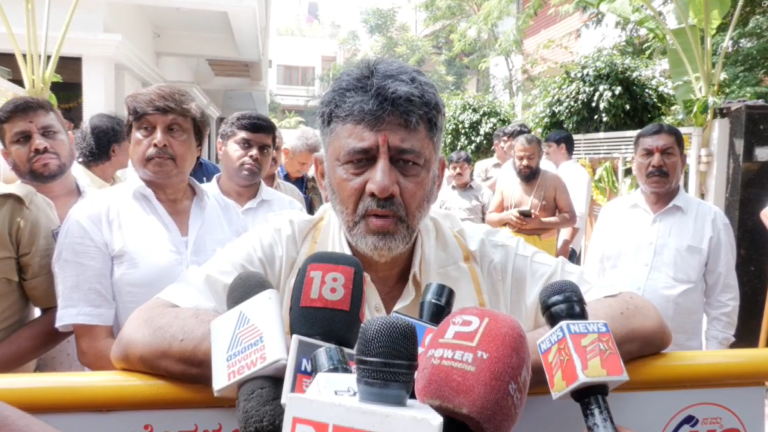
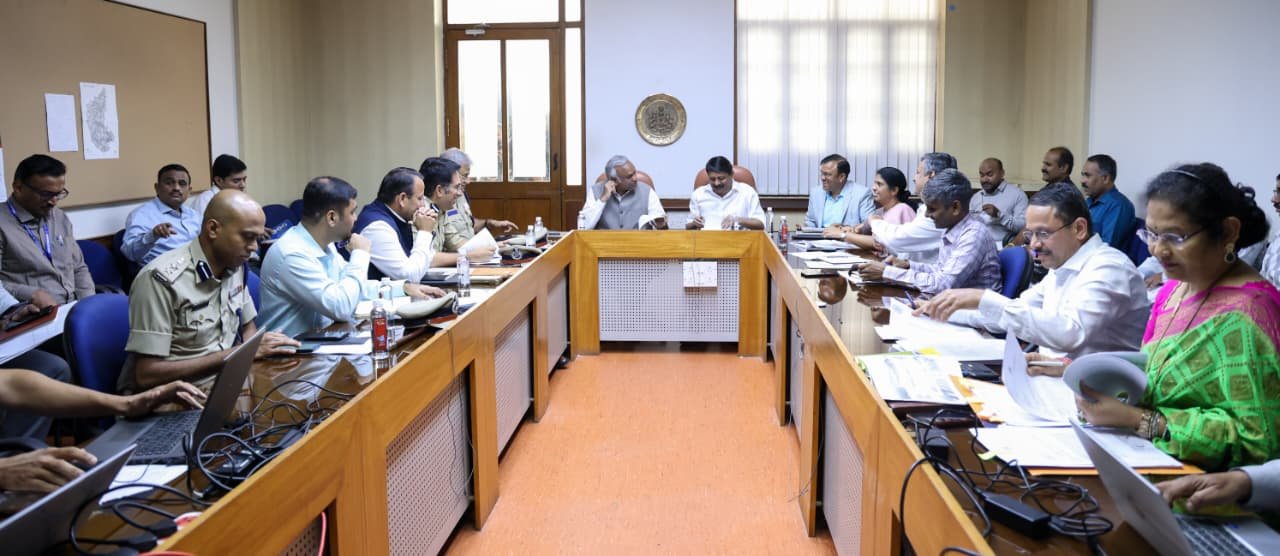
Ministers Priyank Kharge and Byrathi Suresh with officials at the traffic and road-safety review meeting at Vikas Soudha. Photograph supplied.
Bengaluru: Traffic challans could be linked directly to a driver’s digital licence record under a proposal discussed by Karnataka’s Home and Transport departments, alongside a points-based system that could lead to licence suspension for repeated violations.
The proposed integration of the Transport Department’s Sarathi platform with Bengaluru Traffic Police’s e-challan system would allow police to check licence validity on the spot, access a driver’s violation history and attach new cases to the same digital record. Officials discussed the measures at Vikas Soudha on Wednesday in the presence of ministers Priyank Kharge and Byrathi Suresh.
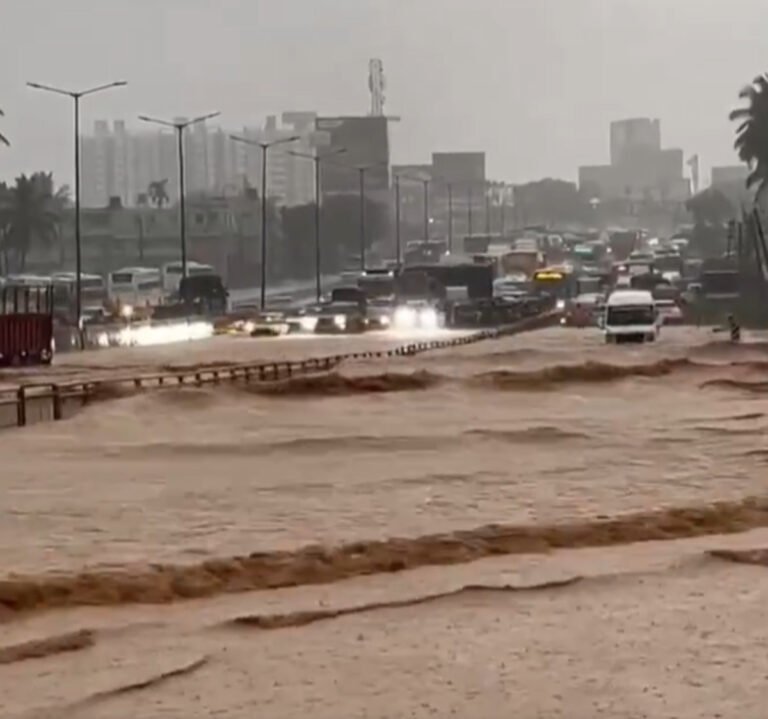
The proposals formed part of a wider review of congestion, road safety and enforcement. Higher fines, licence-related action and restrictions on vehicles with unpaid penalties were discussed; the meeting account does not announce their implementation, new fine amounts or a points threshold.
A digital record of repeat violations
Under the points-based licence proposal, different traffic offences would attract specified points, with suspension considered once a defined limit is reached. The meeting examined the legal steps needed to introduce such a system.
Linking Sarathi and e-challan records is intended to improve the management of licence suspensions and offence histories while reducing paper-based procedures. It would give traffic police a more complete record when checking drivers and registering fresh cases.
Officials also discussed identifying those with five or more traffic violations, recovering pending fines and taking action under the law. Holding vehicles or placing them on a blacklist, where necessary, and restrictions on vehicles repeatedly associated with unpaid fines were among the options examined. Possible amendments to the relevant laws and rules were also discussed.
Training before licence suspension or cancellation
A compulsory road-safety training and awareness programme was proposed for repeat offenders facing licence suspension or cancellation proceedings. The training would cover defensive driving, traffic rules and changes in driving behaviour, with completion recorded in the relevant digital system.
The meeting separately examined higher penalties for offences that obstruct traffic or endanger the public. These included parking or driving on footpaths, driving against the permitted direction on one-way roads, unauthorised parking, parking in prohibited areas, signal violations and obstructing the free flow of traffic, including repeat offences. Higher penalties related to dangerous driving were also discussed.
Unsafe helmets and vehicle accessories under scrutiny
Officials considered action against the manufacture and sale of half-helmets that do not meet road-safety standards, including a possible production ban and enforcement against manufacturers and sellers.
The sale and use of unauthorised horns, modified silencers and excessively bright LED lights were also discussed in the context of noise pollution and road safety.
The meeting examined suitable controls for low-speed battery-powered electric two-wheelers. Concerns were raised about enforcement where certain registration, helmet and other requirements do not currently apply to particular vehicles. Officials discussed vehicle identification, rider accountability and appropriate traffic rules; no new requirements were announced as having taken effect.
Unpaid fines and pollution certificates
Stricter enforcement of pollution-under-control certification for all eligible vehicles was discussed, along with joint operations by transport officials and traffic police. One proposal was to withhold pollution certificates when traffic fines remained unpaid.
The review also called for greater public awareness of vehicle scrapping and available incentives, including tax concessions, to encourage the phased removal of old, highly polluting and mechanically unfit vehicles.
One-city, one-fare proposal and support for shared travel
A “one city–one fare” policy was examined against the backdrop of differences in charges across transport and mobility service providers. The stated objectives included affordable and transparent fares, control of fare fluctuations, fair competition and fewer unnecessary vehicle movements. No common fare was announced.
Officials discussed a state-level framework for carpooling and ride-sharing, including app-based services, park-and-ride facilities and measures to encourage shared transport as a way to ease congestion.
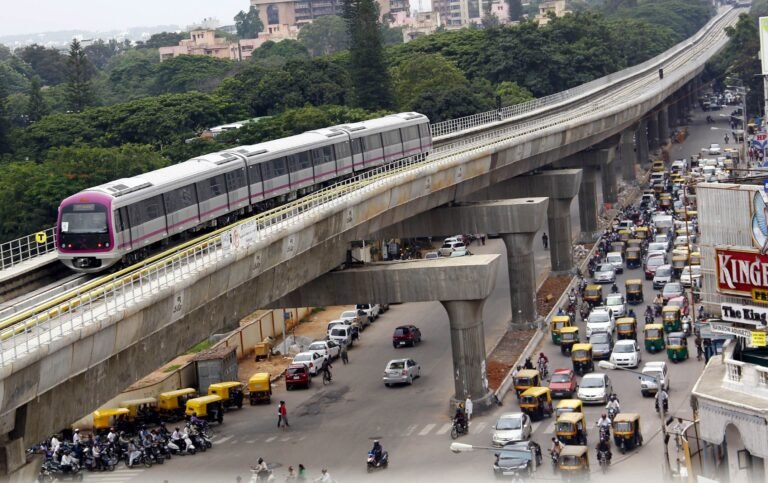
For Metro commuters, the meeting considered designated routes, fixed fares and a permit system for shared autorickshaw services providing first- and last-mile connectivity. The aim is to improve access to Metro stations and reduce dependence on private vehicles.
Faster clearance of broken-down BMTC electric buses
A specialised technical team and an emergency response arrangement were proposed to remove BMTC electric buses that break down on major roads. Better coordination between BMTC and traffic police would support quicker repairs and road clearance.
For technology corridors along the Outer Ring Road, officials discussed expanding BMTC services, feeder buses from Metro stations to technology parks, additional buses during peak hours and support for shared employee transport.
The departments stressed coordinated action to improve enforcement, strengthen road safety and manage Bengaluru’s congestion.
Officials attending included Rajender Singh Kataria from the Home Department, Transport Secretary Deepa Cholan, state police chief Dr. M.A. Saleem, Transport Commissioner Dr. Selvamani, K.B. Shivakumar, Raghunandan Murthy, Bengaluru City Police Commissioner Seemant Kumar Singh and Joint Commissioner of Police Karthik Reddy.
About the Author