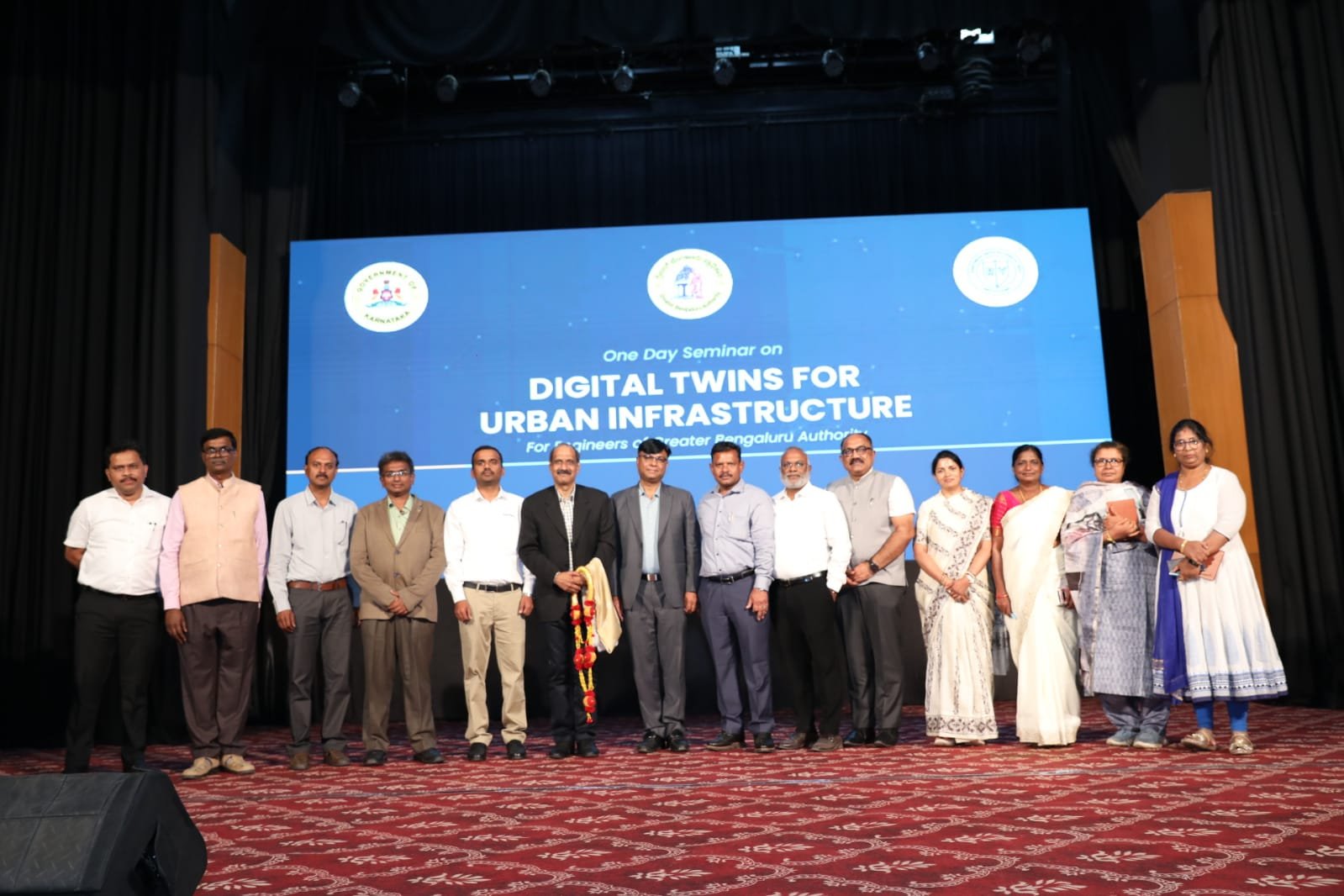
Digital Twin seminar for engineers at Town Hall in Bengaluru. Photo: GBA.
Bengaluru: Bengaluru South City Corporation has signed a memorandum of understanding with RV Institutions as a knowledge partner for training engineers, with Digital Twin technology being explored for planning roads, stormwater drains and flood-management works.
The agreement is a first step towards training programmes intended to strengthen engineers’ technical skills and encourage modern technology in infrastructure management, according to a Greater Bengaluru Authority (GBA) release. RV College of Engineering organised a seminar for engineers at Town Hall on Monday on the use of Digital Twins in urban infrastructure.
South City Corporation Commissioner K.N. Ramesh said technology should help officials identify potential problems early and move from responding after a failure to taking preventive action. He said the corporation was working to involve citizens in administration and urban planning while drawing on universities’ research and technical expertise.
Testing where rainwater could collect
A Digital Twin is a virtual model of physical infrastructure. The release explained that it can bring together information on roads, buildings, drains, drinking-water pipelines, electricity networks, streetlights, lakes and parks to monitor their functioning, analyse conditions and anticipate problems.
For a road affected by waterlogging, for example, the model could analyse its elevation and slope alongside drainage, rainfall and water-flow data. That could help identify where water would accumulate and which sections need improvement, the release said.
Chief Engineer Basavaraj Kabade identified white-topping roads, flyovers, flood management, streetlighting, footpath improvements, junction development, stormwater-drain management and disaster management among the areas where the technology could assist project planning. He said it could support design, monitoring and maintenance as well.
Planning beyond traffic management
B-SMILE CEO Nitish said the traffic police had adopted Digital Twin technology, but its use was not confined to managing congestion. Data analysis and three-dimensional models could also help agencies plan infrastructure projects scientifically and identify implementation problems in advance, he said.
He urged engineers to keep updating their skills, adopt emerging technologies and use Digital Twins effectively in their work.
B-SMILE Technical Director Dr B.S. Prahalad compared the approach with the physical scale models once used to work out intricate designs for temples and heritage buildings. Digital models reflecting the condition of physical infrastructure could now help analyse performance, anticipate problems and guide decisions on planning, monitoring and maintenance, he said.
Ramesh cites water-loss figures
Ramesh said the Bengaluru Water Supply and Sewerage Board had reported that about 30% of water was being lost for various reasons. He said the board had also reported preventing the loss of about 200 million litres a day through the use of technology.
He called for coordination between data, field operations and accountability to improve civic services, and for universities, research institutions and technical experts to work with the corporation.
Referring to the Union government’s recently announced AI governance framework, Ramesh cited its “Trust is the Foundation” and “People First” principles as an emphasis on public confidence and citizen-centred administration.
About the Author