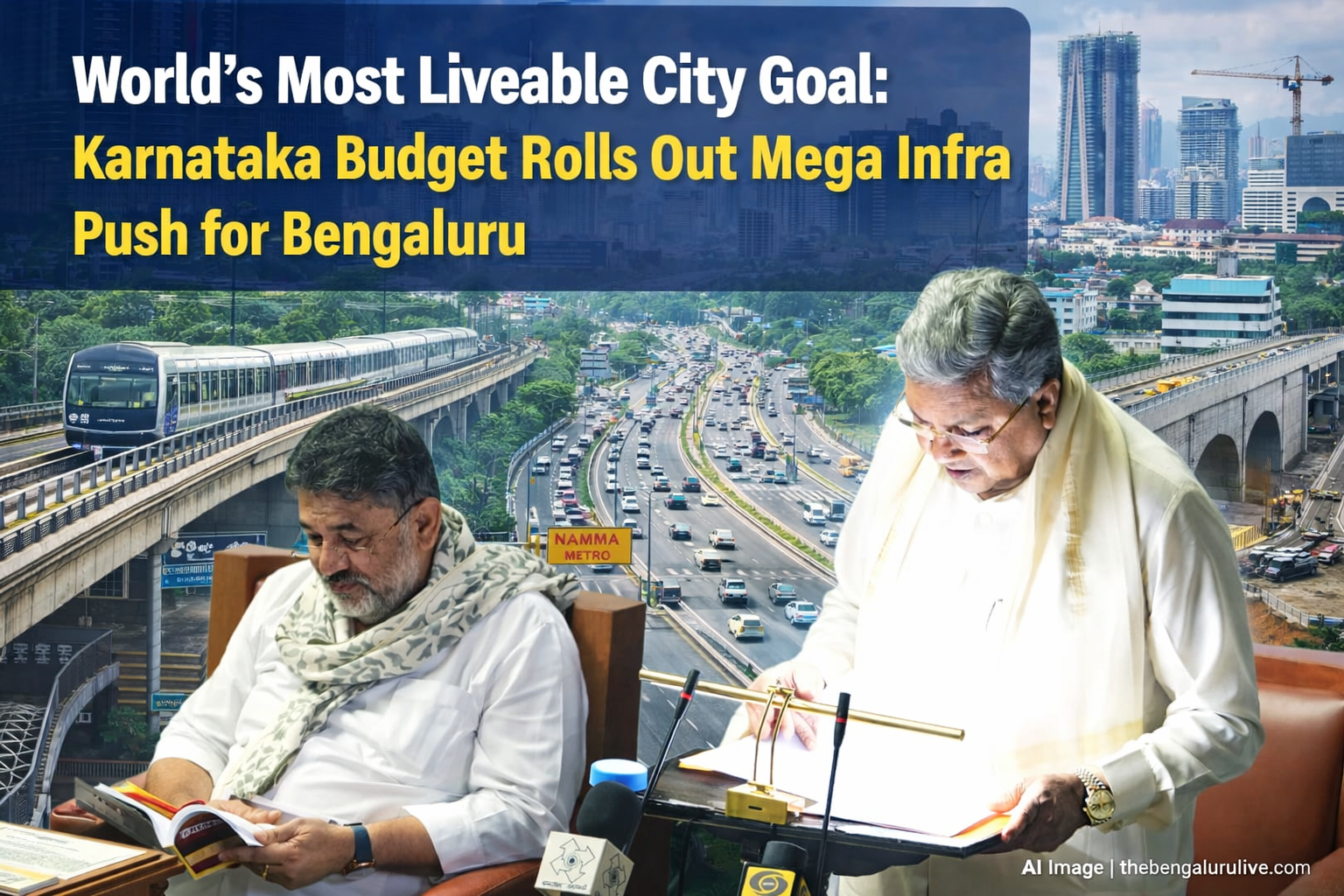
Bengaluru: The Karnataka State Budget 2026-27 outlines a wide-ranging development roadmap for Bengaluru, with major investments in transport infrastructure, water supply, urban governance and public amenities as the government aims to transform the city into “the world’s most liveable city.”
Recognising Bengaluru as the economic and innovation hub of the state, the budget focuses on strengthening mobility, road infrastructure, water security and urban governance while addressing the city’s growing population and traffic challenges.
Major Infrastructure Works Already Underway
The government highlighted several projects undertaken during the 2025-26 financial year:
• Ward road and infrastructure development across five city corporations at a cost of ₹1,255 crore.
• White-topping of 158 km roads with an investment of ₹1,700 crore.
• Arterial and sub-arterial road upgrades costing ₹1,936 crore.
• Transformation of the Outer Ring Road corridor from Silk Board to KR Puram into a global-standard road at a cost of ₹450 crore.
• Stormwater drain upgrades and lake rejuvenation projects worth ₹273 crore.

Governance Reform for Bengaluru
To improve transparency and citizen-friendly administration, the government has created the Greater Bengaluru Authority (GBA) along with five city corporations, aimed at ensuring decentralised governance and faster decision-making.
The state has also increased Bengaluru development grants from ₹3,000 crore to ₹7,000 crore, which will continue in the current financial year.
Massive Road and Mobility Projects
To strengthen Bengaluru’s transport infrastructure:
• 450 km of roads will undergo white-topping over the next three years at a cost of ₹3,000 crore.
• 175 traffic junctions will be beautified, 500 km of footpaths upgraded, and 100 skywalks constructed.
• The World Bank-assisted Storm Water Drain modernisation project worth ₹2,000 crore will improve flood resilience.
• Bengaluru civic corporations will also raise funds through Municipal Bonds for infrastructure development.
Metro Expansion and Pedestrian Infrastructure
The budget emphasises expansion of Namma Metro, currently the second-largest metro network in India.
• The metro network currently spans 96 km, serving nearly 10 lakh commuters daily.
• 41 km of additional metro lines will be completed during 2026-27, benefiting about 15 lakh commuters daily.
• A 9-km pedestrian walkway along the Outer Ring Road Metro viaduct will be built at a cost of ₹160 crore with support from the Outer Ring Road Companies Association (ORRCA).
Cauvery Phase-VI Water Project
To address Bengaluru’s water needs, the government has announced the Cauvery Water Supply Phase-VI project, which will bring an additional 6 TMC of water at an estimated cost of ₹6,939 crore with JICA assistance.
Currently, 2,225 MLD of water is supplied through Cauvery Phases I-V, catering to nearly 1.4 crore residents of the city.
Mega Tunnel Roads and Corridors
The government has approved several large-scale traffic decongestion projects:
• 73 km Bengaluru Business Corridor Phase-1 from Tumakuru Road to Hosur Road, with land acquisition already underway.
• 40 km North-South and East-West tunnel corridors from Hebbal to Silk Board and KR Puram to Mysore Road at a cost of ₹40,000 crore under the BOOT model.
• Tenders have been invited for the 17 km North-South tunnel corridor worth ₹17,780 crore.
• A tunnel road and elevated corridor between Hebbal Junction and Mekhri Circle costing ₹2,250 crore.
Additionally, the Nelamangala–Tavarekere–Bidadi Intermediate Ring Road will be constructed to reduce traffic congestion in the city.
Urban Development and Smart Governance
Other key initiatives include:
• ₹3,885 crore infrastructure works under Phase-4 of the Chief Minister’s Amrutha Nagarothana Scheme, with ₹500 crore additional allocation this year.
• Integration of e-Aasthi with a Unified Property Tax system for automated tax assessment.
• Implementation of Estate Management Rules 2026 to streamline management of ULB properties.
Social Infrastructure and Green Initiatives
The budget also includes social and environmental initiatives:
• Establishment of an Urban Policing Innovation Centre for smart policing solutions in Bengaluru.
• A Jayadeva Cardiovascular Institute regional centre at Govindarajanagar BBMP Hospital with an investment of ₹15 crore.
• Creation of 100 Miyawaki urban forests to increase green cover.
• Launch of two Vidyarthi Indira Canteens in Bengaluru to support students preparing for competitive exams.
ಇದನ್ನೂ ಓದಿ: ಬೆಂಗಳೂರು ವಿಶ್ವದ ಅತ್ಯುತ್ತಮ ನಗರ ಗುರಿ: ಮೆಟ್ರೋ, ಟನಲ್ ರಸ್ತೆ, 450 ಕಿಮೀ ವೈಟ್ಟಾಪಿಂಗ್ ಯೋಜನೆ
About the Author