House-to-House Census Drive Begins in Bengaluru; Full Preparations in Place, Says Munish Moudgil
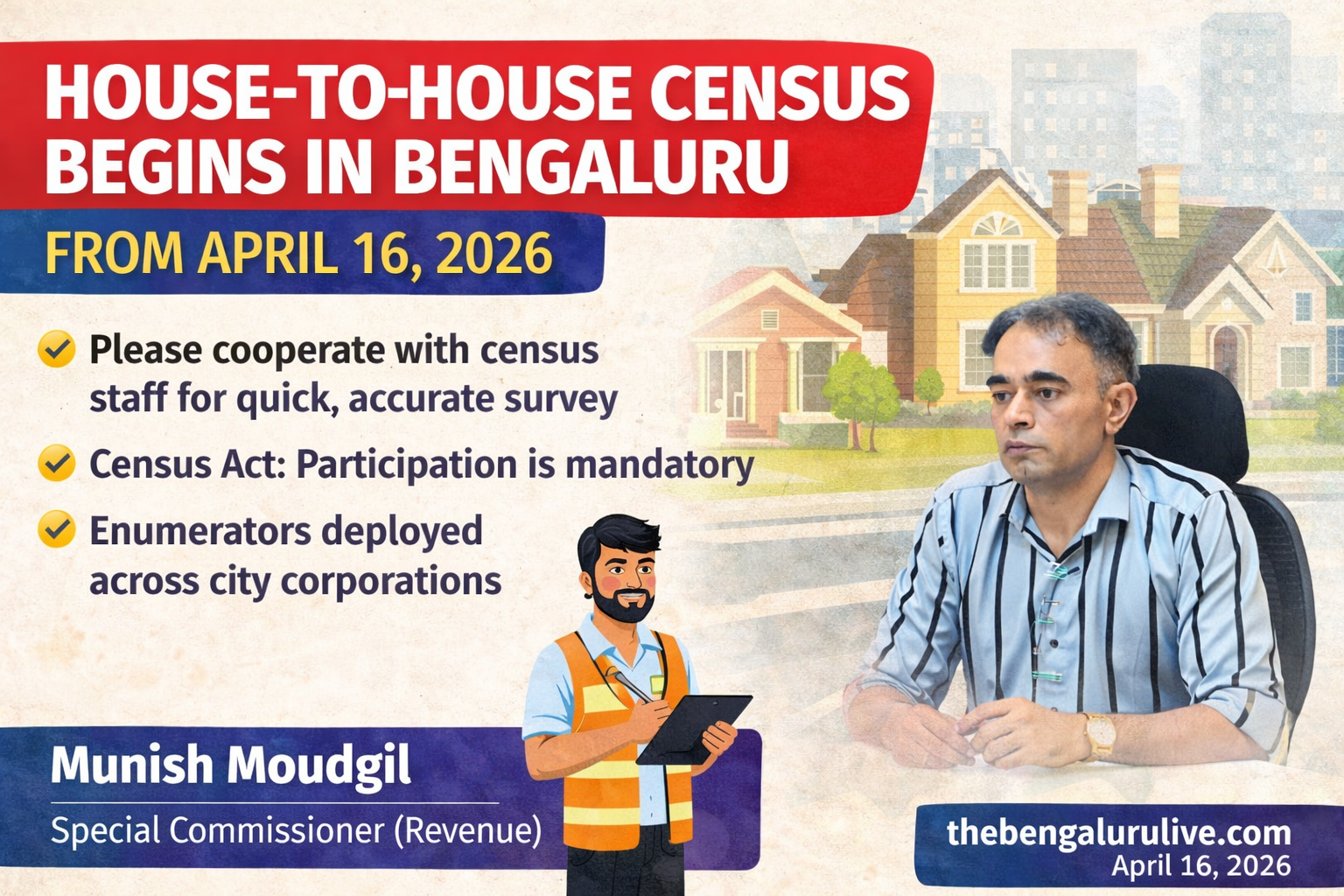
Bengaluru: The Greater Bengaluru Authority (GBA) has completed all preparations for the house-to-house houselisting and housing census exercise across its jurisdiction, Special Commissioner (Revenue) Munish Moudgil announced on April 16.
Addressing the media, Moudgil said the exercise is being undertaken as part of Phase I of the National Census 2027, focusing on “Houselisting and Housing Census.” The survey will be conducted from April 16 to May 15, during which enumerators will visit households to collect essential data. Citizens have been urged to cooperate with officials, as the process will take approximately 5–8 minutes per household.
More than 23,000 enumerators and around 2,500 supervisors have been deployed for the exercise across five city corporations under GBA. In total, over 26,000 personnel, including nearly 10,000 teachers, have been assigned to ensure smooth execution. Certain categories, including those with serious health issues, pregnant women, specially-abled individuals, and mothers with infants, have been exempted from duty.
Officials clarified that the houselisting phase will be followed by the main population census in April 2027. Earlier, from April 1 to April 15, citizens were given an option for self-enumeration; however, participation remained below 2 percent.
Under the Census Act, 1948, participation in the census is mandatory. Authorities have warned that refusal to provide information or non-cooperation with officials may invite legal action.
To ensure coverage, enumerators will visit homes between 9:00 AM and 5:00 PM. Additionally, flexible timings will be introduced after the first week, with visits scheduled between 6:00 PM and 9:00 PM, and early morning slots from 6:00 AM to 10:00 AM for the convenience of residents.
In cases where residents are unavailable, officials will place a sticker outside the premises with contact details, enabling citizens to schedule a revisit. Each enumerator has been assigned approximately 200 households.
The survey will collect detailed information, including housing conditions, building materials, ownership status, number of family members, socio-economic details, and access to amenities such as water, electricity, sanitation, and cooking fuel. Data on assets like mobile phones, vehicles, internet access, and household appliances will also be gathered.
Authorities assured that all information collected will remain strictly confidential and will be used solely for census purposes.
Moudgil emphasized that public cooperation is crucial for the success of this nationwide exercise, which plays a key role in policy planning and governance.
About the Author