
Bengaluru: Karnataka will introduce Artificial Intelligence (AI) education at the primary school level to build a future-ready workforce capable of meeting rising global demand, Chief Secretary Shalini Rajneesh announced on Tuesday, underlining the state’s long-term vision to position itself as a global leader in AI-driven governance and talent development.
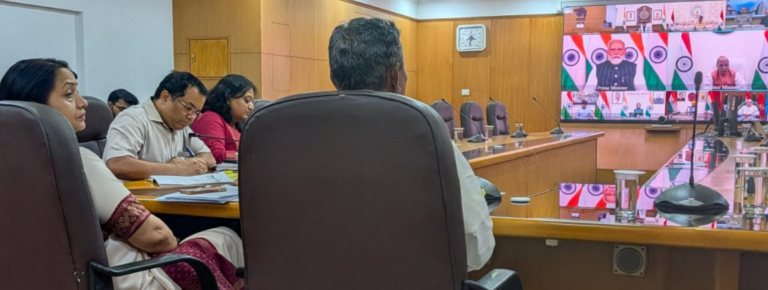
Speaking at the AI Impact Pre-Summit Working Group Meeting held at IISc Bengaluru, the Chief Secretary said early exposure to AI would ensure Karnataka’s students are equipped not just for future jobs, but for shaping future technologies.
“Karnataka has both the responsibility and the capacity to lead AI adoption for public good. Embedding AI learning at the school level is critical to preparing our next generation,” she said.
High-Level Meet Charts Karnataka’s AI Roadmap
The meeting was organised by the Department of Personnel and Administrative Reforms (DPAR – e-Governance) and brought together senior government officials, industry leaders, academicians and technology experts to chart Karnataka’s AI roadmap ahead of the India AI Impact Summit 2026.
Breaking Silos: Shift to Data Lake Governance
A key focus of the Chief Secretary’s address was Karnataka’s transition from siloed departmental databases to an interoperable Data Lake architecture, aimed at enabling smarter, evidence-based policymaking.
“Currently, data related to farmers, land, crops and students exists in isolation. When integrated, its value multiplies,” she noted.
She highlighted a major agriculture use case where AI-driven data integration revealed that only 300 out of 6,000 Gram Panchayats required targeted soil nutrient intervention—allowing the state to optimise fertiliser distribution, reduce waste and improve outcomes.
Voice-Enabled AI to Empower Citizens
Addressing the complexity of government schemes and eligibility criteria, the Chief Secretary outlined a vision for voice-enabled AI interfaces that would allow citizens to interact with government portals in natural language.
“This will help bridge the digital divide while ensuring compliance with privacy and regulatory safeguards,” she said.
She also pointed to the potential of predictive and prescriptive AI in healthcare, particularly in identifying causative factors behind cardiac arrests and supporting doctors with data-driven decision tools.
Operationalising AI: The ‘Bangalore Dividend’
Pankaj Kumar Pandey (IAS), Principal Secretary, DPAR (e-Governance), introduced what he termed the ‘Bangalore Dividend’, a four-helix framework based on Scale, Talent, Demography and Desire to operationalise AI across government departments.
Highlighting a major fiscal use case, he referred to the ₹20,000-crore annual subsidy for 35 lakh irrigation pumpsets.
“By mapping crop data against water requirements using AI, we can reduce water wastage, prevent soil erosion and rationalise subsidy expenditure,” he explained.
Karnataka AI Cell: Innovation in Governance
Pandey detailed the work of the Karnataka AI Cell (KAIC), structured around four pillars—Advisory, Solution Development, Collaboration and Capacity Building.
AI-driven governance tools already in use include:
- Kartavya, an AI-based attendance system covering over 1.5 lakh government officials
- Muzzle Print Initiative, a biometric identification system for cattle to ensure rightful benefit transfer to farmers
- Student Attendance System, tracking attendance of over 50 lakh students
- Saaramsha, an AI-powered tool (pilot stage) that summarises government orders and circulars to enable faster decision-making
Energy Sector & National AI Vision
The session also featured Shashank Mishra (IAS), Joint Secretary, Ministry of Power, Government of India, who spoke about the India Energy Stack and the upcoming Unified Energy Interface (UEI)—a peer-to-peer energy trading platform aimed at transforming the energy sector.
Concluding the meeting, Abhishek Aggarwal, Senior Scientist, MeitY, outlined the national roadmap leading up to the India AI Impact Summit, scheduled in New Delhi on February 19–20, 2026.
He said the summit would be guided by the ‘3 Sutras’—People, Planet and Progress, and operationalised through seven thematic working groups (‘Chakras’) to ensure ethical, inclusive and sustainable AI development.
Call for Collaboration
The Karnataka government invited Global Capability Centres (GCCs), IT firms and startups to collaborate on building scalable, citizen-centric AI solutions.
“It is Karnataka’s time to serve—and to shine,” the Chief Secretary concluded.
ಇದನ್ನೂ ಓದಿ: ಪ್ರಾಥಮಿಕ ಶಾಲೆಗಳಿಂದಲೇ AI ಶಿಕ್ಷಣ: ಕರ್ನಾಟಕದ ಭವಿಷ್ಯಮುಖಿ ಆಡಳಿತಕ್ಕೆ ಬ್ಲೂಪ್ರಿಂಟ್
About the Author